As researchers continue to push the boundaries of quantum computing, they’re turning to silicon-based devices for their potential scalability. However, these devices are notoriously finicky, requiring unique tuning protocols that make it difficult to achieve consistent results. A new approach using machine learning has shown promise in automating this process, allowing researchers to identify patterns and optimize device behavior. By leveraging this technology, scientists may be able to overcome the challenges of device variability and bring us closer to a universal fault-tolerant quantum computer.
Can Silicon-Based Quantum Devices Be Tuned for Scalability?
The quest for scalable quantum computing has led researchers to explore the potential of silicon-based devices. However, the variability of these devices poses a significant challenge. Each device requires unique tuning protocols, making it difficult to achieve consistent results. In this article, we will look at machine learning and its application in automating the tuning process for silicon-based quantum devices.
The Power of Machine Learning
Machine learning has revolutionized various fields by enabling automation and optimization. In the context of silicon-based quantum devices, machine learning can be used to develop algorithms that learn from data and make predictions about device behavior. This approach allows researchers to identify patterns in the parameter space landscape, making it possible to characterize regions where double quantum dot regimes are found.
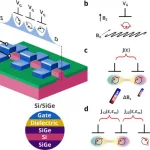
The algorithm developed by the research team demonstrated its effectiveness in tuning three different silicon-based devices: a 4-gate Si FinFET, a 5-gate GeSi nanowire, and a 7-gate GeSiGe heterostructure double quantum dot device. The results showed that the algorithm could achieve tuning times of 30 minutes for the Si FinFET, 10 minutes for the GeSi nanowire, and 92 minutes for the GeSiGe heterostructure device.
Overcoming Device Variability
One of the significant challenges in scaling up quantum computing is device variability. Each device requires unique tuning protocols, making it difficult to achieve consistent results. The algorithm developed by the research team addresses this challenge by providing insight into the parameter space landscape for each device. This allows researchers to characterize the regions where double quantum dot regimes are found, enabling the development of overarching solutions for the tuning of quantum devices.
The use of machine learning in automating the tuning process has significant implications for the scalability of silicon-based quantum devices. By developing algorithms that can learn from data and make predictions about device behavior, researchers can overcome the challenges posed by device variability and achieve consistent results. This approach also enables the development of more efficient tuning protocols, reducing the time and resources required to tune each device.
The Potential of Silicon-Based Devices
Silicon-based devices have great potential for the fabrication of circuits consisting of a large number of qubits. These devices can encode promising spin qubits, demonstrating excellent fidelities, long coherence times, and a pathway to scalability. The material itself provides an opportunity to be purified to a near-perfect magnetically clean environment, resulting in very weak to no hyperfine interactions.
The use of silicon-based devices also offers the potential for fabricating circuits consisting of a large number of qubits, which is essential for achieving a universal fault-tolerant quantum computer. The ability to tune multiple gate electrodes provides the opportunity to define a large parameter space to be explored, making it possible to achieve consistent results across different device architectures and material realizations.
Conclusion
The development of algorithms that can automate the tuning process for silicon-based quantum devices has significant implications for the scalability of these devices. By leveraging machine learning, researchers can overcome the challenges posed by device variability and achieve consistent results. This approach also enables the development of more efficient tuning protocols, reducing the time and resources required to tune each device.
The potential of silicon-based devices for the fabrication of circuits consisting of a large number of qubits makes them an attractive option for achieving a universal fault-tolerant quantum computer. The ability to tune multiple gate electrodes provides the opportunity to define a large parameter space to be explored, making it possible to achieve consistent results across different device architectures and material realizations.
Publication Date: 2024-07-27
Authors: Brandon Severin, D. T. Lennon, Leon C. Camenzind, Florian Vigneau, et al.
Source: Scientific Reports
DOI: https://doi.org/10.1038/s41598-024-67787-z

See today’s quantum computing news on Quantum Zeitgeist for the latest breakthroughs in qubits, hardware, algorithms, and industry deals.