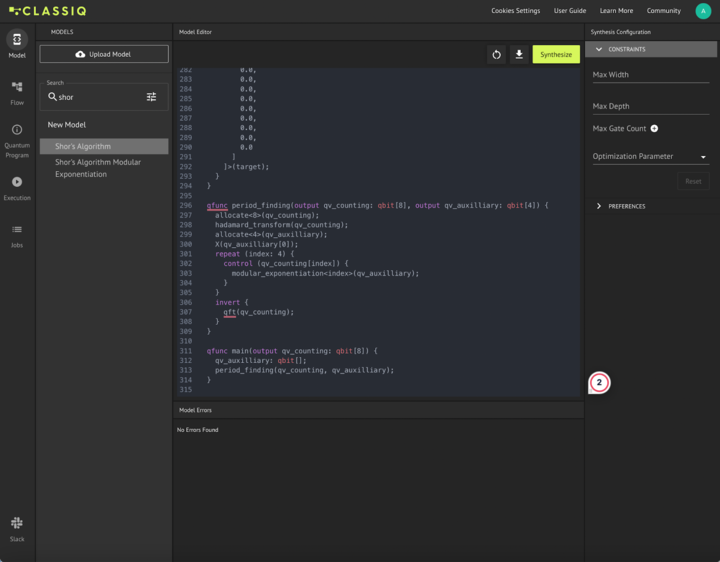
Classiq, a quantum software company, has announced the general availability of Qmod, the first high-level language for quantum programming. This innovative language enables developers to describe quantum algorithms at a high level of abstraction, allowing them to focus on their algorithms’ functional intent while Classiq’s powerful compiler and synthesis engine handle the intricate hardware-aware quantum implementation details.
According to Heather West, PhD, Research Manager, Quantum Computing at IDC, “programming a quantum computer happens at the hardware level, making the technology only accessible to quantum physicists and other quantum specialists.” Qmod changes this by providing abstraction-level application programming that will become a necessity for widespread quantum adoption and usage. Nir Minerbi, CEO and co-founder of Classiq, notes that Qmod enables quantum experts to produce sophisticated programs while allowing developers without a quantum background to innovate and solve complex problems across various industry domains.
Transforming Quantum Computing with Qmod: The First High-Level Language for Quantum Programming
Quantum computing has taken a significant leap forward with the introduction of Qmod, the first high-level language (HLL) for quantum coding. Developed by Classiq, Qmod enables developers to describe quantum algorithms at a high level of abstraction, making it easier to program and utilize quantum computers. This innovative approach allows developers to focus on the functional intent of their algorithms while Classiq’s powerful compiler and synthesis engine handle the intricate hardware-aware quantum implementation details.
Qmod facilitates advanced quantum modeling by supporting unique quantum-computing concepts alongside conventional constructs found in high-level classical programming languages. This enables developers to define what their algorithm should achieve rather than how to achieve it, allowing for more efficient and approachable quantum programming. The language’s declarative nature also lets users optimize for hardware and other constraints automatically, making it an industry-ready tool for researchers and enterprise applications.
The Power of Abstraction in Quantum Computing
The introduction of Qmod marks a significant shift towards abstraction-level application programming in quantum computing. According to Heather West, PhD, Research Manager, Quantum Computing at IDC, “To deliver business or scientific value, quantum computing must be useful and accessible to scientists and engineers seeking to use quantum computing to solve real-world problems, which today it is not.” By providing a high-level language for quantum programming, Qmod enables developers without a quantum background to innovate and solve complex problems across various industry domains.
Qmod’s abstraction level allows developers to focus on the functional intent of their algorithms, rather than the intricacies of quantum hardware. This makes it an essential tool for widespread quantum adoption and usage. As Nir Minerbi, CEO and co-founder of Classiq, notes, “By abstracting the complexities of quantum programming, Qmod delivers the ability to create and deploy dynamic quantum applications effortlessly.”
Seamless Integration with Hardware and Simulation Environments
Classiq’s platform ensures that quantum algorithms designed with Qmod can be seamlessly compiled for a broad range of hardware and simulation environments. The platform’s synthesis engine dynamically adapts implementations to different hardware configurations, allowing for rapid benchmarking and ensuring optimal implementations that make the most of the available hardware.
This seamless integration enables developers to focus on developing their algorithms without worrying about the underlying hardware. Qmod code can be easily translated and is compatible across different formats and hardware, making it an ideal tool for researchers and industry applications.
Democratizing Access to Quantum Computing
Classiq’s platform, including Qmod, aims to democratize access to quantum computing by providing a single point of entry into quantum computing. The high-level descriptive quantum software development environment automates quantum programming, ensuring that a broad range of talents can harness quantum computing without requiring deep, specialized knowledge of quantum physics.
By providing an all-encompassing platform with a single point of entry into quantum computing, Classiq enables users to take full advantage of the quantum computing revolution. This includes access to a broad range of quantum hardware, making it easier for developers to innovate and solve complex problems across various industry domains.
The Future of Quantum Computing
The introduction of Qmod marks a significant milestone in the development of quantum computing. By providing a high-level language for quantum programming, Classiq has taken a crucial step towards democratizing access to quantum computing. As the quantum ecosystem continues to evolve, Qmod is poised to play a vital role in powering the next generation of quantum computers, HPC, and quantum simulators.
With its world-class team of scientists and engineers, Classiq is well-positioned to continue driving innovation in the field of quantum computing. Backed by investors such as HPE, HSBC, Samsung, Intesa Sanpaolo, and NTT, Classiq’s groundbreaking quantum engine is set to revolutionize the way we approach quantum computing.
External Link: Click Here For More
See today’s quantum computing news on Quantum Zeitgeist for the latest breakthroughs in qubits, hardware, algorithms, and industry deals.