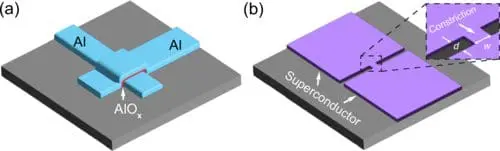
The quest for more efficient and reliable quantum computing has led researchers to explore innovative designs for superconducting qubits. A recent study presents a novel superconductor-constriction-superconductor (ScS) nanobridge junction, which replaces traditional SIS Josephson junctions in transmon qubits. The ScS design offers improved charge dispersion but at the cost of smaller anharmonicity, crucial for achieving gigahertz frequency operation. The study provides a framework for estimating necessary parameters for high-frequency ScS transmon operation, paving the way for future investigations into this promising technology.
Can Superconductor Constriction Improve Quantum Computing?
The quest for more efficient and reliable quantum computing has led researchers to explore innovative designs for superconducting qubits. A recent study by Mingzhao Liu and Charles T. Black from the Center for Functional Nanomaterials at Brookhaven National Laboratory presents a computational analysis of a novel superconductor-constriction-superconductor (ScS) nanobridge junction, which replaces traditional superconductor-insulator-superconductor (SIS) Josephson junctions in transmon qubits.
The ScS design offers improved charge dispersion compared to the SIS transmon, but at the cost of smaller anharmonicity. This tradeoff is crucial for achieving gigahertz frequency operation. The study provides a framework for estimating the superconductor material properties and junction dimensions necessary for high-frequency ScS transmon operation.
What are Superconducting Qubits?
Superconducting qubits, such as the transmon architecture, have become a popular choice for quantum computing due to their immunity to charge noise and relatively long coherence lifetimes. The core of these devices consists of one or more Josephson junctions (JJs), which are predominantly superconductor-insulator-superconductor tunnel junctions (SIS). In the SIS design, a thin film sandwich structure is typically used, comprising aluminum-aluminum oxide-aluminum (Al-AlOx-Al) layers.
The fabrication process for these JJs involves physical vapor deposition of the top and bottom Al layers from two different angles relative to the substrate through a common mask. After depositing the first Al layer, the sample is exposed to a controlled level of oxygen to form the thin AlOx barrier. The exponential dependence of the JJ critical supercurrent (Ic) on tunnel barrier width sets a requirement for tightly controlled oxidation conditions.
Challenges in Fabricating SIS JJs
To achieve low device-to-device variation for fabrication at the manufacturing scale, additional considerations must be implemented, such as minimizing junction area variations. In addition to these challenges, the exponential dependence of Ic on tunnel barrier width requires tightly controlled oxidation conditions.
The ScS Design: A Novel Approach
The ScS design replaces traditional SIS JJs with a coplanar superconductor-constriction-superconductor (ScS) Josephson junction. This novel approach features two superconducting pads connected by a nanobridge with length d and width w, as shown in Figure 1b.
Computational Analysis
Within the scope of Ginzburg-Landau theory, the study finds that the ScS transmon has improved charge dispersion compared to the SIS transmon, but at the cost of smaller anharmonicity. These calculations provide a framework for estimating the superconductor material properties and junction dimensions necessary for high-frequency ScS transmon operation.
Implications for Quantum Computing
The ScS design offers a promising approach for improving the performance of superconducting qubits in quantum computing applications. By optimizing the nanobridge dimensions and superconductor material properties, researchers can achieve gigahertz frequency operation while minimizing anharmonicity. This tradeoff is crucial for achieving high-fidelity quantum computations.
Future Directions
Further research is needed to fully explore the potential of the ScS design in quantum computing applications. The study’s findings provide a solid foundation for future investigations into the optimization of nanobridge dimensions and superconductor material properties. As researchers continue to push the boundaries of superconducting qubits, the ScS design may play a key role in advancing the field of quantum computing.
The ScS design offers a novel approach to improving the performance of superconducting qubits in quantum computing applications. By optimizing nanobridge dimensions and superconductor material properties, researchers can achieve gigahertz frequency operation while minimizing anharmonicity. The study’s findings provide a framework for estimating the necessary parameters for high-frequency ScS transmon operation, paving the way for future investigations into this promising technology.
Publication Date: 2024-07-09
Authors: Mingzhao Liu and Charles T. Black
Source: Physical review. A/Physical review, A
DOI: https://doi.org/10.1103/physreva.110.012427
See today’s quantum computing news on Quantum Zeitgeist for the latest breakthroughs in qubits, hardware, algorithms, and industry deals.