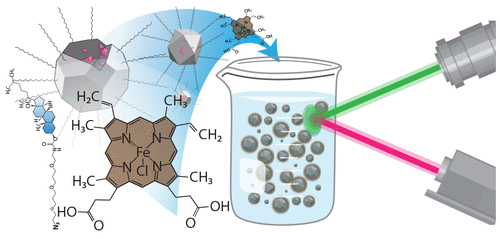
Researchers have made significant progress in developing nanodiamonds containing nitrogen-vacancy (NV) centers as a promising material for quantum and biological sensing. These carbon nanoparticles are nontoxic and robust and can be used to measure external fields and perturbations within living systems. However, modifying their surfaces without degrading their properties has been a challenge. A new method has been developed to coat nanodiamonds with an emulsion layer that preserves their quantum features, enhances their colloidal stability, and provides functional groups for subsequent modifications.
The emulsion layer preserves the NV centers’ optical and spin properties while providing a platform for surface modification. This breakthrough has significant implications for the future of nanodiamond-based quantum sensing, enabling researchers to tailor these materials to specific applications in biological imaging, sensing, quantum computing, and cryptography.
Can Nanodiamonds Revolutionize Quantum Sensing?
Nanodiamonds containing nitrogen-vacancy (NV) centers have been touted as promising materials for quantum and biological sensing. The NV center is a non-bleaching emitter in the near-infrared biological window, allowing for fluorescence imaging within living biological systems. These carbon nanoparticles are nontoxic, robust, and unlikely to degrade within the body. Moreover, the NV center hosts an optically addressable spin state, enabling nanoscale quantum measurement of various external fields and perturbations in vitro or in vivo.
However, despite their potential, nanodiamond surfaces have proven challenging to modify without degrading their colloidal stability or the NV centers’ optical and spin properties. This has limited their application in biological and chemical environments. To overcome this hurdle, researchers have developed a simple and general method to coat nanodiamonds with a thin emulsion layer that preserves their quantum features, enhances their colloidal stability, and provides functional groups for subsequent crosslinking and click-chemistry conjugation reactions.
The Emulsion Layer: A Game-Changer for Nanodiamond Surface Functionalization
The emulsion layer is a crucial component in the surface functionalization of nanodiamonds. This thin coating enables preserving the NV centers’ optical and spin properties while providing a platform for subsequent modifications. The emulsion layer comprises carboxyl and azide-functionalized amphiphiles, which can be tailored to specific applications.
The emulsion layer’s impact on the NV centers’ spin lifetime has been studied, revealing that it does not significantly affect this critical parameter. This is a significant finding, as it ensures that the nanodiamonds retain their quantum properties despite adding the emulsion layer. Furthermore, the emulsion layer provides a chemical sensitivity to paramagnetic ions using T1 relaxometry, enabling the quantification of the nanodiamonds’ response to external magnetic fields.
Click-Chemistry Conjugation: A Powerful Tool for Nanodiamond Modification
Click-chemistry conjugation is a powerful tool for modifying the surface of nanodiamonds. This approach allows researchers to selectively attach molecules or nanoparticles to the nanodiamond surface, creating complex nanostructures and hybrid materials.
In this study, the researchers demonstrate the use of click-chemistry conjugation to decorate nanodiamonds with combinations of carboxyl and azide-functionalized amphiphiles. These modifications enable the attachment of various molecules or nanoparticles, opening up new avenues for applications in quantum sensing and biological imaging.
The Future of Nanodiamond-Based Quantum Sensing
Developing a simple and general method to coat nanodiamonds with an emulsion layer has significant implications for the future of nanodiamond-based quantum sensing. This approach enables the preservation of the NV centers’ optical and spin properties while providing a platform for subsequent modifications.
The potential applications of this technology are vast, ranging from biological imaging and sensing to quantum computing and cryptography. The ability to functionalize nanodiamond surfaces with specific molecules or nanoparticles will enable researchers to tailor these materials to specific applications, unlocking new possibilities in the field of quantum sensing.
In conclusion, the development of a simple and general method to coat nanodiamonds with an emulsion layer has significant implications for the future of nanodiamond-based quantum sensing. This approach enables the preservation of the NV centers’ optical and spin properties while providing a platform for subsequent modifications. The potential applications of this technology are vast, ranging from biological imaging and sensing to quantum computing and cryptography.
The ability to functionalize nanodiamond surfaces with specific molecules or nanoparticles will enable researchers to tailor these materials to specific applications, unlocking new possibilities in the field of quantum sensing. As researchers continue to explore the properties and applications of nanodiamonds, it is clear that this technology has the potential to revolutionize our understanding of the quantum world and its many mysteries.
Publication details: “Nanodiamond Emulsions for Enhanced Quantum Sensing and Click-Chemistry Conjugation”
Publication Date: 2024-06-29
Authors: Henry J. Shulevitz, Ahmad Amirshaghaghi, Mathieu Ouellet, Caroline Brustoloni, et al.
Source: ACS applied nano materials
DOI: https://doi.org/10.1021/acsanm.4c01699


See today’s quantum computing news on Quantum Zeitgeist for the latest breakthroughs in qubits, hardware, algorithms, and industry deals.