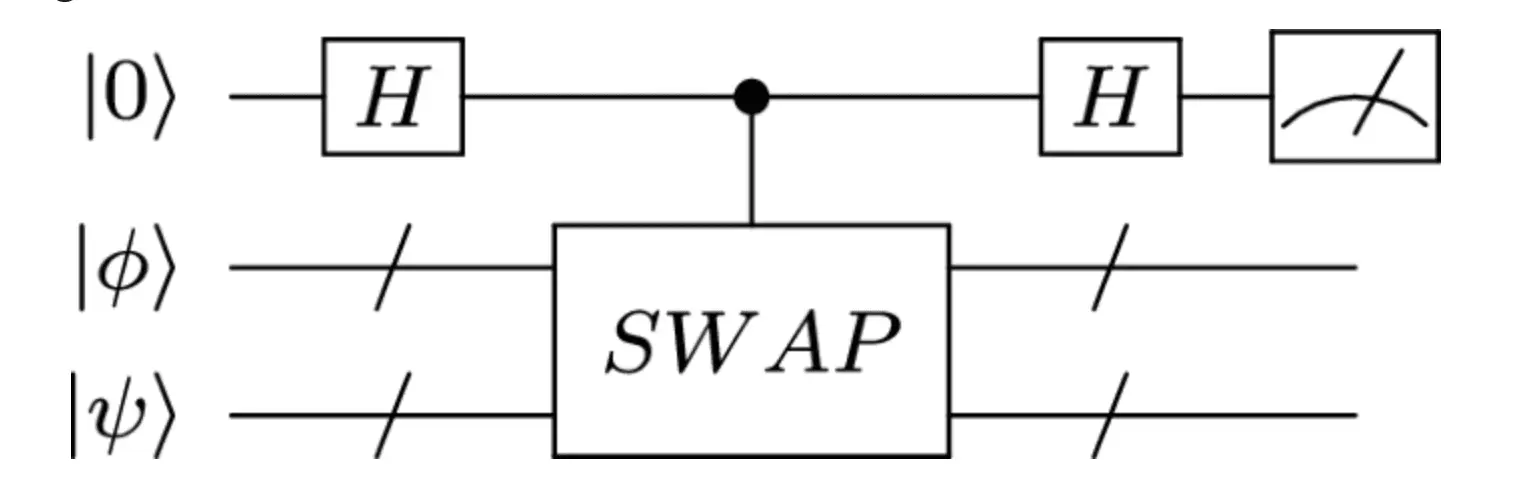
Quantum computers have the potential to solve complex problems that are difficult or impossible for classical computers to solve on their own. One approach is through hybrid quantum-classical algorithms, where part of the work is shifted to a classical computer. The variational quantum algorithm uses a parametrized quantum circuit to generate trial states and then applies the SWAP test to find the eigenvectors of a unitary matrix. This algorithm can be adapted to solve more complex problems, such as finding the eigenvectors of normal matrices and performing quantum principal component analysis (PCA) on unknown input mixed states.
Can Quantum Computers Solve Complex Problems?
In recent years, there has been growing interest in hybrid quantum-classical algorithms, where part of the work is shifted to a classical computer. This approach has shown promise in solving complex problems that are difficult or impossible for classical computers to solve on their own.
One such algorithm is the variational quantum algorithm, which uses a parametrized quantum circuit to generate trial states and then applies the SWAP test to find the eigenvectors of a unitary matrix. The algorithm is based on the idea of using a compact set of classical parameters to describe the eigenvector, allowing it to be reproduced on demand.
The variational eigenvector finder can be adapted to solve more complex problems, such as finding the eigenvectors of normal matrices and performing quantum principal component analysis (PCA) on unknown input mixed states. These algorithms can be run with low-depth quantum circuits, making them suitable for implementation on noisy intermediate-scale quantum computers (NISQCs).
However, as the size of the system increases, optimization problems may arise due to barren plateaus. In such cases, the proposed algorithm can be used as a primitive to boost known quantum algorithms.
What is Quantum Information Processing?
Quantum information processing refers to the study and development of algorithms and systems that use quantum mechanics to process and manipulate information. This field has seen significant progress in recent years, with the development of new algorithms and technologies that have the potential to revolutionize fields such as cryptography, optimization, and machine learning.
One key area of research is the development of hybrid quantum-classical algorithms, which combine the strengths of both classical and quantum computers to solve complex problems. These algorithms typically involve a continuous feedback loop between the classical and quantum parts of the system, allowing for the optimization of parameters and the generation of new trial states.
How Do Quantum Computers Work?
Quantum computers work by using quantum bits, or qubits, which are the fundamental units of quantum information. Qubits are different from classical bits in that they can exist in multiple states simultaneously, known as a superposition. This property allows qubits to process certain types of information more efficiently than classical computers.
Quantum computers also use quantum gates, which are the quantum equivalent of logic gates in classical computers. Quantum gates perform operations on qubits, such as entangling them or applying phase shifts. By combining multiple quantum gates, complex quantum algorithms can be implemented.
What is the SWAP Test?
The SWAP test is a quantum algorithm that is used to find the eigenvectors of a unitary matrix. The algorithm works by generating trial states using a parametrized quantum circuit and then applying the SWAP test to determine whether the trial state is an eigenvector or not.
The SWAP test involves measuring the overlap between two qubits, one of which is in a known state and the other of which is in the trial state. If the overlap is high, it indicates that the trial state is close to being an eigenvector. The algorithm can be repeated multiple times, with the parameters of the quantum circuit being updated based on the results of the previous iteration.
What are Eigenvectors?
Eigenvectors are vectors that are unchanged by a linear transformation, except for a scaling factor. In other words, if a matrix is applied to an eigenvector, the result is simply a scaled version of the original vector.
In quantum mechanics, eigenvectors play a crucial role in the study of quantum systems. They can be used to describe the states of particles and systems, and are essential for understanding many quantum phenomena.
What is Quantum Principal Component Analysis (PCA)?
Quantum PCA is an algorithm that uses quantum computers to perform principal component analysis on unknown input mixed states. The algorithm works by generating trial states using a parametrized quantum circuit and then applying the SWAP test to determine whether the trial state is an eigenvector or not.
The algorithm can be used to identify the most important features of a dataset, which can be useful in many applications such as data compression and feature selection.
Publication Date: 2024-06-25
Authors: Juan Carlos García‐Escartín
Source: Quantum information processing
DOI: https://doi.org/10.1007/s11128-024-04461-3



See today’s quantum computing news on Quantum Zeitgeist for the latest breakthroughs in qubits, hardware, algorithms, and industry deals.