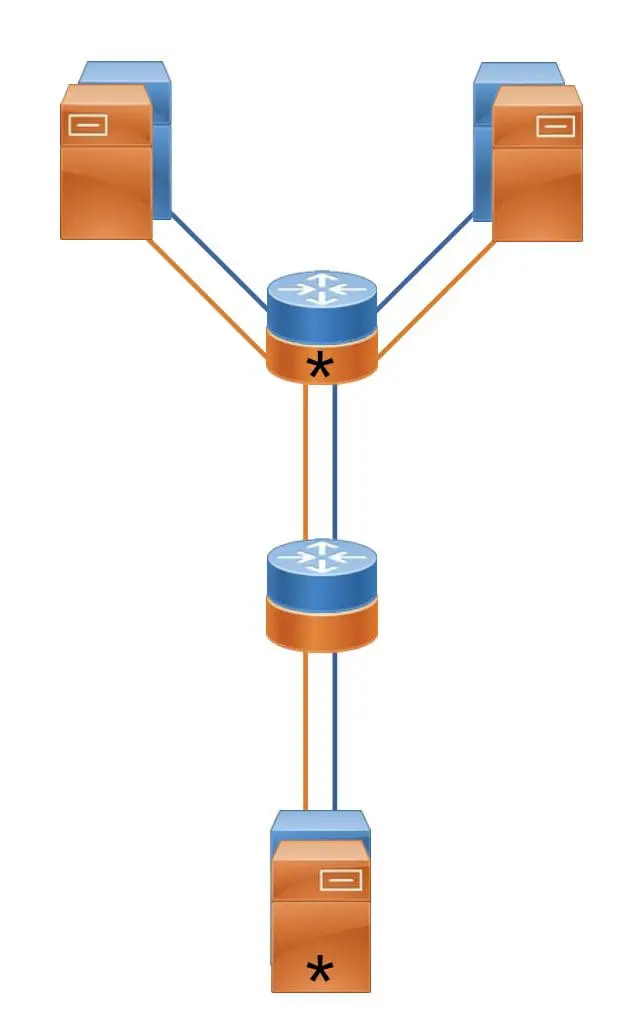
Researchers from USI Lugano, Yale University, and the University of Chicago have developed BellKAT, a specification language for quantum networks based on Kleene algebra. BellKAT addresses challenges in quantum networks, such as resource competition, and allows for the modular specification of entanglement distribution rules. The team has also provided a sound and complete equational theory for BellKAT, enabling the verification of network protocols, crucial for the reliability and security of quantum networks. The development of BellKAT is a significant step towards formal reasoning about quantum network protocols and could lead to advancements in quantum technologies.
What is the Purpose of Quantum Networks?
Quantum networks are distributed systems that provide communication services to distributed quantum applications. They offer numerous advantages over what is possible in a classical setting, enhancing the capabilities of existing applications and paving the way for fundamentally new ones. The most notable benefits are related to enhanced communication capabilities, which lead to increased security. Examples of these include unconditionally secure client-server communication, blind cloud computing, and secure multiparty computation.
Distribution is also essential to expand quantum computation beyond the capabilities of individual quantum-enabled computers to quantum clusters. Quantum networks connect quantum capable nodes to achieve capabilities that are impossible using only classical information. Their fundamental unit of communication is the Bell pair, which consists of two entangled quantum bits. However, Bell pairs are fragile and difficult to transmit directly, necessitating a network of repeaters along with software and hardware that can ensure the desired results.
Challenging intrinsic features of quantum networks, such as dealing with resource competition, motivate formal reasoning about quantum network protocols. To this end, a team of researchers from USI Lugano in Switzerland and Yale University and the University of Chicago in the USA have developed BellKAT, a novel specification language for quantum networks based upon Kleene algebra.
What is BellKAT and How Does it Work?
BellKAT is a specification language for quantum networks based on Kleene algebra. To cater to the specific needs of quantum networks, the researchers designed an algebraic structure called BellSKA, which they use as the basis of BellKAT’s denotational semantics. BellKAT’s constructs describe entanglement distribution rules that allow for modular specification.
The researchers gave BellKAT a sound and complete equational theory, allowing them to verify network protocols. They also provided a prototype tool to showcase the expressiveness of BellKAT and how to optimize and verify networks in practice. The development of BellKAT is a significant step towards formal reasoning about quantum network protocols, addressing the challenges intrinsic to quantum networks such as resource competition.
What is the Significance of BellKAT?
The development of BellKAT is a significant step towards formal reasoning about quantum network protocols. It addresses the challenges intrinsic to quantum networks, such as resource competition. The BellKAT specification language allows for the modular specification of entanglement distribution rules, a critical aspect of quantum networks.
The researchers have also provided a sound and complete equational theory for BellKAT, enabling the verification of network protocols. This is crucial for ensuring the reliability and security of quantum networks. Furthermore, they have developed a prototype tool to demonstrate the expressiveness of BellKAT and how it can be used to optimize and verify networks in practice.
Who are the Researchers Behind BellKAT?
The team behind the development of BellKAT includes researchers from USI Lugano in Switzerland and Yale University and the University of Chicago in the USA. The team comprises Anita Buckley, Pavel Chuprikov, Rodrigo Otoni, Robert Soulé, Robert Rand, and Patrick Eugster. Their combined expertise in quantum networks, Kleene algebra, and formal specifications has led to the creation of BellKAT, a novel specification language for quantum networks.
What are the Future Implications of BellKAT?
The development of BellKAT has significant implications for the future of quantum networks. By providing a formal language for specifying quantum networks, BellKAT can help to address the challenges inherent in these networks, such as resource competition. This could lead to more efficient and reliable quantum networks, enhancing the capabilities of quantum applications.
Furthermore, the ability to verify network protocols using BellKAT’s equational theory could improve the security of quantum networks. This is particularly important given the potential for quantum networks to provide unconditionally secure communication. Finally, the prototype tool developed by the researchers demonstrates the practical applicability of BellKAT, suggesting that it could be used to optimize and verify quantum networks in real-world settings.
How Does BellKAT Contribute to Quantum Technologies?
BellKAT contributes to quantum technologies by providing a formal language for specifying quantum networks. This is a significant advancement, as quantum networks are a key component of quantum technologies, enabling quantum computation beyond the capabilities of individual quantum-enabled computers.
By providing a way to formally specify and verify quantum network protocols, BellKAT can help to ensure the reliability and security of these networks. This could lead to advancements in quantum technologies, including enhanced communication capabilities and increased security. The development of BellKAT is therefore a significant contribution to the field of quantum technologies.
What are the Key Concepts and Terms in the Article?
The key concepts and terms in the article include quantum networks, Bell pairs, Kleene algebra, BellKAT, BellSKA, and formal specifications. Quantum networks are distributed systems that provide communication services to distributed quantum applications. Bell pairs are the fundamental unit of communication in quantum networks, consisting of two entangled quantum bits.
Kleene algebra is a type of algebra used in the specification language for quantum networks developed by the researchers, known as BellKAT. BellSKA is an algebraic structure designed by the researchers to cater to the specific needs of quantum networks. Formal specifications are a way of describing the behavior of a system in a rigorous way, and are used in the development of BellKAT.
Publication Date: 2024-06-20
Authors: Anita Buckley, Pavel Chuprikov, Rodrigo Otoni, Robert Soulé, et al.
Source: Proceedings of the ACM on programming languages
DOI: https://doi.org/10.1145/3656430



See today’s quantum computing news on Quantum Zeitgeist for the latest breakthroughs in qubits, hardware, algorithms, and industry deals.