A team of researchers has developed a new method of topology optimization for truss structures, commonly used in bridges and towers, using quantum annealing. This quantum computing method finds the global minimum of a function, aiding in the complex problem of optimizing these structures. The researchers used a representation of real numbers as a sum of random number combinations for quantum annealing analysis, expressing the nodal displacement and cross-sectional area of the truss with binary variables. This method offers a more efficient and accurate solution, potentially leading to more cost-effective and robust designs in construction.
What is Quantum Annealing and How Does it Apply to Truss Structure Optimization?
Quantum annealing is a method used in quantum computing to find the global minimum of a given function. In a recent study, a team of researchers, including Rio Honda, Katsuhiro Endo, Taichi Kaji, Yudai Suzuki, Yoshiki Matsuda, Shu Tanaka, and Mayu Muramatsu, developed a new method of topology optimization for truss structures using quantum annealing. Truss structures are commonly used in the construction of bridges, towers, and other similar structures. The optimization of these structures is a complex problem that requires high computational power and sophisticated algorithms.
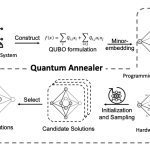
The researchers used a representation of real numbers as a sum of random number combinations to perform quantum annealing analysis. The nodal displacement of the truss structure was expressed with binary variables. The Hamiltonian, a function used in quantum mechanics to describe the total energy of a system, was formulated based on the elastic strain energy and position energy of the truss structure. The researchers confirmed that truss deformation analysis is possible using quantum annealing.
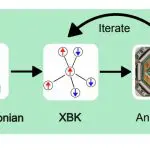
The cross-sectional area of the truss was also expressed with binary variables. The researchers performed iterative calculations for the changes in displacement and cross-sectional area, leading to the optimal structure under the prescribed boundary conditions. This method of optimization is a significant advancement in the field of structural engineering and quantum computing.
Why is Topology Optimization Important and How Does Quantum Computing Help?
Topology optimization is a mathematical method that optimizes material layout within a given design space, for a given set of loads and boundary conditions, such that the resulting layout meets a prescribed set of performance targets. It is a crucial aspect of structural design, especially in the construction of bridges, towers, and other similar structures. However, finding the optimal solution can be challenging due to the combinatorial nature of the problem. Traditional computational methods often get stuck in local solutions, requiring repeated calculations with small steps to obtain a globally optimal solution. This increases the computational cost and makes the process inefficient.
Quantum computers, however, offer a promising solution to this problem. They have been applied to solve practical problems in recent years, attracting attention due to their capability to perform calculations faster than classical computers for some problems. Quantum computers use properties such as quantum superposition and quantum entanglement to achieve high-speed computation. A bit used in a classical computer represents a state of 0 or 1. In contrast, a qubit used in a quantum computer can handle a superposition of 0 and 1, allowing multiple states to be computed in parallel. Quantum entanglement also enables the handling of quantum interactions between distant qubits. This means that in a quantum computer, the state of one bit can affect the state of other bits, unlike in a classical computer.
How Does Quantum Annealing Work in the Context of Truss Structure Optimization?
In the context of truss structure optimization, quantum annealing is used to find the optimal configuration of the truss structure that minimizes the total energy of the system. The total energy of the system is described by the Hamiltonian, which is formulated based on the elastic strain energy and position energy of the truss structure. The nodal displacement and the cross-sectional area of the truss are expressed with binary variables, which are used in the quantum annealing analysis.
The researchers performed iterative calculations for the changes in displacement and cross-sectional area, leading to the optimal structure under the prescribed boundary conditions. This process is repeated until the optimal configuration is found. The use of quantum annealing in this context allows for a more efficient and accurate optimization process compared to traditional computational methods.
What are the Implications of this Study?
The study conducted by the team of researchers represents a significant advancement in the field of structural engineering and quantum computing. The method they developed for topology optimization of truss structures using quantum annealing offers a more efficient and accurate solution to a complex problem. This could potentially lead to more cost-effective and robust designs in the construction of bridges, towers, and other similar structures.
Furthermore, the study also contributes to the growing body of research on the practical applications of quantum computing. As quantum computers become more advanced and accessible, we can expect to see more innovative applications of this technology in various fields, including structural engineering.
What are the Future Directions for this Research?
While the study presents a promising method for truss structure optimization, there is still much to explore in this field. Future research could focus on refining the method and exploring its applicability to other types of structures and materials. Additionally, as quantum computing technology continues to evolve, new possibilities for its application in structural engineering and other fields will likely emerge.
The researchers’ work also opens up opportunities for collaboration between the fields of structural engineering and quantum computing. By combining the expertise and methodologies of these two fields, we can expect to see more innovative solutions to complex problems in the future.
Publication Date: 2024-06-16
Authors: Ryumon Honda, Katsuhiro Endo, Tatsuru Kaji, Yusuke Suzuki, et al.
Source: Scientific reports
DOI: https://doi.org/10.1038/s41598-024-64588-2

See today’s quantum computing news on Quantum Zeitgeist for the latest breakthroughs in qubits, hardware, algorithms, and industry deals.