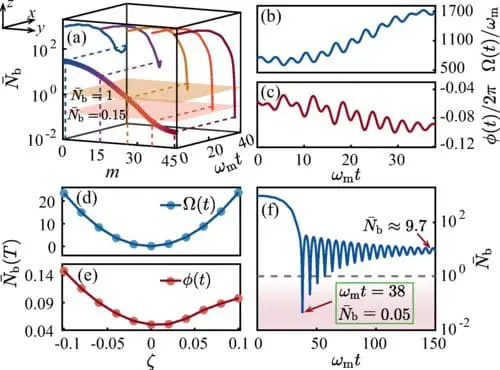
Researchers from the Key Laboratory of Low-Dimensional Quantum Structures and Quantum Control of Ministry of Education, the Quantum Computing Center RIKEN, and the University of New South Wales have developed a quantum-learning-control method for optimally controlling Linear Gaussian Quantum (LGQ) systems. The method, based on the gradient-descent algorithm, allows for more efficient control of LGQ systems and provides a deeper understanding of these systems. The team demonstrated the practical applications of their method through deep optomechanical cooling and large optomechanical entanglement, which could have significant implications for the development of quantum technologies.
What is the Significance of Controlling Linear Gaussian Quantum Systems?
Linear Gaussian Quantum (LGQ) systems are a critical component in the study of fundamental quantum theory and the development of modern quantum technology. Efficiently controlling these systems is a significant task that has implications for a wide range of scientific and technological applications. The control of LGQ systems is not just a theoretical exercise, but a practical necessity for the advancement of quantum technology.
The LGQ systems are characterized by both linear dynamics and Gaussian characteristic functions. These systems play a crucial role in quantum physics, quantum control theory, and quantum information. The control of these systems is a complex task that requires a deep understanding of quantum mechanics and advanced mathematical techniques.
The control of LGQ systems is not just about manipulating the systems to perform specific tasks. It is also about understanding the fundamental properties of these systems and how they can be harnessed for practical applications. This understanding can lead to new insights into the nature of quantum mechanics and the development of new quantum technologies.
How Can Quantum Learning Control Optimize LGQ Systems?
A team of researchers from various institutions, including the Key Laboratory of Low-Dimensional Quantum Structures and Quantum Control of Ministry of Education, the Quantum Computing Center RIKEN, and the University of New South Wales, have proposed a general quantum-learning-control method for optimally controlling LGQ systems. This method is based on the gradient-descent algorithm, a popular optimization technique in machine learning.
The researchers’ approach flexibly designs the loss function for diverse tasks by utilizing first and second-order moments that completely describe the quantum state of LGQ systems. This approach allows for a more efficient and effective control of LGQ systems, surpassing traditional methods.
The quantum-learning-control method not only optimizes the control of LGQ systems but also provides a deeper understanding of these systems. This understanding can lead to new insights into the nature of quantum mechanics and the development of new quantum technologies.
What are the Practical Applications of this Quantum Learning Control Approach?
The researchers demonstrated the practical applications of their quantum-learning-control method through deep optomechanical cooling and large optomechanical entanglement. Optomechanical cooling is a process that cools a mechanical resonator to its ground state, while optomechanical entanglement is a quantum phenomenon where the states of two or more objects become linked so that the state of one object cannot be described independently of the state of the other objects.
The researchers’ approach enables the fast and deep ground-state cooling of a mechanical resonator within a short time, surpassing the limitations of sideband cooling in the continuous wave driven strong-coupling regime. This has significant implications for the development of quantum technologies that require the cooling of mechanical resonators to their ground state.
Furthermore, the researchers’ approach could generate optomechanical entanglement remarkably fast and surpass several times the corresponding steady-state entanglement even when the thermal phonon occupation reaches one hundred. This has significant implications for the development of quantum technologies that require the generation of large optomechanical entanglement.
What is the Future of Quantum Learning Control?
The researchers’ work on quantum learning control of LGQ systems is a significant step forward in the field of quantum control theory. It not only broadens the application of quantum learning control but also opens an avenue for optimal control of LGQ systems.
The future of quantum learning control is promising. With the advancement of quantum technology and the increasing understanding of quantum mechanics, the control of LGQ systems will become more efficient and effective. This will lead to the development of new quantum technologies and the advancement of quantum control theory.
The researchers’ work is a testament to the potential of quantum learning control. It is a significant contribution to the field of quantum control theory and a promising step towards the future of quantum technology.
Publication details: “Optimal control of linear Gaussian quantum systems via quantum learning control”
Publication Date: 2024-06-06
Authors: Yu-Hong Liu, Ye‐Xiong Zeng, Qingyuan Tan, Daoyi Dong, et al.
Source: Physical review. A/Physical review, A
DOI: https://doi.org/10.1103/physreva.109.063508

See today’s quantum computing news on Quantum Zeitgeist for the latest breakthroughs in qubits, hardware, algorithms, and industry deals.