The quantum internet, an emerging technology, has increased the need for advanced quantum networking techniques. Researchers Zebo Yang, Ali Ghubaish, Raj Jain, Hassan Shapourian, and Alireza Shabani have proposed a new set of asynchronous routing protocols for quantum networks. These protocols, which maintain a dynamic topology in a distributed manner, overcome challenges posed by the probabilistic nature of entanglement generation and restricted coherence time. The study indicates that asynchronous protocols achieve a larger upper bound and a significantly higher entanglement rate than existing synchronous approaches, suggesting they will have a profound impact on quantum networks as technology advances.
What is Asynchronous Entanglement Routing for the Quantum Internet?
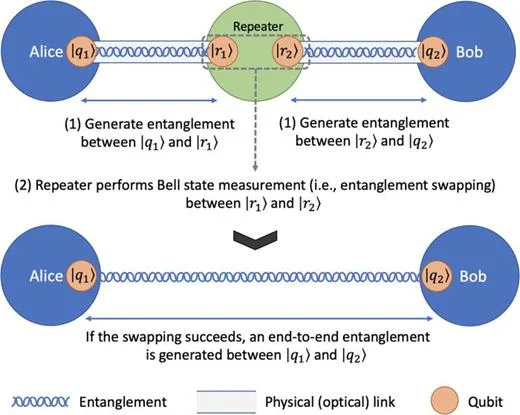
The quantum internet is an emerging technology that has significantly increased the need for advanced quantum networking techniques. Various models of quantum repeaters have been presented, each outlining a unique strategy to ensure quantum communication over long distances. The focus of this article is on repeaters that employ entanglement generation and swapping. This involves establishing remote end-to-end entanglement through repeaters, a concept referred to as quantum-native repeaters or first-generation repeaters in some literature.
The challenges in routing with quantum-native repeaters arise from probabilistic entanglement generation and restricted coherence time. Current approaches use synchronized time slots to search for entanglement-swapping paths, resulting in inefficiencies. The authors of this article, Zebo Yang, Ali Ghubaish, Raj Jain, Hassan Shapourian, and Alireza Shabani, propose a new set of asynchronous routing protocols for quantum networks.
How Does Asynchronous Routing Work in Quantum Networks?
The authors incorporate the idea of maintaining a dynamic topology in a distributed manner, which has been extensively studied in classical routing for lossy networks. This involves using a destination-oriented directed acyclic graph or a spanning tree. The protocols update the entanglement-link topology asynchronously, identify optimal entanglement-swapping paths, and preserve unused direct-link entanglements.
The asynchronous routing protocols proposed by the authors are designed to overcome the challenges posed by the probabilistic nature of entanglement generation and the restricted coherence time. By maintaining a dynamic topology in a distributed manner, the protocols can efficiently identify optimal entanglement-swapping paths and preserve unused direct-link entanglements.
What are the Benefits of Asynchronous Routing Protocols for Quantum Networks?
The results of the study indicate that asynchronous protocols achieve a larger upper bound with an appropriate setting and significantly higher entanglement rate than existing synchronous approaches. Furthermore, the rate increases with coherence time, suggesting that it will have a much more profound impact on quantum networks as technology advances.
The asynchronous routing protocols for quantum networks proposed by the authors offer several advantages over existing synchronous approaches. They achieve a larger upper bound and a significantly higher entanglement rate, which increases with coherence time. This suggests that as technology advances, asynchronous routing protocols will have an increasingly profound impact on quantum networks.
Who are the Key Players in this Research?
The research was conducted by Zebo Yang, Ali Ghubaish, and Raj Jain from the Department of Computer Science and Engineering at Washington University in St. Louis, Missouri, USA. Hassan Shapourian from Cisco Research in San Jose, California, USA, and Alireza Shabani from the NSF Center for Quantum Networks in Tucson, Arizona, USA, also contributed to the research.
The research was a collaborative effort between academics and industry professionals. The team’s diverse backgrounds and expertise contributed to the development of the new set of asynchronous routing protocols for quantum networks.
What is the Future of Quantum Internet?
The quantum internet is still an emerging technology, and the need for advanced quantum networking techniques is expected to continue to rise. As technology advances, the impact of asynchronous routing protocols on quantum networks is expected to become increasingly profound.
The authors’ research suggests that asynchronous routing protocols will play a significant role in the future of quantum internet. As technology continues to advance, these protocols are expected to become increasingly important in ensuring efficient and effective quantum communication over long distances.
What is the Significance of this Research?
This research is significant because it presents a new set of asynchronous routing protocols for quantum networks. These protocols overcome the challenges posed by the probabilistic nature of entanglement generation and the restricted coherence time, which are limitations of current synchronous approaches.
The research is also significant because it suggests that asynchronous routing protocols will have a profound impact on quantum networks as technology advances. This has implications for the future of quantum internet and the development of advanced quantum networking techniques.
Publication details: “Asynchronous entanglement routing for the quantum internet”
Publication Date: 2024-01-18
Authors: Zebo Yang, Ali Ghubaish, Raj Jain, Hassan Shapourian, et al.
Source: AVS quantum science
DOI: https://doi.org/10.1116/5.0172819