The Quantum Approximate Optimization Algorithm (QAOA) has shown potential in solving complex combinatorial problems, particularly the maximum cut (MaxCut) problem. Researchers from the University of Cambridge have analyzed the QAOA’s performance using basin-hopping global optimization methods. They found that focusing on the collection of minima could improve the algorithm’s efficiency. The study also highlighted the challenges of implementing quantum algorithms on current noisy intermediate-scale quantum (NISQ) devices due to short decoherence times and significant quantum noise. The findings provide a promising direction for the future of quantum algorithms and their application in quantum computing.
What is the Quantum Approximate Optimization Algorithm?
The Quantum Approximate Optimization Algorithm (QAOA) is a variational quantum algorithm (VQA) that has shown significant potential in solving NP-hard combinatorial problems in the current noisy intermediate-scale quantum (NISQ) era. The algorithm is particularly useful in solving the maximum cut (MaxCut) problem for a given graph. This is achieved by the successive implementation of L-quantum circuit layers within a corresponding Trotterized ansatz.
The challenge of exploring the cost function of VQAs, which arises from an exponential proliferation of local minima with increasing circuit depth, has been well documented. However, fewer studies have investigated the impact of circuit depth on QAOA performance in finding the correct MaxCut solution.
How is the QAOA Performance Analyzed?
In a study conducted by Choy Boy and David J Wales from the Yusuf Hamied Department of Chemistry, University of Cambridge, basin-hopping global optimization methods were employed to navigate the energy landscapes for QAOA ansätze for various graphs. The aim was to analyze QAOA performance in finding the correct MaxCut solution.
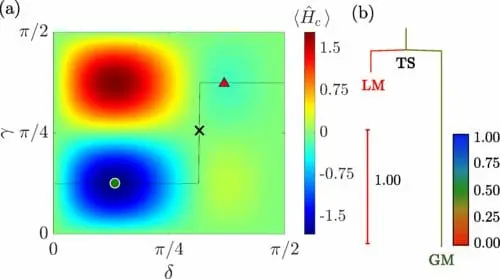
The structure of the solution space was also investigated using discrete path sampling to build databases of local minima and the transition states that connect them. This provided insightful visualizations using disconnectivity graphs.
What are the Findings of the Study?
The study found that the corresponding landscapes generally have a single funnel organization, which makes it relatively straightforward to locate low-lying minima with good MaxCut solution probabilities. In some cases below the adiabatic limit, the second-lowest local minimum may even yield a higher solution probability than the global minimum.
This important observation has motivated the researchers to develop broader metrics in evaluating QAOA performance based on collections of minima obtained from basin-hopping global optimization. Hence, they established expectation thresholds in elucidating useful solution probabilities from local minima. This approach may provide significant gains in elucidating reasonable solution probabilities from local minima.
What is the Significance of the Study?
The study’s findings are significant as they provide a new approach to evaluating the performance of the QAOA. By focusing on the collection of minima obtained from basin-hopping global optimization, the researchers were able to establish expectation thresholds that could provide significant gains in elucidating reasonable solution probabilities from local minima.
This approach could potentially improve the efficiency and effectiveness of the QAOA in solving NP-hard combinatorial problems, particularly the MaxCut problem.
What are the Challenges in Implementing Quantum Algorithms?
The initial setback of implementing practical quantum algorithms utilizing the quantum phase estimation (QPE) architecture onto current-day noisy intermediate-scale quantum (NISQ) devices has been a significant challenge. These devices typically possess short decoherence times and significant quantum noise, which has prompted the rapid development of alternative quantum algorithms such as the QAOA.
What is the Future of Quantum Algorithms?
The study by Choy Boy and David J Wales provides a promising direction for the future of quantum algorithms. By developing broader metrics for evaluating their performance and establishing expectation thresholds, the researchers have provided a potential pathway for improving their efficiency and effectiveness.
This could potentially lead to significant advancements in quantum computing, particularly in the application of quantum algorithms to solving complex combinatorial problems.
Publication details: “Energy landscapes for the quantum approximate optimization algorithm”
Publication Date: 2024-06-03
Authors: Boy Choy and David J. Wales
Source: Physical review. A/Physical review, A
DOI: https://doi.org/10.1103/physreva.109.062602



See today’s quantum computing news on Quantum Zeitgeist for the latest breakthroughs in qubits, hardware, algorithms, and industry deals.