Researchers from Seoul National University have made significant strides in quantum machine learning (QML) by introducing the concept of dequantization. This process determines if a classical model can efficiently replace a quantum model. The team used the tensor network formalism to identify every variational QML (VQML) model as a subclass of matrix product state (MPS) model. They also introduced an efficient quantum kernel-induced classical kernel, hinting at a possible way to dequantize quantum kernel methods. This research unifies classical and quantum machine learning models within a single framework, contributing significantly to the field of QML.
What is the Dequantization of Quantum Machine Learning Models?
The concept of dequantization is crucial in assessing the true potential of quantum algorithms. Dequantization refers to the process of determining whether a classical model can efficiently replace a given quantum model. In a recent study conducted by Seongwook Shin, Yong Siah Teo, and Hyunseok Jeong from the Department of Physics and Astronomy at Seoul National University, the researchers introduced the dequantizability of the function class of variational quantum machine learning (VQML) models.
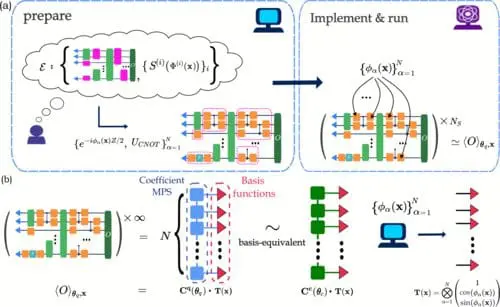
The team employed the tensor network formalism, which effectively identified every VQML model as a subclass of matrix product state (MPS) model. This model is characterized by constrained coefficient MPS and tensor product-based feature maps. From this formalism, the researchers were able to identify the conditions for which a VQML model’s function class is dequantizable or not.
Furthermore, the team introduced an efficient quantum kernel-induced classical kernel, which is as expressive as given any quantum kernel. This hints at a possible way to dequantize quantum kernel methods. The study presents a thorough analysis of VQML models and demonstrates the versatility of the tensor network formalism to properly distinguish VQML models according to their genuine quantum characteristics. This unifies classical and quantum machine learning models within a single framework.
What is Quantum Machine Learning?
Quantum machine learning (QML) has garnered significant interest among various communities and industries in recent years. It is seen as a prominent candidate for practical applications on quantum devices. Variational QML (VQML) uses a variational quantum circuit as a data processor. The variational parameters in the quantum circuit are optimized with the help of classical optimization algorithms in order to learn and predict data outputs.
VQML aims to achieve a more powerful machine learning model by exploiting a possible quantum advantage of quantum circuits in the noisy intermediate scale quantum (NISQ) era. While there exist theoretical proofs that demonstrate the possibility of achieving a quantum advantage in machine learning tasks in fully quantum settings, more effort is required to understand whether machine learning from classical data can also achieve such a quantum advantage.
How is the Assessment of VQML and Classical ML Models Conducted?
For the purpose of understanding whether machine learning from classical data can also achieve a quantum advantage, a fair assessment of VQML and classical machine learning models is in order. Both of these models possess inherently different structures. Moreover, the preprocessing of classical data always precedes VQML when they are encoded on NISQ machines.
The researchers from Seoul National University have made significant strides in this area by introducing the dequantizability of the function class of VQML models. By employing the tensor network formalism, they were able to effectively identify every VQML model as a subclass of matrix product state (MPS) model. This has allowed them to identify the conditions for which a VQML model’s function class is dequantizable or not, thereby making a significant contribution to the field of quantum machine learning.
What is the Significance of the Tensor Network Formalism?
The tensor network formalism is a crucial tool in the study conducted by the researchers from Seoul National University. It allowed them to effectively identify every VQML model as a subclass of matrix product state (MPS) model. This model is characterized by constrained coefficient MPS and tensor product-based feature maps.
From this formalism, the researchers were able to identify the conditions for which a VQML model’s function class is dequantizable or not. Furthermore, they introduced an efficient quantum kernel-induced classical kernel, which is as expressive as given any quantum kernel. This hints at a possible way to dequantize quantum kernel methods.
The tensor network formalism has demonstrated its versatility in properly distinguishing VQML models according to their genuine quantum characteristics. This has allowed for the unification of classical and quantum machine learning models within a single framework, thereby making a significant contribution to the field of quantum machine learning.
What is the Future of Quantum Machine Learning?
The study conducted by the researchers from Seoul National University presents a thorough analysis of VQML models and demonstrates the versatility of the tensor network formalism. This has allowed for the unification of classical and quantum machine learning models within a single framework.
The introduction of an efficient quantum kernel-induced classical kernel, which is as expressive as given any quantum kernel, hints at a possible way to dequantize quantum kernel methods. This could potentially pave the way for further advancements in the field of quantum machine learning.
While there exist theoretical proofs that demonstrate the possibility of achieving a quantum advantage in machine learning tasks in fully quantum settings, more effort is required to understand whether machine learning from classical data can also achieve such a quantum advantage. The work done by the researchers from Seoul National University is a significant step in this direction.
Conclusion
The study conducted by Seongwook Shin, Yong Siah Teo, and Hyunseok Jeong from the Department of Physics and Astronomy at Seoul National University has made significant strides in the field of quantum machine learning. By introducing the dequantizability of the function class of VQML models and employing the tensor network formalism, they have effectively identified every VQML model as a subclass of matrix product state (MPS) model.
This has allowed them to identify the conditions for which a VQML model’s function class is dequantizable or not. Furthermore, they introduced an efficient quantum kernel-induced classical kernel, which is as expressive as given any quantum kernel. This hints at a possible way to dequantize quantum kernel methods.
The study presents a thorough analysis of VQML models and demonstrates the versatility of the tensor network formalism. This has allowed for the unification of classical and quantum machine learning models within a single framework, thereby making a significant contribution to the field of quantum machine learning.
Publication Date: 2024-05-29
Authors: Seongwook Shin, Yong Siah Teo and Hyunseok Jeong
Source: Physical review research
DOI: https://doi.org/10.1103/physrevresearch.6.023218


See today’s quantum computing news on Quantum Zeitgeist for the latest breakthroughs in qubits, hardware, algorithms, and industry deals.