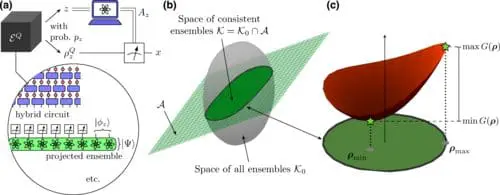
Max McGinley, a researcher from the TCM Group at Cavendish Laboratory in Cambridge, has proposed a new method to understand quantum dynamics. The method allows for the empirical inference of properties of quantum states generated by dynamics involving measurements, particularly in many-body settings. The approach is based on an optimization task that determines the minimum and maximum values a desired quantity could take, providing a feasible range for the true value. This research offers a more efficient way to study quantum dynamics, highlighting the importance of classical simulations in understanding quantum phenomena.
What is the New Approach to Understanding Quantum Dynamics?
Quantum mechanics, a fundamental theory in physics, describes nature at the smallest scales of energy levels of atoms and subatomic particles. It is a complex field that has been the subject of extensive research and study. One of the key aspects of quantum mechanics is the concept of quantum states and their dynamics. Quantum states are the different states that a quantum system can be in, and their dynamics involve the changes in these states over time.
Max McGinley, a researcher from the TCM Group at Cavendish Laboratory in Cambridge, United Kingdom, has proposed a new method to empirically infer properties of quantum states generated by dynamics involving measurements. This method is particularly useful in many-body settings, where the number of measurements is extensive, making traditional approaches based on postselection intractable due to their exponential sample complexity.
How Does This New Method Work?
McGinley’s method introduces a general-purpose scheme that can be used to infer any property of the post-measurement ensemble of states, such as the average entanglement entropy or frame potential, using a scalable number of experimental repetitions. The approach is based on an optimization task where one asks what are the minimum and maximum values that the desired quantity could possibly take while ensuring consistency with observations.
The true value of this quantity must then lie within a feasible range between these extrema, resulting in two-sided bounds. Narrow feasible ranges can be obtained by using a classical simulation of the device to determine which estimable properties one should measure. Even in cases where this simulation is inaccurate, unambiguous information about the true value of a given quantity realized on the quantum device can be learned.
What are the Applications and Limitations of This Method?
As an immediate application, McGinley shows that his method can be used to verify the emergence of quantum state designs in experiments. However, he also identifies some fundamental obstructions that, in some cases, prevent sharp knowledge of a given quantity from being inferred and discusses what can be learned in cases where classical simulation is too computationally demanding to be feasible.
In particular, he proves that any observer who cannot perform a classical simulation cannot distinguish the output states from those sampled from a maximally structureless ensemble. This highlights the importance of classical simulations in understanding quantum dynamics and the limitations of empirical methods in the absence of such simulations.
How Does This Method Address the Challenges in Quantum Mechanics?
The probabilistic nature of quantum measurements makes probing such phenomena in experiment a considerable challenge. This is because the states of interest cannot be prepared deterministically; rather, in each repetition of the experiment, a different randomly chosen outcome and hence a different post-measurement state is obtained.
Using conventional learning techniques, any property of a given quantum state can only be inferred through repeated preparation and measurement, which in this context would only be possible if the experiment is run sufficiently many times such that each state is realized on multiple occasions. Such a postselection-based approach has a sample complexity that is exponential in the number of measurements, which is infeasible for many-body systems.
What is the Significance of This Research?
This research is significant as it provides a new approach to understanding the complex dynamics of quantum states. By proposing a method that can infer properties of quantum states from experimental data without suffering from the exponential cost of postselection, it offers a more feasible and efficient way to study quantum dynamics.
Moreover, by identifying the role of classical simulations in determining which estimable properties one should measure, it highlights the interplay between classical and quantum computations in understanding quantum phenomena. This research thus contributes to the ongoing efforts to unravel the mysteries of quantum mechanics and its potential applications in various fields.
Publication Date: 2024-05-29
Authors: Max McGinley
Source: PRX Quantum 5, 020347
DOI: https://doi.org/10.1103/PRXQuantum.5.020347




See today’s quantum computing news on Quantum Zeitgeist for the latest breakthroughs in qubits, hardware, algorithms, and industry deals.