Quantum error correction (QEC) is vital to scalable quantum information processing applications. It uses entanglement to encode quantum information redundantly, allowing for real-time error detection and correction. Bosonic codes offer an alternative to traditional discrete-variable quantum codes, with syndrome measurements that are natively analog and can be concatenated with discrete-variable codes. However, decoding in the continuous-variable setting presents challenges. Researchers have proposed new decoding methods that exploit analog syndrome information from bosonic qubit readout. This research could lead to more efficient quantum error correction methods, crucial for advancing quantum computing technology.
What is Quantum Error Correction and Why is it Important?
Quantum error correction (QEC) is a crucial aspect of scalable quantum information processing applications. Traditional discrete-variable quantum codes, which use multiple two-level systems to encode logical information, can be hardware intensive. An alternative approach is provided by bosonic codes, which use the infinite dimensional Hilbert space of harmonic oscillators to encode quantum information. Two promising features of bosonic codes are that syndrome measurements are natively analog and that they can be concatenated with discrete-variable codes.
QEC is designed to suppress qubit errors by harnessing entanglement to redundantly encode quantum information in the logical qubit state of a larger physical Hilbert space. This encoding provides the system with additional degrees of freedom that can be used to detect and correct errors in real time. Beyond the initial encoding, full QEC protocols must incorporate logical gates that allow the encoded quantum information to be manipulated in a fault-tolerant way. This provides the ability to compute fault tolerantly while keeping the system protected against local noise.
Identifying and realizing feasible and practical schemes for fault-tolerant operation remains one of the core challenges of quantum computing, both in experiment and in theory. The goal of QEC is to check whether errors occurred on the encoded information and if so, to decode, i.e., to computationally derive a suitable recovery operation to restore an error-free state.
What are the Advantages and Challenges of Continuous-Variable Codes?
Both discrete-variable and continuous-variable (CV) codes for quantum error correction have been considered in the literature and are seen as candidates for feasible quantum codes. The latter offer some compelling advantages for a number of platforms, notably for cat codes and Gottesman-Kitaev-Preskill (GKP) codes. However, there are also some challenges that are unique to the continuous-variable setting.
In particular, it is not obvious how to do decoding in light of continuous syndrome information, as it is not clear how to make use of continuous information in this task. For example, the development of good decoders for GKP codes constitutes a well-known technical challenge. The lack of good methods of decoding for quantum error-correcting codes with a continuous component can be seen as a roadblock in the field.
How Can Bosonic Codes Help in Quantum Error Correction?
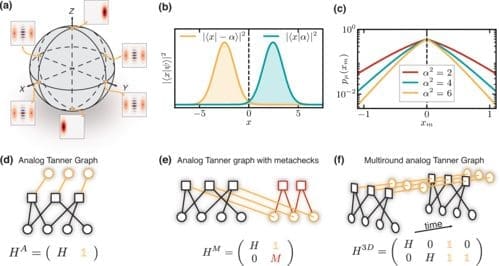
Bosonic encodings offer an alternative to discrete-variable (DV) qubits. In this approach, the logical qubit state is non-locally encoded in the infinite-dimensional Hilbert space of a harmonic oscillator. This approach has two promising features: syndrome measurements are natively analog, and they can be concatenated with discrete-variable codes.
In this work, the researchers propose novel decoding methods that explicitly exploit the analog syndrome information obtained from the bosonic qubit readout in a concatenated architecture. Their methods are versatile and can be generally applied to any bosonic code concatenated with a quantum low-density parity-check (QLDPC) code.
What is the Concept of Quasi-Single Shot Protocols?
The researchers introduce the concept of quasi-single shot protocols as a novel approach that significantly reduces the number of repeated syndrome measurements required when decoding under phenomenological noise. To realize the protocol, they present the first implementation of time-domain decoding with the overlapping window method for general QLDPC codes and a novel analog single-shot decoding method.
This approach lays the foundation for general decoding algorithms using analog information and demonstrates promising results in the direction of fault-tolerant quantum computation with concatenated bosonic-QLDPC codes.
What is the Future of Quantum Error Correction?
The work of these researchers represents substantial progress on the partial use of continuous syndrome information in the notions of quantum error correction. By exploring the combination of two promising classes of codes – instances of bosonic codes and quantum low-density parity-check (LDPC) codes – and investigating suitable decoding protocols for general bosonic-LDPC constructions that make such partial use of analog information, they aim to bring the advantages of DV and CV quantum error correction closer together.
This research opens up new possibilities for the development of more efficient and effective quantum error correction methods, which are crucial for the advancement of quantum computing technology.
Publication details: “Analog Information Decoding of Bosonic Quantum Low-Density Parity-Check Codes”
Publication Date: 2024-05-30
Authors: Lucas Berent, Timo Hillmann, Jens Eisert, Robert Wille, et al.
Source: PRX Quantum 5, 020349
DOI: https://doi.org/10.1103/PRXQuantum.5.020349
See today’s quantum computing news on Quantum Zeitgeist for the latest breakthroughs in qubits, hardware, algorithms, and industry deals.