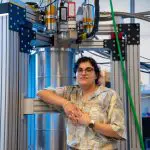
Jason Parisi, a physicist at the Princeton Plasma Physics Laboratory, has developed a new theoretical model that brings us closer to commercial fusion power. The model refines understanding of plasma behavior in different shapes of tokamak, a device used in nuclear fusion research. The model is the first to match behaviors seen in the U.S. Department of Energy’s National Spherical Torus Experiment. It explores the limits of plasma pressure before instabilities occur, which could help optimize plasmas for fusion reactions. The research enhances understanding of plasma behavior and brings scientists closer to designing a fusion reactor that generates more power than it consumes.
Understanding Plasma Behavior for Fusion Energy
Harnessing energy from plasma necessitates a precise understanding of its behavior during fusion to keep it hot, dense, and stable. A new theoretical model about a plasma’s edge, which can become unstable and bulge, brings the prospect of commercial fusion power closer to reality. The model refines the thinking on stabilizing the edge of the plasma for different tokamak shapes, according to Jason Parisi, a staff research physicist at the Princeton Plasma Physics Laboratory (PPPL). Parisi is the lead author of three articles describing the model that were published in the journals Nuclear Fusion and Physics of Plasma.
The model focuses on a part of the plasma called the pedestal, which is located at the edge. The pedestal is prone to instabilities because the plasma’s temperature and pressure often drop sharply across this area. The new model is noteworthy because it is the first to match pedestal behaviors that were seen in the U.S. Department of Energy’s (DOE) National Spherical Torus Experiment (NSTX), based at PPPL. While conventional tokamaks are shaped like doughnuts, NSTX is one of several tokamaks that are shaped more like a cored apple. The difference in tokamak proportions impacts plasma and, as the model indicates, the pedestal.
Ballooning Instabilities and the New Model
Parisi, together with a team of scientists, explored the limits of pedestals and investigated how much pressure could be applied to plasma inside a fusion reactor before instabilities appeared. They studied disruptions in the pedestal called ballooning instabilities: bulges of plasma that jut out, like the end of a long balloon when squeezed. The model is an extension of a model that people have used in the field for about a decade, but the team made the ballooning stability calculation a lot more sophisticated.
To develop their model, the scientists looked at the relationship between pedestal measurements, height and width, and ballooning instabilities. Parisi said the new model fit on the first try. “I was surprised by how well it works. We tried to break the model to ensure it was accurate, but it fits the data really well,” he said.
Expanding the EPED Model and Tokamak Designs
The existing model, known as EPED, was known to work for doughnut-shaped tokamaks but not for the spherical variety. “We decided to give it a go, and just by changing one part of EPED, now it works really well,” Parisi said. The results also give researchers a clearer picture of the contrast between the two tokamak designs.
“There is certainly a big difference between the stability boundary for the apple shape and the standard-shaped tokamak, and our model can now somewhat explain why that difference exists,” he said. The findings could help minimize plasma disruptions. Tokamaks are designed to intensify the pressure and temperature of plasma, but instabilities can thwart those efforts. If plasma bulges out and touches the walls of the reactor, for example, it can erode the walls over time. Instabilities can also radiate energy away from the plasma. Knowing how steep a pedestal can be before instabilities occur could help researchers find ways to optimize plasmas for fusion reactions based on the proportions of the tokamak.
Plasma Shape and Pedestal Measurements
Parisi’s second paper in the series explores how well the EPED model aligns with the height and width of the pedestal for different plasma shapes. “Your core fusion pressure, and therefore your power, is so sensitive to how high your pedestal is. And so, if we were to explore different shapes for future fusion devices, we definitely want to make sure that our predictions work,” he said.
Parisi started with old data from experimental discharges in NSTX and then modified the plasma’s edge shape. He found that changing the shape had a very big effect on the width-to-height ratio of the pedestal. Additionally, Parisi found that some shapes could lead to several possible pedestals, particularly in tokamaks shaped like NSTX and its descendant, which is currently being upgraded, NSTX-U. This would give those running a fusion shot a choice between, for example, a steep or shallow pedestal.
Heating, Fueling and Pedestals
Heating and fueling are other important factors and ones that Parisi’s third paper explores. Specifically, Parisi looked at certain pedestals and determined the amount of heating and fueling required to achieve it given a particular plasma shape. A steep pedestal typically requires far more heating than a shallow pedestal, for example.
The paper also considers how a sheared flow, which occurs when adjacent particles move at different flow speeds, can impact the pedestal height and width. Past experiments in NSTX found that when part of the interior of the vessel was coated in lithium and the flow shear was strong, the pedestal became three to four times wider than when no lithium was added. “It seems to be able to allow the pedestal to continue to grow,” said Parisi. “If you could have a plasma in a tokamak that was all pedestal, and if the gradients were really steep, you would get a really high core pressure and a really high fusion power.”
Understanding the variables involved in getting to a stable, high-power plasma brings researchers closer to their ultimate goal of commercializing fusion power.
External Link: Click Here For More



See today’s quantum computing news on Quantum Zeitgeist for the latest breakthroughs in qubits, hardware, algorithms, and industry deals.