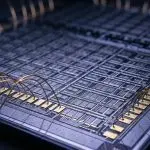
Alice & Bob, a quantum computing company, has launched its first cat qubit chip, Boson 4, on Google Cloud Marketplace. The chip offers unprecedented protection against one type of quantum error, accelerating the development of fault-tolerant quantum computers. The Boson 4 chip extends the bit-flip time to over seven minutes, a significant improvement over current technology. The company’s CEO, Théau Peronnin, believes the chip will spark interest among researchers. Alice & Bob’s technology could potentially reduce the hardware requirements for building a large-scale quantum computer by up to 200 times.
Alice & Bob’s Quantum Computing Breakthrough: The Boson 4 Chip
Alice & Bob, a quantum computing company, has released a new single cat-qubit chip, the Boson 4, on Google Cloud Marketplace. This marks the first time a cat qubit, a promising platform for fault-tolerant quantum computers, has been made publicly available. The Boson 4 chip demonstrates a significant advancement in quantum computing, particularly in its ability to protect quantum information from one of the two types of errors that can corrupt it.
Quantum bits, or qubits, are susceptible to two types of errors: bit-flip and phase-flip. These errors can occur dozens of times per second in superconducting qubits, even in the best cases. The Boson 4 chip, however, extends the bit-flip time to over seven minutes, four orders of magnitude improvement over the state-of-the-art and a world record for superconducting qubits. Future iterations of the chip will focus on improving the phase-flip performance and enabling multi-qubit operation.
The Importance of Fault Tolerance in Quantum Computing
Fault tolerance is now seen as a crucial achievement to unlock the full potential of quantum computing. It could enable industry-changing applications in chemistry, biotechnology, cryptography, and other fields if proven and scaled. The Boson 4 chip demonstrates a key aspect of Alice & Bob’s approach to fault-tolerant quantum computing: embedding bit-flip correction in each qubit.
Cat qubits are designed to be protected from bit-flips, to the point where additional error-correcting qubits are only needed to tackle the remaining phase-flips. This design makes it possible to create fault-tolerant computers using far fewer qubits, potentially up to 200 times fewer according to the latest paper by Alice & Bob and Inria.
Public Access to the Boson 4 Chip
With the Boson 4 chip now available to the public on Google Cloud Marketplace, the scientific community can verify the benefits and potential of cat qubits by performing its experiments. Théau Peronnin, CEO and co-founder of Alice & Bob, expressed his belief that the Boson 4 will spark interest among researchers and that the company is committed to continuously extending the range of experiments that can be performed with it.
Alice & Bob and the Evolution of the Boson Series
Alice & Bob is a quantum computing company founded in Paris and Boston in 2020. The company has already raised €30 million in funding, hired over 95 employees, and demonstrated experimental results surpassing those of technology giants with far greater resources. Alice & Bob specializes in cat qubits, a pioneering technology developed by the company’s founders and later adopted by Amazon.
The Boson series has evolved significantly since its inception. Boson 1 showed that bit-flips could be suppressed exponentially while only linearly increasing phase-flips. Boson 2 demonstrated that by removing the transmon, bit-flip lifetime could reach 100 seconds. Boson 3 reached a bit-flip time of over 10 seconds using a new design, TomCat, and was featured in the scientific journal Nature. Now, Boson 4 builds upon the measurement protocols developed with Boson 3 while further improving bit-flip lifetime to more than 7 minutes.

Alice & Bob believe that a useful quantum computer should feature at least 100 logical qubits and a 10e-8 error rate. Boson 4 addresses and solves the first challenge to meeting this target, bit-flip time. The company is already working on two multi-qubit chip generations: hydrogen to detect quantum errors and Helium to exponentially remove phase-flips through error correction. These advancements mark significant steps towards the realization of a fault-tolerant quantum computer.
External Link: Click Here For More

See today’s quantum computing news on Quantum Zeitgeist for the latest breakthroughs in qubits, hardware, algorithms, and industry deals.