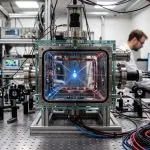
The Center for Supercomputing of Galicia (CESGA) in Spain is opening access to its QMIO quantum computer, the first of its kind in the country. The initiative, supported by a €30M investment, aims to position Galicia as a leader in quantum technology. The QMIO infrastructure, deployed by Fujitsu, will be available for research and development at universities, research centers, and businesses. The quantum technologies are expected to accelerate economic development in various sectors, including medicine, artificial intelligence, and biotechnology. The European project NExt ApplicationS of Quantum Computing (NEASQC) has already achieved milestones such as creating new financial algorithms and diagnosing cancer.
Quantum Computing in Galicia: A Leap Forward in Technology
The Galician government has announced that it will open the QMIO quantum computer, located at the Center for Supercomputing of Galicia (CESGA), to researchers from Galicia and across Spain. This move is part of a broader initiative to position Galicia as a leading region in quantum computing technology, a field that is currently generating significant international interest. The QMIO quantum computer, installed and operational since October 2023, is the first in Spain and boasts the highest number of cubicles in a public institution in Southern Europe.
The QMIO infrastructure will be accessible to researchers and developers from universities, research centers, technology centers, and businesses at regional and national levels. An access protocol will be implemented to encourage collaboration between researchers from Galicia and the rest of Spain, to enhance scientific relevance and attracting talent. National research centers will be granted access provided they collaborate with Galician research entities.
Quantum technologies are expected to act as a disruptive technological element that will accelerate economic development across virtually every sector. This is due to their potential to lead to numerous applications and advancements in fields such as medicine, artificial intelligence, environment, biotechnology, pharmacology, chemistry, aeronautics, automotive, logistics, telecommunications, finance, and more.
Quantum computing, in particular, holds the promise of discovering new medicines, designing new materials, discovering new chemical processes, accelerating and reducing the consumption of artificial intelligence models, optimizing production processes, and improving energy efficiency, among other benefits. For instance, the European project NExt ApplicationS of Quantum Computing (NEASQC), in which CESGA and the University of A Coruña (UDC) participate, has already achieved milestones such as the creation of two new financial algorithms and the diagnosis of cancer.
Galicia’s Investment in Quantum Technology
The QMIO quantum computer is part of the Galicia School Technology Pole initiative, in which the Galician government and other institutions have invested €30 million. The initiative has already created about thirty high-skilled direct jobs in Galicia, and this number is expected to increase in the coming years due to the projects that researchers will undertake.
The Galician government’s decision to open access to QMIO for research and development activities aims to place the research community at the forefront of this emerging technology and position Galicia as a leader in research and innovation in quantum information technologies in the coming years.
Access Protocol for QMIO Quantum Computer
Access to the QMIO quantum computer will be free and exclusively for research and development activities, with a small portion reserved for educational purposes aimed at fostering talent in quantum computing. An access protocol will be established to assign permits based on the scientific interest of the proposals, although direct access for small exploratory projects is also contemplated.
The protocol outlines four types of access: through the Spanish Network of Supercomputing (RES), open access, access reserved for CESGA, and access for educational purposes. Each type of access has its own procedures and protocols, with the aim of ensuring the most effective use of the quantum computer’s resources.
The Future of Quantum Computing in Galicia
The introduction of the QMIO quantum computer and the opening of its access to researchers across Spain marks a significant step forward in Galicia’s commitment to advancing quantum technology. As the first quantum computer of its kind in Spain, QMIO is expected to play a crucial role in driving research and innovation in quantum technologies, attracting talent, and fostering economic development in the region. With the ongoing efforts of the Galician government and institutions like CESGA, Galicia is well-positioned to become a leading region in quantum technology in the coming years.
External Link: Click Here For More




See today’s quantum computing news on Quantum Zeitgeist for the latest breakthroughs in qubits, hardware, algorithms, and industry deals.