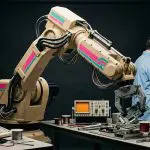
The Institute for Public Policy Research (IPPR) warns that up to 8 million UK jobs could be at risk from artificial intelligence (AI) unless the government intervenes. The report suggests that back office, entry level, and part-time jobs are most vulnerable to automation, with women and young people disproportionately affected. The IPPR proposes three potential scenarios: worst case, with 7.9 million job losses; a central scenario, with 4.4 million job losses but economic gains of £144bn per year; and a best case scenario, with no job losses and an economic boost of £306bn per year. The IPPR urges the government to develop a job-centric industrial strategy for AI.
The Impact of AI on the UK Labour Market
A recent report by the Institute for Public Policy Research (IPPR) has revealed the potential impact of generative artificial intelligence (AI) on the UK labour market. The study, which is the first of its kind, suggests that the UK is at a critical juncture, with the potential for significant job disruption or substantial GDP gains, depending on government policy.
The report identifies two key stages of generative AI adoption: the first wave, which is currently underway, and a second wave in which companies will integrate existing AI technologies more deeply into their processes. The IPPR’s analysis of 22,000 tasks in the UK economy, covering every type of job, finds that 11 per cent of tasks done by workers are already exposed to AI in the first wave. This could increase to 59 per cent of tasks in the second wave, affecting increasingly higher earning jobs.
The Jobs Most at Risk
The study suggests that back-office, entry-level, and part-time jobs are at the highest risk of being disrupted during the first wave. These include secretarial, customer service, and administrative roles. Women are more likely to be in such jobs, which means they will be among the most affected. Young people are also at high risk as firms hire fewer people for entry-level jobs and introduce AI technologies instead. In addition, those on medium and low wages are most exposed to being replaced by AI.
Potential Scenarios
The IPPR has modelled three illustrative scenarios for the potential impact of the second wave of AI adoption on the labour market, depending on policy choices. The worst-case scenario involves full displacement, with all jobs at risk being replaced by AI, leading to 7.9 million job losses and no GDP gains. The central scenario predicts 4.4 million jobs disappearing, but with economic gains of 6.3 per cent of GDP (£144bn per year). The best-case scenario involves full augmentation, with all jobs at risk being adapted to AI, leading to no job losses and an economic boost of 13 per cent to GDP (£306bn per year).
The Role of Government and Policy Makers
The report urges government intervention to ensure that the economic gains from AI are widely spread, rather than accruing to only a few. Without government action and with companies left to their own devices, the worst-case scenario is a real possibility, the IPPR warns. The institute recommends the government develops a job-centric industrial strategy for AI that encourages job transitions and ensures that the benefits of automation are shared widely across the economy. This should include supporting green jobs, fiscal policy measures, and regulatory changes.
The Future of Work in the Age of AI
The report concludes that the deployment of AI could free up labour to fill gaps related to unaddressed social needs, such as social care and mental health services, which are currently under-resourced. However, the modelling shows that there is no single predetermined path for how AI implementation will play out in the labour market. The question now is less whether AI can be useful, but rather how fast and in what manner employers will use it. The report emphasizes that technology isn’t destiny and a jobs apocalypse is not inevitable – government, employers and unions have the opportunity to make crucial design decisions now that ensure we manage this new technology well.
External Link: Click Here For More



See today’s quantum computing news on Quantum Zeitgeist for the latest breakthroughs in qubits, hardware, algorithms, and industry deals.