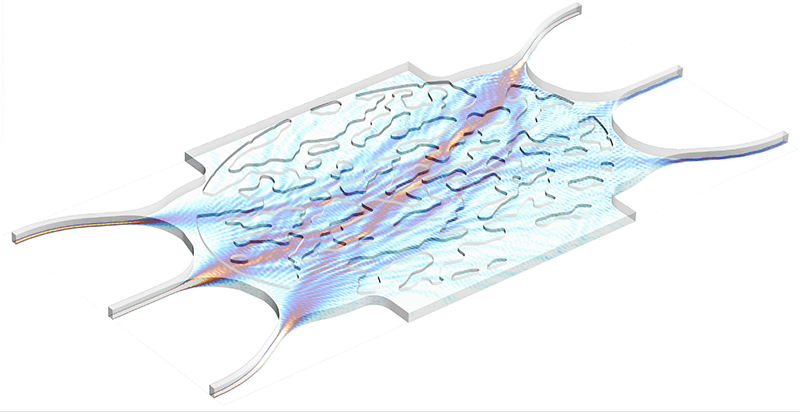
Metamaterials, synthetic materials designed to manipulate light, could revolutionize analog optical computing, according to Nader Engheta and his team at the University of Pennsylvania. These materials can perform mathematical operations and have been used to create a programmable metamaterial silicon photonics chip. This chip could process information at light speed, using less energy than conventional computers, and could enhance the efficiency of AI tools. Despite challenges such as the need for sophisticated fabrication processes, the future of metamaterial-based analog optical computing looks promising, with potential applications in secure computing and data protection.
What are Metamaterials and How Do They Impact Analog Optical Computing?
Metamaterials are synthetic materials composed of many units, each smaller than the wavelength of the light they are designed to manipulate. These materials can be tailored to display properties not found in naturally occurring materials, such as an ear-zero or negative refractive index. These exotic properties can enable unique applications, from sub-wavelength imaging to invisibility cloaking.
The design flexibility of metamaterials has inspired several groups to explore strategies for turning them into computing machines. In 2014, Nader Engheta and his collaborators at the University of Pennsylvania put forward a first set of proposals. Their simulations suggested that metamaterials could realize a suite of mathematical operations, including differentiation, integration, and convolution. The approach involves taking an electromagnetic wave as an input function and manipulating it through interaction with the metamaterial so that the output wave corresponds to a desired mathematical transformation of the input.
Five years later, Engheta’s group realized this proposal experimentally. Working at microwave wavelengths, their scheme involved a block of a metamaterial with several input and output ports connected by waveguides in a feedback loop. The experiments demonstrated that for a given input, the device’s output was the solution of the so-called Fredholm integral equation, which is used in fields as diverse as fluid mechanics, antenna design, and quantum mechanics perturbation theory.
How Can Metamaterials Be Used in Analog Optical Computing?
The idea of an analog computer, a device that uses continuous variables rather than zeros and ones, may evoke obsolete machinery from mechanical watches to bombsight devices used in World War II. However, emerging technologies, including AI, may reap great benefits from this computing approach. A promising direction involves analog computers that process information with light rather than with electrical currents.
As reported at the 2024 APS March Meeting by Nader Engheta of the University of Pennsylvania, composite media known as metamaterials offer a powerful platform for building analog optical computers. In recent work, his team demonstrated a metamaterial platform that could be mass-produced and integrated with silicon electronics, as well as an approach for building architectures that could be reprogrammed in real-time to perform different computing tasks.
Metamaterial-based analog optical computers may one day perform certain tasks much faster and with less power than conventional computers, says Engheta. This is because they process information at the speed of light with a fraction of the energy needed to power the millions of operations that a conventional digital processor needs to perform to solve the same tasks.
What Are the Challenges and Future Directions in Metamaterial-Based Analog Optical Computing?
While the potential of metamaterials in analog optical computing is promising, there are several challenges to overcome. One of the main challenges is the need for sophisticated, customized fabrication processes, which limit the potential for mass production.
However, Engheta and his colleagues have now developed an on-chip platform that may overcome such limitations. The team’s metamaterial design channels light through structured waveguides on a silicon chip. The researchers inverse-designed and built a micron-sized chip with a structure reminiscent of their 2019 microwave design.
In parallel to the optical work, Engheta is pushing the mathematical abilities of analog computers using proof-of-principle devices at lower frequencies. The group’s latest result added an important new feature: reconfigurability, the ability of an equation solver to be reprogrammed to perform different math.
How Can Metamaterials Improve AI Tools?
The programmable metamaterial silicon photonics chip would be a boon for analog optical computing, says Engheta. This is particularly true for AI tools such as neural networks. To solve equations, the scheme will need to incorporate feedback waveguides linking outputs to inputs, an engineering challenge that the team plans to address in next-generation chips.
The programmable metamaterial silicon photonics chip would process information at the speed of light with a fraction of the energy needed to power the millions of operations that a conventional digital processor needs to perform to solve the same tasks. Here, light goes through a waveguide labyrinth, and when it comes out, you get the answer in one shot, he says.
And since photons, unlike electrons, don’t interact with each other, parallel operations could be carried out simultaneously, simply by shining light at different wavelengths through the device. This would have privacy benefits because it does not require intermediate steps that store information into a potentially hackable memory, says Engheta.
What Are the Potential Applications of Metamaterial-Based Analog Optical Computing?
The potential applications of metamaterial-based analog optical computing are vast. From sub-wavelength imaging to invisibility cloaking, the exotic properties of metamaterials can enable unique applications.
In the field of AI, for example, the programmable metamaterial silicon photonics chip could perform operations much faster and with less power than conventional computers. This could greatly enhance the efficiency and speed of AI tools such as neural networks.
Moreover, such a device would have privacy benefits because it does not require intermediate steps that store information into a potentially hackable memory. This could make it a valuable tool in secure computing and data protection.
Conclusion: The Future of Metamaterial-Based Analog Optical Computing
The future of metamaterial-based analog optical computing looks promising. With the ability to perform operations much faster and with less power than conventional computers, these devices could revolutionize various fields, from AI to secure computing.
However, there are still several challenges to overcome, including the need for sophisticated, customized fabrication processes and the engineering challenge of incorporating feedback waveguides linking outputs to inputs.
Despite these challenges, the work of researchers like Nader Engheta and his team at the University of Pennsylvania is paving the way for the development of powerful, efficient, and secure computing devices. As research in this field continues, we can expect to see more exciting developments in the near future.
Publication Date: 2024-03-29
Authors: Matteo Rini
Source: Physics
DOI: https://doi.org/10.1103/physics.17.52




See today’s quantum computing news on Quantum Zeitgeist for the latest breakthroughs in qubits, hardware, algorithms, and industry deals.