A recent announcement saw the government invest almost $1 billion into American-headquartered PsiQuantum, a quantum computing company aiming to scale massively to millions of qubits. The company has raised one of the biggest VC rounds in Quantum Computing. Now, it can add to that raise a massive investment by the Australian government.
The silicon photonic quantum computer could scale to millions of qubits, leading to what some call utility-scale quantum computing. Currently, superconducting qubit chips are up to around 1,000 qubits in number. Still, that number is expected to increase as competitors like Big Blue (IBM) have recently stuck to their qubit roadmap, executing floorless. But can the silicon photonic devices from the likes of PsiQuantum offer a shortcut to the million qubit threshold?
Building the world’s first useful quantum computer
PsiQuantum
Massive Investment Into Quantum Computing
This is the most significant funding we have ever seen in the Quantum space. It is orders of magnitudes higher than other pure-play start-up quantum businesses, which are typically the order of tens of millions. Two orders of magnitude more investment certainly creates what you might say is an uneven playing field for European businesses such as Oxford Ionics, OQC, and Pasqal. Will these European-founded companies disappear as minnows in the face of such a massive funding round?
The massive funding will enable PsiQuantum to hire away many of the brightest minds from academia and rival start-ups, perhaps even Xanadu, which overlaps in technology and is also developing photonic-based quantum computers. There is no question that PsiQuantum will be able to hire more people at higher salaries and likely compete for talent with the likes of Google, Microsoft, and Amazon, which have specialized quantum computing divisions.

Have we now reached peak hype for Quantum Computing? Just as Mistral, a French AI start-up barely weeks old, raised almost half a billion in funding, could we see a similar story emerge in Quantum? The Australian government will have its reasons for funding, but the founders are connected with the country; to our knowledge, co-founders Terry Rudolph and Jeremy O’Brien are both Australian. However, the broader play could be that the Oz economy needs to find innovative areas to lead and generate growth.
One business that has emerged from the Australian Quantum ecosystem is Q-CTRL. Undoubtedly, the broader landscape of that fact is that anywhere other than Silicon Valley seems to lag, whether in Australia, Asia, or Europe. Quantum could offer a fresh start, a way to leap-frog the typical hurdles of investing small funds in many start-ups and waiting for some (hopefully) to emerge into fully-fledged businesses while the others hit the wall.
Investing a billion into one company is a bet and requires some cajones. But in life, sometimes, diversification doesn’t always pay off. As Europe tends to invest in the broader quantum ecosystem (and still not enough, in our opinion), there is the danger that it becomes too diversified, and start-ups can never compete against the big players in the tech space.
IBM, who are executing like banshees in reaching key qubit milestones. These diversified tech businesses have profitable businesses that generate cash that can be directed into quantum and, when required, unlike a pure-play quantum start-up that has to make money from selling a nascent quantum technology.
Silicon Photonics
Silicon is an established technology. Collectively, humans have made billions upon billions of silicon chips. We’ve been doing so in earnest since the 1960s and continue to this day, each iteration of a microprocessor or silicon chip offering more power. We’ve seen the evolution of what some might say is a mature technology. But after 60 years, we’ve learned a thing or two about silicon manufacturing and processing.
In the vast array of qubit technologies competing, silicon is something that humans have been building for more than half a century, with some of the brightest minds powering the future. Betting on silicon photonics is not such a crazy idea; we already understand semiconductors pretty well.
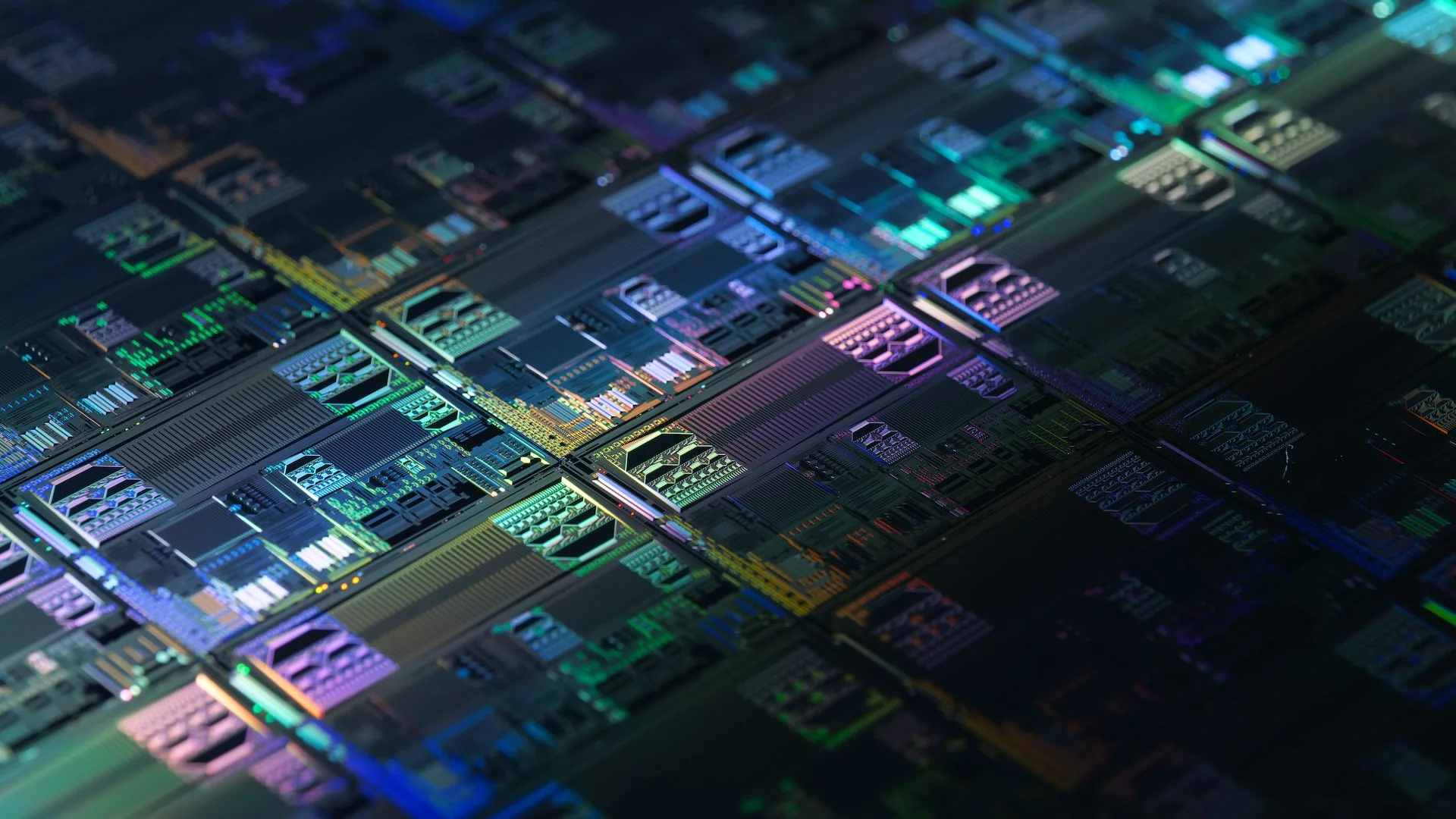
The PsiQuantum platform’s core comprises integrated circuits that handle the entire lifecycle of a photonic qubit, creation, manipulation, and detection, within a single chip. These components include monolithically-integrated superconducting single-photon detectors, silicon photonics waveguides, and elements that enable high-fidelity quantum operations.
The latest paper details the manufacturing process, adapted from standard semiconductor processes, to include quantum-specific functionalities like single-photon detection and generation. This integration is vital to overcoming previous challenges in photonic quantum computing, such as high component density and low error rates necessary for fault tolerance.
Of course, we cannot predict the future among all the competing qubit technologies. Ion Traps, Superconducting, Silicon, Superconducting, Neutral Atom, and even Topological are in the mix. Nature, innovation, and Darwinian evolution of the best technology must play out. However, the fact that silicon expertise can be borrowed and adapted from an installed base of what we estimate are millions of people has got to be one vote in the silicon technology camp.
Xanadu is also pioneering photonic quantum computing and has been key in leading the development of using light to generate the quantum states that are manipulated into the computational states needed to perform quantum calculations. Xanadu uses a different approach. It aims at Silicon photonics (SiPh), which manufactures integrated photonics on the CMOS platform.
…basing the computer on quantum states of light is the best and fastest route toward a modular, easy-to-network, room temperature device with millions of qubits.
Xanadu on the benefits of photonic quantum computing
More widely, using silicon photonics could offer enormous benefits. It’s been stated that photonics is the future technology of quantum computing. After all, we all have seen the benefits of manipulating light, you might be using a fiber optic cable to receive these words. Basing a future on light might be another win, as there is vast talent in photonics already, with expertise applied to getting light to do some amazing things. So, already, there are the ingredients that might make the Australian government investment of almost a billion dollars plausible punt.

PsiQuantum Stats
Already rocking over 280 employees, the company has become one of the largest pure-play quantum computing companies. Sporting a multi-billion dollar valuation already (pre-money) of $3.2 billion, it is one of the titans of the QC world. Rigetti has a market cap of 202.47M USD, IonQ of 1.81B USD, and a D-Wave value of 221.49M USD. Recently floated Zapata AI has a market cap of 40.24M USD. Therefore, IonQ is a peer in terms of valuation.
The rest are an order of magnitude or two lower in market cap. We suspect PsiQuantum’s valuation isn’t much different from the internal efforts of quantum teams at Google and IBM. Of course, such information is private and not available. Still, we think Google and IBM will each have spent multiple billions in developing their quantum computing stack, including developing languages such as Qiskit and Cirq.
So what do you get for that 3+ billion dollar market cap with PsiQuantum? Aside from the hundreds of staff, there are over 400 patents. People-wise, the founding team comprises some of the most accomplished quantum researchers, including its founder, Jeremey O’Brien, Dr. Pete Shadbolt, Prof. Terry Rudolph, and Prof. Mark Thompson. But that is not the end of the lineup.
PsiQuantum was co-founded by a distinguished team led by Prof. Jeremy O’Brien, who serves as CEO. Prof. O’Brien brings an extensive quantum physics and engineering background, with over two decades of experience and significant contributions to the field, including the development of Integrated Quantum Photonics and the invention of the Variational Quantum Eigen Solver (VQE).
His academic tenure includes roles at prestigious institutions such as Stanford and Bristol Universities, and he has published widely, enhancing his reputation within the scientific community.
Alongside Prof. O’Brien, Dr. Pete Shadbolt holds the position of Chief Scientific Officer, bringing expertise, particularly in photonic quantum computing. He achieved early breakthroughs during his PhD at the University of Bristol. Prof. Terry Rudolph, another key co-founder and native Aussie, serves as Chief Architect, having developed the foundational theoretical approach to photonic quantum computing that underpins PsiQuantum’s technology.
Prof. Mark Thompson, the Chief Technologist, complements the team with his rich photonic and quantum technologies history, bridging academic prowess with practical industry applications.
The investment might seem eye-watering, but the more you look into what you’re getting, the more you see that the mission and scope are also eye-watering. If PsiQuantum manages to create “useful” quantum computers with many qubits, they will revolutionize many sectors and humanity. Possible applications and ramifications include everything from cracking encryption to fast, but specific algorithms in all applications once scale-up has been conquered (along with error correction).
The investment, while significant, might seem less like a crazy punt and more like investing $100k into Google when it was Sergey and Larry’s pet project (Backrub) at Stanford University. That would make anyone look like an investing genius. Has the Australian government twigged that the way to fight against Silicon Valley is to get in there and fund it themselves?
See today’s quantum computing news on Quantum Zeitgeist for the latest breakthroughs in qubits, hardware, algorithms, and industry deals.