Topological subsystem codes, a type of quantum error correction (QEC) codes, are crucial for reliable quantum data storage and processing. Researchers Jacob C Bridgeman, Aleksander Kubica, and Michael Vasmer have introduced a new class of QEC codes, subsystem Abelian quantum double (SAQD) codes, which offer a different approach to constructing and understanding topological subsystem codes. The team also explored the performance of these codes against phenomenological noise, finding memory thresholds around 1%. However, they suggest these models may not self-correct quantum memory, a challenge for future research.
What are Topological Subsystem Codes, and Why Are They Important?
Topological subsystem codes are a class of quantum error correction (QEC) codes that are crucial for the reliable storage and processing of quantum information. Quantum information is susceptible to noise, which can lead to errors and loss of data. To protect against this, QEC codes are used to detect and correct errors. Topological subsystem codes are particularly appealing because they can be realized by arranging qubits on a lattice and measuring geometrically local parity checks.
The most prominent examples of topological codes include the toric code and color code, which can be implemented in two spatial dimensions with currently pursued quantum hardware such as superconducting circuits or Rydberg atoms. However, the process of performing reliable QEC becomes more intricate and resource-intensive in the presence of unavoidable measurement errors.
To tackle this challenge, researchers have introduced unorthodox topological codes such as the three-dimensional subsystem toric code and gauge color code that allow for single-shot QEC. This property asserts that even in the presence of measurement errors, one can perform reliable QEC with a topological code by only performing a constant number of measurement rounds of geometrically local operators.
How are Topological Subsystem Codes Constructed?
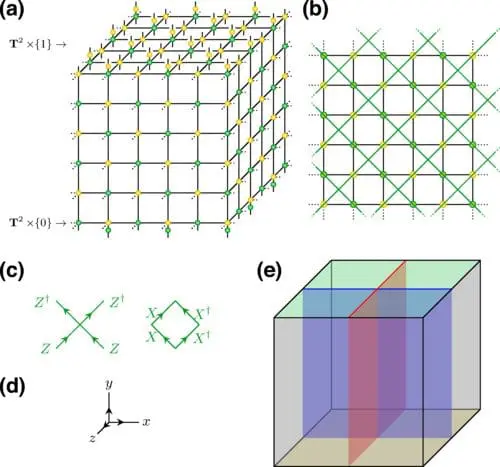
In a recent study, researchers Jacob C Bridgeman, Aleksander Kubica, and Michael Vasmer have provided a systematic construction of a novel class of QEC codes referred to as subsystem Abelian quantum double (SAQD) codes. This class can be viewed as a generalization of the subsystem toric code and is also closely related to the gauge color code.
Their construction allows for any Abelian quantum double model that is natively defined in two spatial dimensions to realize a corresponding topological subsystem code in three spatial dimensions. This new perspective on topological subsystem codes offers a radically different approach to their construction and understanding.
What is the Performance of Topological Subsystem Codes?
The researchers also investigated topological subsystem codes from the perspective of reliable quantum memories capable of single-shot QEC. They described computationally efficient decoding algorithms and benchmarked their performance against phenomenological noise.
The results showed memory thresholds around 1%, which are competitive with that of the surface code, given the advantage of single-shot QEC. However, the researchers argue that the Hamiltonians that naturally arise from topological subsystem codes are probably at a phase transition, indicating that these models will not serve as a self-correcting quantum memory.
What are the Implications of this Research?
This research provides a new perspective on the construction and understanding of topological subsystem codes. The systematic construction of SAQD codes not only generalizes the recently introduced subsystem toric code but also provides a new perspective on several aspects of the original model.
The study also provides insights into the performance of topological subsystem codes against phenomenological noise, which is crucial for their application in quantum computing. However, the indication that these models will not serve as a self-correcting quantum memory poses a challenge that needs to be addressed in future research.
What are the Future Directions for this Research?
The research by Bridgeman, Kubica, and Vasmer opens up new avenues for the study of topological subsystem codes. Their systematic construction of SAQD codes provides a foundation for further exploration and development of these codes.
Future research could focus on improving the performance of topological subsystem codes against phenomenological noise and exploring ways to make these models serve as self-correcting quantum memories. This study’s findings also highlight the need for further research into the physical origins of the single-shot QEC property, which remains elusive.
Publication details: “Lifting Topological Codes: Three-Dimensional Subsystem Codes from Two-Dimensional Anyon Models”
Publication Date: 2024-04-12
Authors: Jacob C. Bridgeman, Aleksander Kubica and Michael Vasmer
Source: PRX Quantum 5, 020310
DOI: https://doi.org/10.1103/PRXQuantum.5.020310