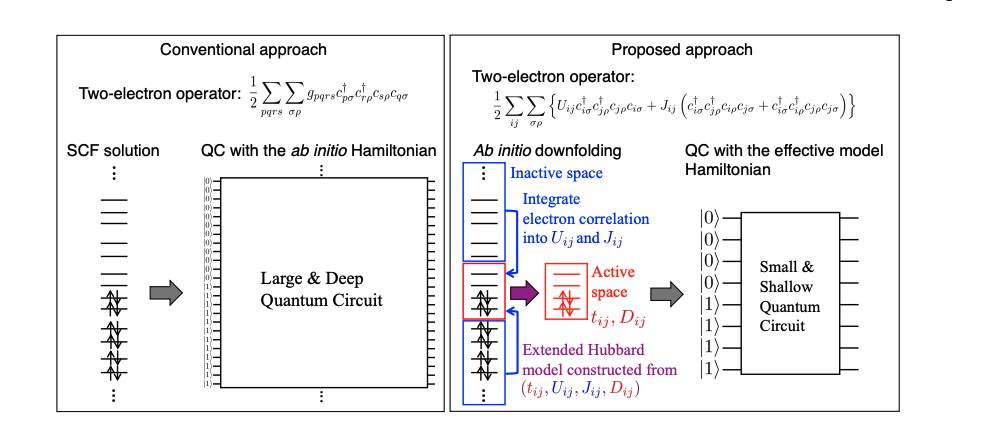
Researchers from Osaka University and RIKEN have proposed the Extended Hubbard Hamiltonian, a method derived via the ab initio downfolding method, to improve the efficiency of quantum computing for molecular electronic structure calculations.
The method reduces the complexity of the electron-electron interaction operators, making quantum computing more scalable. The approach has been validated on the vertical excitation energies and excitation characters of ethylene, butadiene, and hexatriene. The researchers believe this method could significantly enhance quantum chemical calculations, with potential applications in drug discovery and materials research.
What is the Extended Hubbard Hamiltonian and How Can it Improve Quantum Computing?
The Extended Hubbard Hamiltonian is a method proposed by researchers Yuichiro Yoshida, Nayuta Takemori, and Wataru Mizukami from the Center for Quantum Information and Quantum Biology at Osaka University, the Center for Emergent Matter Science at RIKEN, and the Graduate School of Engineering Science at Osaka University. This method, derived via the ab initio downfolding method, was originally formulated for periodic materials and is now being applied towards efficient quantum computing of molecular electronic structure calculations.
The ab initio downfolding method allows the first-principles Hamiltonian of chemical systems to be coarse-grained by eliminating the electronic degrees of freedom in higher energy space and reducing the number of terms of electron repulsion integral from ON^4 to ON^2. This approach has been validated numerically on the vertical excitation energies and excitation characters of ethylene, butadiene, and hexatriene. The dynamical electron correlation is incorporated within the framework of the constrained random phase approximation in advance of quantum computations. The constructed models capture the trend of experimental and high-level quantum chemical calculation results.
The L1-norm of the fermion-to-qubit mapped model Hamiltonians is significantly lower than that of conventional ab initio Hamiltonians, suggesting improved scalability of quantum computing. The numerical outcomes and the results of the simulation of excited-state sampling demonstrate that the ab initio extended Hubbard Hamiltonian may hold significant potential for quantum chemical calculations using quantum computers.
How Can Quantum Computers Solve Electronic Structure Problems?
Quantum computers are expected to solve electronic structure problems of chemistry that are potentially valuable to humanity and beyond the reach of classical computers. Quantum phase estimation is a well-known algorithm that uses a quantum computer to estimate the eigenvalues of the chemistry Hamiltonians. Through estimating the quantum computational cost of the phase estimation algorithms, the potential applications of fault-tolerant quantum computers have been explored to address global challenges in chemistry such as nitrogen fixation, carbon dioxide reduction catalysis, materials research for batteries, and drug discovery.
One of the traditional and most attractive themes in quantum chemistry is the computation of electronic excited states. The evaluation of excited states is still challenging for classical computation partly because these states are often described by a linear combination of a larger number of Slater determinants in contrast to the ground state, which is often well-described by a single Slater determinant. This highlights the suitability of quantum computational approaches leveraging the superposition nature of a quantum state. Various quantum algorithms have recently been proposed for evaluating excited states of molecules.
In principle, quantitative quantum chemical calculations on a quantum computer require a large number of quantum bits (qubits). The increase in the number of qubits is directly related to the increase in the number of molecular orbitals in Jordan-Wigner (JW) mapping, a typical fermion-to-qubit mapping. The use of many orbitals can provide a quantitative description of the electron correlation, especially the dynamical electron correlation, but more qubits require more quantum computational cost.
What are the Challenges and Solutions in Implementing Quantum Gates?
The complexity of the molecular electronic structure Hamiltonian, elaborately modeled using many orbitals, triggers the fatal problem of the required number of quantum gates to implement it becoming exceedingly large. The second-quantized electronic structure Hamiltonian of a chemical system has an ON^4 electron repulsion integral tensor, where N is the number of spin orbitals. It induces a single Trotter step of the time-evolution operator to become ON^4 circuit depth with the naive implementation. Such an inherent complexity poses challenges for fault-tolerant quantum computations as well as quantum simulations using near-term quantum devices.
To reduce the non-Clifford gate counts, the Coulomb operator of electronic structure Hamiltonians is factorized or sparsified. Simplification of electronic structure Hamiltonians in chemistry is crucial to avoid the excessively complicated quantum circuit operations. A prospective way to save the number of qubits is to construct an effective Hamiltonian of the active space consisting of chemically essential orbitals prior to quantum computation.
Such approaches to effectively reducing the number of electronic degrees of freedom are known as downfolding approaches and several downfolding methods for quantum computation have been proposed recently. Downfolding approaches are very powerful because they incorporate the dynamical electron correlation related to the huge exterior space into the effective Hamiltonian in a relatively small active space.
How Can the Ab Initio Downfolding Method Improve Quantum Computing?
The ab initio downfolding method was developed to make a low-energy model for periodic materials. This method can parameterize an extended Hubbard model by incorporating the contributions from the higher energy degrees of freedom into the electronic interactions of the lower energy degrees of freedom near the Fermi level based on constrained random phase approximation (cRPA).
The ab initio downfolding approach has been widely applied to strongly correlated electronic phenomena in materials such as superconductivity. However, the ON^4 complexity of ab initio electronic Hamiltonians still remains in the previous studies. Considering those above, it is desired to construct an effective subspace model that possesses sufficient capability for discussing the electronic properties of molecules while reducing the complexity of the electron-electron interaction operators.
The researchers propose introducing an extended Hubbard Hamiltonian derived via the ab initio downfolding method towards efficient quantum computing of molecular electronic structure calculations. By utilizing this method, the first-principles Hamiltonian of chemical systems can be coarse-grained by eliminating the electronic degrees of freedom in higher energy space and reducing the number of terms of electron repulsion integral from ON^4 to ON^2. This approach is validated numerically on the vertical excitation energies and excitation characters of ethylene, butadiene, and hexatriene. The dynamical electron correlation is incorporated within the framework of the constrained random phase approximation in advance of quantum computations. The constructed models capture the trend of experimental and high-level quantum chemical calculation results.
What is the Potential of the Extended Hubbard Hamiltonian for Quantum Chemical Calculations?
The L1-norm of the fermion-to-qubit mapped model Hamiltonians is significantly lower than that of conventional ab initio Hamiltonians, suggesting improved scalability of quantum computing. The numerical outcomes and the results of the simulation of excited-state sampling demonstrate that the ab initio extended Hubbard Hamiltonian may hold significant potential for quantum chemical calculations using quantum computers.
The researchers’ work suggests that the extended Hubbard Hamiltonian could be a powerful tool for quantum chemical calculations. By reducing the complexity of the electron-electron interaction operators, the method could make quantum computing more efficient and scalable. This could have significant implications for a range of applications, from drug discovery to materials research.
In conclusion, the extended Hubbard Hamiltonian represents a promising approach to improving the efficiency and scalability of quantum computing. By reducing the complexity of the electron-electron interaction operators, this method could make quantum chemical calculations more efficient and scalable, opening up new possibilities for quantum computing in chemistry and beyond.
Publication details: “Ab initio extended Hubbard model of short polyenes for efficient quantum
computing”
Publication Date: 2024-04-02
Authors: Yuichiro Yoshida, Nayuta Takemori and Wataru Mizukami
Source: arXiv (Cornell University)
DOI: https://doi.org/10.48550/arxiv.2404.01623



See today’s quantum computing news on Quantum Zeitgeist for the latest breakthroughs in qubits, hardware, algorithms, and industry deals.