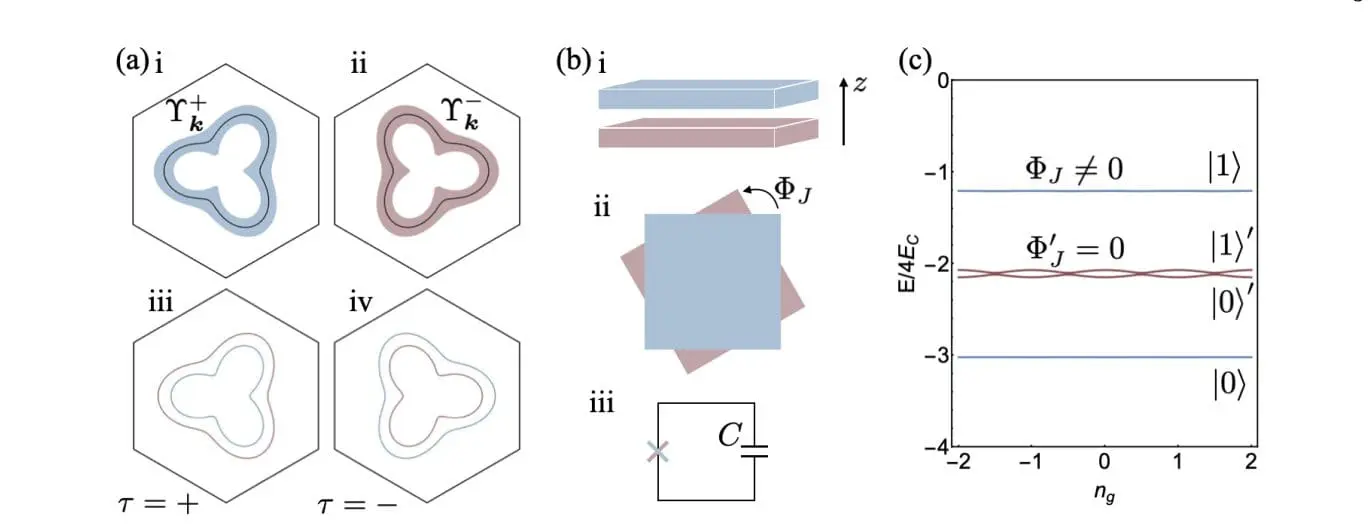
Researchers from the School of Engineering and Sciences Tecnológico de Monterrey and the School of Mathematical and Physical Sciences at the University of Technology Sydney have proposed a new design for superconducting transmon qubits. The design uses a c-axis junction comprising triplet superconductors set at a relative twist angle, allowing for direct control of the single and double Cooper pair tunneling strength and an anomalous magnetic flux. This design could potentially reduce errors in superconducting qubits, a critical bottleneck in advancing superconducting quantum computers. The design is highly tunable within a single junction and requires no magnetic field.
What is the New Development in Superconducting Transmon Qubits?
Superconducting transmon qubits are highly sought after for their strong anharmonicity and insensitivity to offset charge, making them ideal for low-error implementation. In a recent study, Sebastián DomínguezCalderón from the School of Engineering and Sciences Tecnológico de Monterrey, and Harley Scammell from the School of Mathematical and Physical Sciences University of Technology Sydney, propose a new design for these qubits. Their design involves a c-axis junction comprising triplet superconductors set at a relative twist angle. This junction allows for direct control of the single and double Cooper pair tunneling strength and, most notably, an anomalous magnetic flux.
The researchers’ design offers a novel zero-field functionality, as the anomalous flux is determined by the twist angle of the junction. This design is based on symmetry arguments and is demonstrated using a model of moiré graphene-based c-axis junctions. The researchers’ key innovation is the use of triplet superconductivity in the presence of spin-orbit coupling (SOC) and intrinsic magnetization. They consider a junction of spin-triplet superconductors with vectors at some nonzero angle relative to each other on either side of the junction. Due to SOC, the twist angle of the junction determines the angle of the vectors. This angle then acts via a nonlinear relationship as an anomalous magnetic flux.
Why is this Development Significant?
Superconducting quantum computers have shown significant improvements and have demonstrated dramatic speedup compared to their classical counterparts. However, a critical bottleneck in their advancement is errors. As the number of qubits increases, so does the number of error sources. Therefore, it is crucial to reduce errors in superconducting qubits, making this a primary avenue of research.
The researchers’ design offers a solution to this problem. Their design allows for optimal design of the transmon qubit, with control over three parameters: single and double pair tunneling and anomalous flux. This design is highly tunable within a single junction and does not require a magnetic field. The researchers’ construction achieves this desirable qubit architecture using all-electrical control, zero magnetic field, and within a single junction.
How Does the Design Work?
The researchers’ design involves a junction of spin-triplet superconductors with vectors at some nonzero angle relative to each other on either side of the junction. Due to spin-orbit coupling (SOC), the twist angle of the junction determines the angle of the vectors. This angle then acts via a nonlinear relationship as an anomalous magnetic flux. This is the researchers’ key finding.
The researchers chose to model the key features of moiré graphene for several reasons. They required triplet superconductivity but without nodes in the order parameter, as nodes introduce decoherence. They also required a valley system that can host superconductivity and, moreover, triplet superconductivity. They needed a superconducting valley system that can simultaneously host magnetic order. Finally, they required a system into which SOC can be induced. These criteria naturally directed them to moiré graphene.
What is the Role of Moiré Graphene in the Design?
Moiré graphene was chosen for the model because it met all the criteria required by the researchers. It can host triplet superconductivity without nodes in the order parameter, it can host a valley system that can host superconductivity and triplet superconductivity, it can simultaneously host magnetic order, and SOC can be induced into it.
The researchers also noted that SOC can be proximity-induced into moiré graphene via a transition metal dichalcogenide (TMD) substrate. The form of the induced SOC can be readily tuned based on the relative twist angle graphene and TMD layers.
What are the Implications of this Development?
This development in the design of superconducting transmon qubits has significant implications for the advancement of quantum computers. The researchers’ design offers a solution to the critical bottleneck in the advancement of superconducting quantum computers: errors. Their design allows for optimal design of the transmon qubit, with control over three parameters: single and double pair tunneling and anomalous flux.
This design is highly tunable within a single junction and does not require a magnetic field. The researchers’ construction achieves this desirable qubit architecture using all-electrical control, zero magnetic field, and within a single junction. This could potentially lead to the development of more efficient and error-free quantum computers.
triplet-superconducting transmon qubit”
Publication Date: 2024-03-11
Authors: Sebastián Domínguez-Calderón and Harley D. Scammell
Source: arXiv (Cornell University)
DOI: https://doi.org/10.48550/arxiv.2403.07215
See today’s quantum computing news on Quantum Zeitgeist for the latest breakthroughs in qubits, hardware, algorithms, and industry deals.