Researchers Biswajit Basu, Saravanan Gurusamy, and Frank Gaitan have developed a quantum computing algorithm to solve the partial differential equation (PDE) for tephra dispersal during submarine volcanic eruptions. The algorithm provides crucial information about the rate of volcanic energy release, the formation of hydrothermal megaplumes, and submarine depositional patterns. The research also transforms the semi-infinite spatial domain problem into a finite one, making it easier to apply the quantum algorithm. This work contributes to the emerging field of using quantum algorithms to solve classical PDEs, and could be applied to other advection-diffusion problems.
What is the Quantum Algorithm for Computing Dispersal of Submarine Volcanic Tephra?
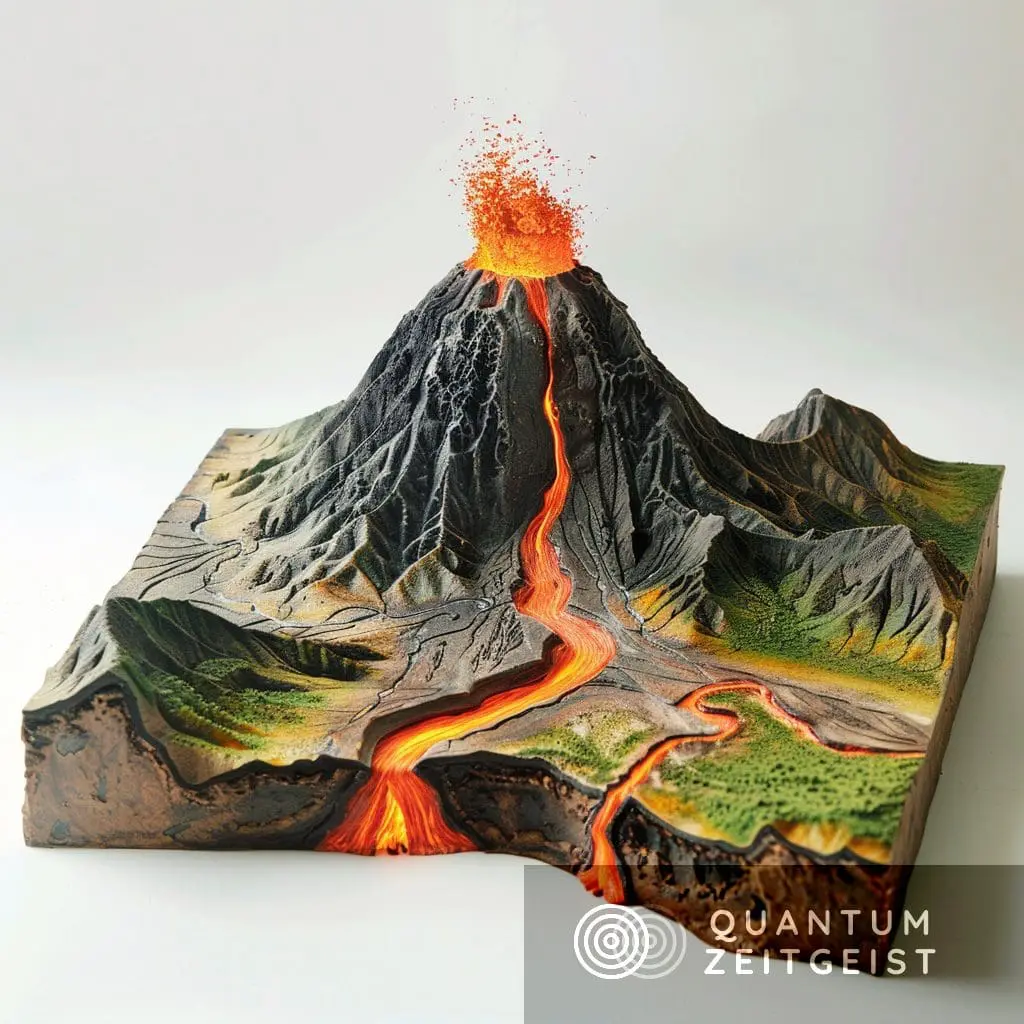
In a recent research article, Biswajit Basu, Saravanan Gurusamy, and Frank Gaitan have developed a quantum computing algorithm to solve the partial differential equation (PDE) for tephra dispersal through advection in the semi-infinite horizontal buoyant region of a submarine volcanic eruption. The concentration of pyroclastic particles in the fluid domain of a hydrothermal megaplume provides crucial information about the rate of volcanic energy release, the mechanism of formation of the megaplume, and submarine depositional patterns.
This work builds on previous research by Gaitan and others, and it opens up opportunities to solve wider classes of PDEs with different applications of interest. Some additional specific contributions of this work include transforming the semi-infinite spatial domain problem into a problem on a finite spatial domain for applying the quantum algorithm. The researchers also investigated the effect of spatial and temporal resolution on the solution of PDEs for the quantum algorithm.
How Does the Quantum Algorithm Work?
The quantum algorithm developed by the researchers has the potential to solve complex problems that are difficult to solve using classical algorithms and computers. One such problem is the solution of the PDEs representing viscous fluid flow governed by the Navier-Stokes equations. These equations universally represent scenarios ranging from turbulence in aerospace design through magnetohydrodynamics in plasma physics.
The researchers have used the quantum algorithm to solve for the flow of tephra discharged during deep-sea marine volcanic eruptions. This is an interesting problem of relevance as there are examples of deeper volcanic eruptions such as the relatively recent eruptions of the Axial Seamount off the Oregon coast of the USA resulting in submarine horizontal tephra flow formations.
What are the Implications of the Quantum Algorithm?
The quantum algorithm for solving the advection equation in this paper is of relevance and can be applied to other important problems recently studied by the researchers. The applications of quantum algorithms for solving classical problems such as those described by PDEs are still at its stage of infancy with research ongoing in the field.
The research in this paper contributes to the new and almost unexplored field of developing quantum algorithms for solving classical PDEs by developing quantum algorithms to solve yet another important problem of advection of particles in a semi-infinite fluid medium. Some insights into the complexity of the quantum algorithms are provided. The impact of initial and boundary conditions and regularity of the functions in space and time, including noisy data on the nontrivial solutions sought, are also reported, further advancing the knowledge in the field.
What is the Formulation Framework for Quantum Computation?
For modeling the important problem of transport of particles in a fluid medium, the advection equation is widely used. The problem of solving the tephra transport within the neutrally buoyant component of a hydrothermal plume, i.e., the umbrella, is a significant challenge that the researchers have addressed using the quantum algorithm.
The researchers have transformed the semi-infinite spatial domain problem into a problem on a finite spatial domain for applying the quantum algorithm. They have also investigated the effect of spatial and temporal resolution on the solution of PDEs for the quantum algorithm. Furthermore, possible modification of the algorithm with different spatial discretization schemes has been presented, and their influence and implications on the solution of the PDE have been discussed.
What are the Future Prospects of the Quantum Algorithm?
The study in this paper paves an important pathway to venture into other types of advection-diffusion problems. The quantum algorithm for solving the advection equation in this paper is of relevance and can be applied to other important problems recently studied by the researchers.
The applications of quantum algorithms for solving classical problems such as those described by PDEs are still at its stage of infancy with research ongoing in the field. However, the research in this paper contributes to the new and almost unexplored field of developing quantum algorithms for solving classical PDEs, further advancing the knowledge in the field.
Publication Date: 2024-03-01
Authors: Biswajit Basu, Saravanan Gurusamy and Frank Gaitan
Source: Physics of Fluids
DOI: https://doi.org/10.1063/5.0189674