Machine learning, a subset of artificial intelligence, is revolutionizing the study of quantum many-body systems. The use of neural networks, known as neural quantum states (NQS), allows for the approximation of many-body wave functions, providing a compact and accurate representation of complex functions. Despite optimization challenges, NQS have shown potential in describing many-body problems, simulating quantum circuits, and performing quantum state tomography tasks. The future of machine learning in quantum physics is promising, with ongoing research expected to yield further advancements in the study of quantum many-body systems.
What is the Role of Machine Learning in Quantum Physics?
Machine learning, a subset of artificial intelligence, has been making significant strides in various fields, including quantum physics. The intersection of machine learning and quantum physics has led to the development of new tools and algorithms that have revolutionized the study of quantum many-body systems. This is due to the similarities between the two fields, such as the application of linear algebra in large vector spaces, probability and statistics, and challenging optimization tasks.
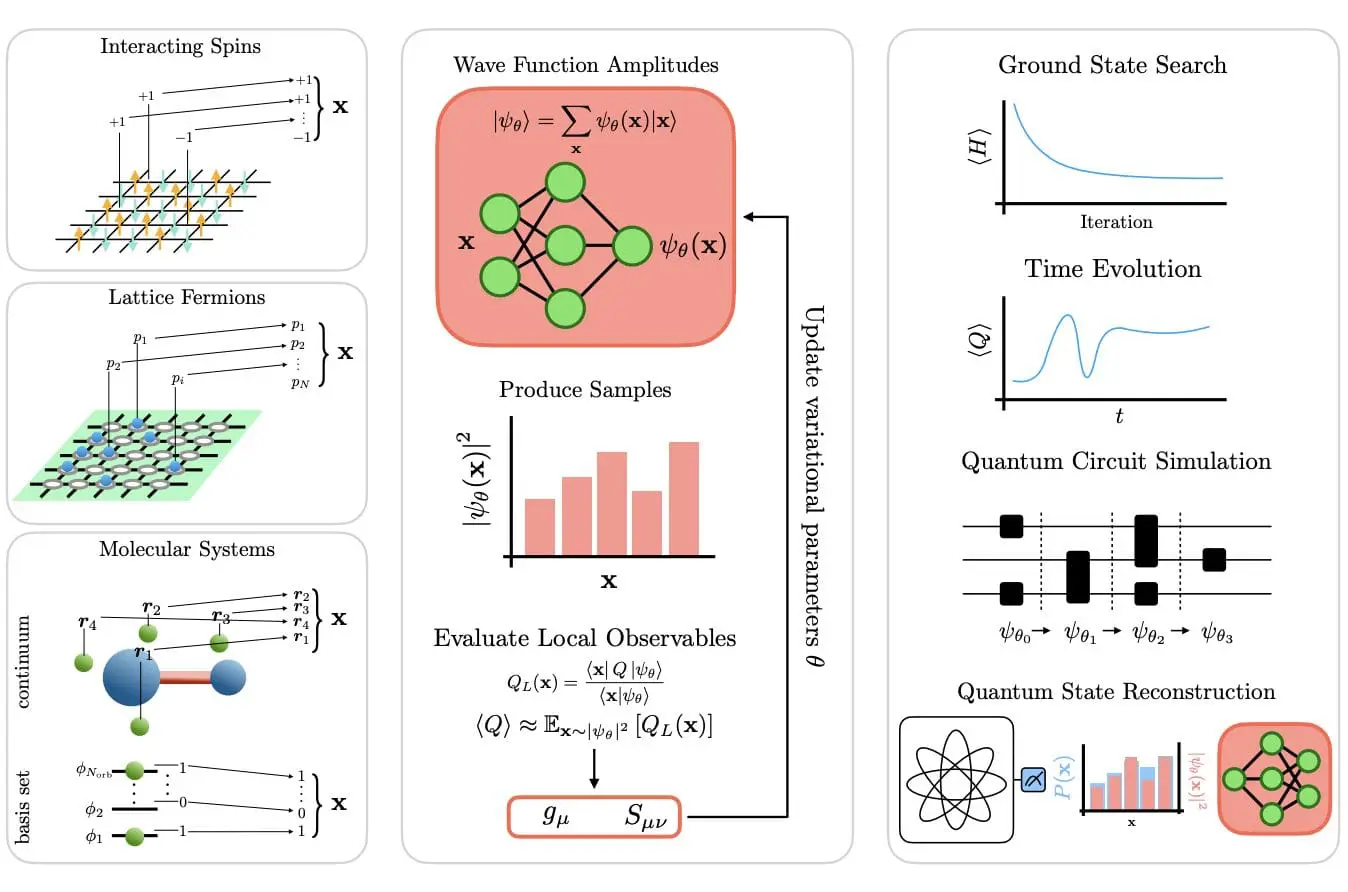
The application of machine learning techniques to quantum physics has resulted in improved accuracy and efficiency of numerical many-body methods. This is achieved by approximating many-body wave functions using neural networks, a process that has shown great promise in the field. These neural networks, referred to as neural quantum states (NQS), provide a compact and accurate representation of the exponentially-scaling components of the many-body state.
The large expressive power of neural networks allows for the accurate representation of complex functions. It has been empirically and theoretically demonstrated that neural networks can approximate relevant quantum states whose entanglement entropy scales with the number of degrees of freedom of the problem. This is a significant advancement, as traditional variational states like the matrix product state (MPS) are not capable of efficiently describing highly-entangled states.
How are Neural Networks Optimized in Quantum Physics?
The approximation of quantum states by neural networks relies on the gradient-based optimization of the weights and biases. This process requires the use of Monte Carlo stochastic techniques for the estimation of expectation values, overlaps, and gradients. This optimization presents the greatest challenges for NQS compared to other many-body methods like the density matrix renormalization group (DMRG) used to optimize the parameters of a MPS.
Despite these challenges, NQS have demonstrated enormous potential in the description of challenging many-body problems, including systems of interacting spins and systems of interacting fermions. These techniques have also demonstrated outstanding levels of accuracy in the description of the time evolution of many-body systems, the simulation of quantum circuits, and quantum state tomography tasks.
What are the Applications of Neural Networks in Quantum Physics?
The application of neural networks in quantum physics is vast and varied. One of the main applications is in the study of the ground state properties of systems of interacting spins and systems of interacting fermions. This involves the unitary transformation of many-body wave functions to describe the time evolution of many-body systems and to simulate quantum circuits.
Another significant application of NQS is in the problem of quantum state tomography. This is a process of determining the quantum state of a system based on measured data. The use of NQS in quantum state tomography has shown promising results, demonstrating the potential of machine learning techniques in advancing our understanding of quantum physics.
What is the Future of Machine Learning in Quantum Physics?
The future of machine learning in quantum physics looks promising. The continued development and refinement of machine learning techniques, particularly neural networks, will likely lead to further advancements in the study of quantum many-body systems.
Despite the challenges associated with the optimization of neural networks in quantum physics, ongoing research in this field is expected to yield solutions that will improve the accuracy and efficiency of these techniques. This will further enhance the potential of machine learning in quantum physics, opening up new avenues for exploration and discovery.
Conclusion
The intersection of machine learning and quantum physics has led to significant advancements in the study of quantum many-body systems. The use of neural networks in approximating many-body wave functions has shown great promise, despite the challenges associated with their optimization. The application of these techniques in the study of the ground state properties of systems of interacting spins and fermions, as well as in quantum state tomography, has demonstrated their potential in advancing our understanding of quantum physics. The future of machine learning in quantum physics looks promising, with ongoing research expected to yield further advancements in this field.
Publication Date: 2024-02-16
Authors: Matija Medvidović and Javier Robledo Moreno
Source: arXiv (Cornell University)
DOI: https://doi.org/10.48550/arxiv.2402.11014