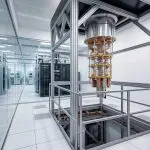
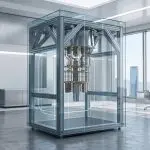
The Fraunhofer Institute of Integrated Circuits IIS Division Development Center X-ray Technology in Germany is exploring using quantum computing devices to optimize computed tomography data acquisition strategies. The team found that quantum annealing technology is particularly promising for real-life applications due to its quality of results and scalability. Quantum computing, with its unique computational benefits over classical hardware, offers a promising solution for solving optimization problems in computed tomography, contributing to trajectory optimization for data acquisition.
Quantum Computing and Computed Tomography: An Exploration
The Fraunhofer Institute of Integrated Circuits IIS Division Development Center X-ray Technology in Fürth, Germany, has been exploring the application of different quantum computing devices for deriving an optimal computed tomography data acquisition strategy. The team, led by Theobald OJ Fuchs, includes Dimitri Prjamkov, Kilian Dremel, Thomas Lang, Simon Semmler, Mareike Weule, Markus Firsching, and Stefan Kasperl.
Quantum Computing: An Emerging Technology
Quantum computing is an emerging technology with unique advantages in both theoretical and practical considerations. It describes the practical implementation of quantum mechanics and the controlled interaction with such systems. Its theoretical background is known to express unique properties and computational benefits far beyond the capabilities of conventional hardware. The smallest computational unit within quantum computing is the qubit, representing any convex combination of selected basis states funded in the superposition principle. This allows for simultaneously performing computations on all basis states, offering a unique computational benefit over classical hardware.
Quantum Computing Devices: General Purpose and Optimization Devices
Currently, two major quantum computing devices are operational: general-purpose devices and devices dedicated to solving optimization problems. General-purpose devices feature a complete set of operations allowing the implementation of any implementable quantum algorithm. These operations are implemented as quantum gates, the quantum computing analog to classical gates. On the other hand, quantum devices dedicated to a specific domain are quantum annealers, which gradually evolve a given initial configuration towards the ground state of a Hamiltonian encoding the optimization problem.
Quantum Computing and Computed Tomography: A Promising Combination
The team at the Fraunhofer Institute found that while solving the problem for a limited dataset size is possible on either device, the quantum annealing technology seems most promising for real-life applications both in terms of the quality of the results and considering scaling issues. They used several examples to demonstrate the use of quantum computers in the planning and optimization of data acquisition in computed tomography.
Trajectory Optimization in Computed Tomography
Determining an optimal data acquisition in computed tomography (CT) is an ongoing field of research. The goal is to select a subset of X-ray images (projections) from the overall possible set of projections, which contributes the most information to the three-dimensional digital reconstruction of the object. The team modeled the selection of projection subsets as an optimization problem and solved it on classical and quantum devices.
Quantum Computing: A Solution for Optimization Problems
Quantum computing promises a computational improvement for solving optimization problems in computed tomography. The team at the Fraunhofer Institute compared the results obtained from quantum devices to the classical approach and found that quantum computing offers a promising solution for real-life applications.
Conclusion
The exploration of quantum computing devices for deriving an optimal computed tomography data acquisition strategy by the team at the Fraunhofer Institute contributes to the field of trajectory optimization for data acquisition in computed tomography. The results show that quantum annealing technology seems most promising for real-life applications, offering a unique computational benefit over classical hardware.
Comparison of Different Quantum Computing Devices for Optimization of Computed Tomography Data Acquisition is a research article authored by Dimitri Prjamkov, Kilian Dremel, Thomas Lang, Simon Semmler, Mareike Weule, Markus Firsching, Stefan Kasperl, and Theobald Fuchs. The article was published on March 1, 2024, in the e-Journal of Nondestructive Testing. The research focuses on the optimization of computed tomography data acquisition using different quantum computing devices. The full article can be accessed through its DOI: https://doi.org/10.58286/29236.
See today’s quantum computing news on Quantum Zeitgeist for the latest breakthroughs in qubits, hardware, algorithms, and industry deals.