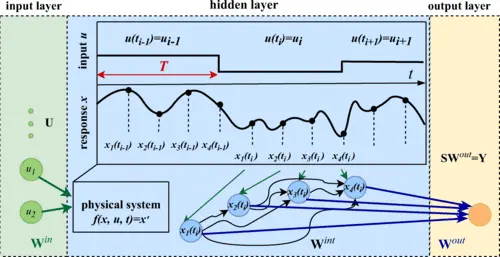
Quantum reservoir computing, a computational approach that uses small quantum systems to solve complex tasks, faces challenges such as the collapse of the quantum system when measurements are made, erasing the memory of the reservoir.
Researchers from Technische Universität Ilmenau Institute of Physics and IQST Ulm University have proposed a solution to enhance performance and reduce computational cost by artificially restricting the memory of the quantum reservoir. This approach reduces the number of quantum operations needed for time series prediction tasks and provides a way to tune the nonlinearity of the reservoir’s response.
Quantum Reservoir Computing: Enhancing Performance and Reducing Time Complexity
Introduction to Quantum Reservoir Computing
Quantum reservoir computing is a computational approach that leverages the complexity and high dimensionality of small quantum systems, along with the fast trainability of reservoir computing, to solve complex tasks. This field of quantum computation promises a significant computational speedup over classical computation for certain sets of problems, including machine learning. However, the practical application of quantum reservoir computing is currently hindered by several limitations, including the collapse of the quantum system when measurements are made, which erases the memory of the reservoir.
The Time Complexity Problem in Quantum Reservoir Computing
One of the major challenges in quantum reservoir computing is the time complexity problem. This arises because for every output, the entire input signal is needed to reinitialize the reservoir, leading to quadratic time complexity. This is due to the fact that with each measurement, the quantum system state collapses and all information about the input signal is lost. Therefore, for each time step of the output, the entire signal up to that point is needed to reinitialize the reservoir.
Proposed Solution: Artificial Memory Restriction
A team of researchers from Technische Universität Ilmenau Institute of Physics and Institute for Complex Quantum Systems and IQST Ulm University have proposed a scheme to enhance the performance and reduce the computational cost of quantum reservoir computing. The proposed solution involves artificially restricting the memory of the quantum reservoir by only using a small number of inputs to reinitialize the reservoir after measurements are performed. This approach not only reduces the number of quantum operations needed to perform time-series prediction tasks but also provides an experimentally accessible means of tuning the nonlinearity of the response of the reservoir.
Impact of Artificial Memory Restriction on Nonlinearity and Time Complexity
The artificial memory restriction strongly influences the nonlinearity of the reservoir response due to the influence of the initial reservoir state. It also substantially reduces the number of quantum operations needed to perform time-series prediction tasks due to the linear rather than quadratic time complexity. The reinitialization length therefore provides an experimental accessible means of tuning the nonlinearity of the response of the reservoir, which can lead to significant task-specific performance improvement.
Numerical Study on Transverse Ising Model and Quantum Processor Model
The researchers conducted a numerical study on the linear and quadratic algorithms for a fully connected transverse Ising model and a quantum processor model. The results showed that the proposed algorithm leads to improved performance for these tasks and addresses the problem of quadratically increasing reinitialization sequences for timeseries tasks. This demonstrates the potential of the proposed scheme in enhancing performance and reducing the computational cost of quantum reservoir computing.
In the article titled “Enhancing the performance of quantum reservoir computing and solving the time-complexity problem by artificial memory restriction”, published on January 16, 2024, authors Saud Čindrak, Brecht Donvil, Kathy Lüdge, and Lina Jaurigue explore the potential of artificial memory restriction in improving the performance of quantum reservoir computing. The paper also addresses the issue of time complexity in quantum computing. The full article can be accessed through its DOI: 10.1103/physrevresearch.6.013051.




See today’s quantum computing news on Quantum Zeitgeist for the latest breakthroughs in qubits, hardware, algorithms, and industry deals.