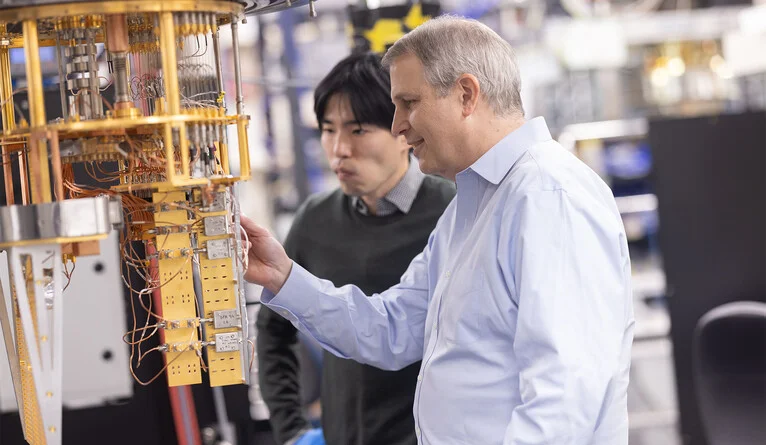
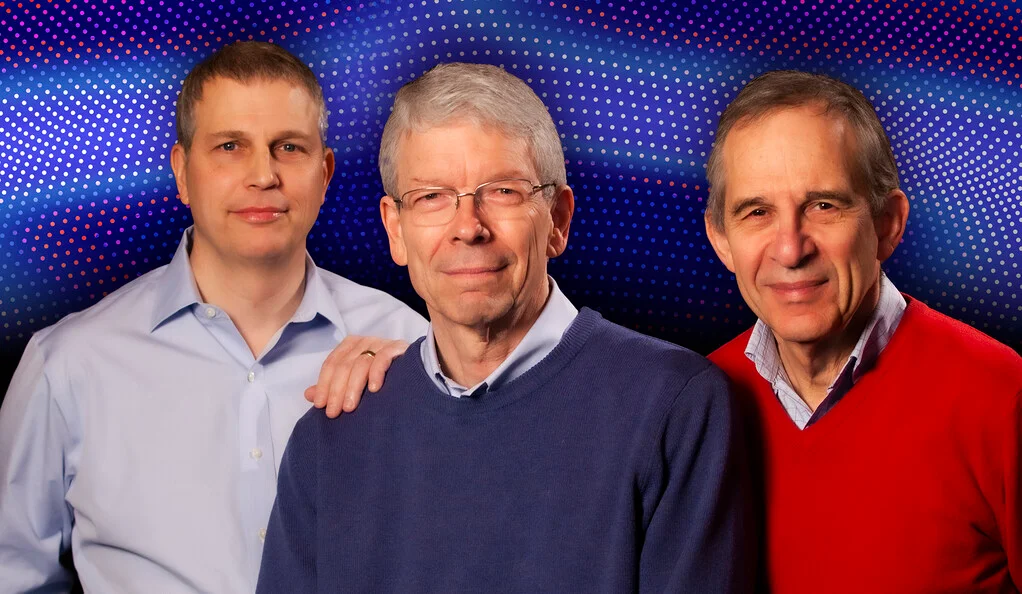
Yale University’s Robert Schoelkopf, Michel Devoret, and Steven Girvin have been pioneering quantum computing research for 20 years. Their work in Circuit QED (quantum electrodynamics) has influenced global research and quantum computing product development. Their approach has led to hundreds of academic papers and citations. The team’s work has also helped Yale become a talent hub for the tech industry, with former students and researchers moving on to roles at IBM, Google, and Silicon Valley start-ups. The trio’s vision was to create a superconducting electrical circuit that utilizes quantum physics features, potentially revolutionizing fields such as medicine, clean energy, and artificial intelligence.
Yale’s Quantum Computing Effort
Yale’s Quantum Computing Journey: Two Decades of Innovation
Yale University’s quest to build a fully functional quantum computer is a story of three physicists – Robert Schoelkopf, Michel Devoret, and Steven Girvin. Their collective efforts have shaped the global approach to quantum computing research. Over the past 20 years, they have built the scientific infrastructure for a new generation of technology, influencing research in labs worldwide and informing the development of quantum computing products.
The Trailblazing Approach: Circuit QED
The trio’s approach to quantum computing, known as Circuit QED (Quantum Electrodynamics), has generated hundreds of academic papers and been cited over 100,000 times. Their work has made Yale a hub for tech industry talent in quantum computing, with many of their students and researchers moving on to positions at IBM, Google, and Silicon Valley start-ups, as well as academic institutions globally.
Their vision was to create the architecture for a superconducting electrical circuit that harnesses quantum physics’ unique features, such as superposition and entanglement. This system could potentially deliver significant advances in medicine, clean energy, chemical engineering, cybersecurity, traffic control, and artificial intelligence.
“We were making the first quantum bits, marrying the world of quantum physics to the world of electrical engineering,”
Devoret
The Pioneers: Schoelkopf, Girvin, and Devoret
Schoelkopf, Girvin, and Devoret have been central to Yale’s Circuit QED research. Schoelkopf, a former radio astronomer at Caltech, joined Yale as a postdoctoral researcher in 1995. Girvin, a theorist studying the Quantum Hall effect, joined Yale in 2000. Devoret, a physicist who had done seminal work on artificial atom design, joined the Yale faculty in 2002.
The birth of Circuit QED came from the combination of Schoelkopf’s expertise in quantum circuits and Devoret’s new microwave technology. Their first peer-reviewed studies began appearing in major journals within two years of Devoret joining Yale.
“Rob and I set up a line of research in which we combined our expertise in quantum circuits and this new microwave technology,” he said. “It was the birth of Circuit QED.”
The Transmon Qubit and Schoelkopf’s Law
One of the team’s early landmark moments was the creation of the transmon qubit in 2007. This superconducting qubit was simple to build and had decreased sensitivity to charge noise, an electrical field that can disrupt qubit performance. Over the years, the lifetime of qubits has increased roughly a million-fold, a progression now sometimes called Schoelkopf’s Law.
Quantum Error Correction
By the early 2010s, Yale’s quantum researchers focused on one of the significant hurdles facing quantum computing – error correction. In 2014, they showed for the first time the ability to track quantum errors as they occur. In 2016, the Yale team created the first error correction system that could fix errors as they happened.
Quantum Gates and Universal Entanglers
By the late 2010s, Yale researchers turned their attention to making their qubits more robust, expanding error correction, and exploring new ways that qubits can perform basic tasks necessary in a computer. In 2018, Yale demonstrated the ability to “teleport” a quantum gate. In 2019, Yale developed a “universal entangler”.
The Future of Quantum Computing at Yale
While these innovations have put Yale at the forefront of quantum computing, the researchers recognize that much work remains before a truly useful quantum computer is ready. The lifespan of a qubit needs to be longer, error correction must be expanded and refined, and every concept and feature Yale has pioneered will benefit from further simplification for practical use.
Yale’s quantum team is actively involved in each of these pursuits. In addition, Yale researchers continue to provide national leadership and help create jobs in quantum technology. In 2019, Yale startup firm Quantum Circuits Inc. opened a facility in New Haven for the development and testing of quantum computing technology. In 2020, Girvin was named director of the Co-design Center for Quantum Advantage, a new national center for quantum research led by Brookhaven National Laboratory.
“Usually in physics, we think of our contributions to society as being indirect,” said Schoelkopf, Sterling Professor of Applied Physics at Yale School of Engineering & Applied Science with a secondary appointment in Physics in Yale’s Faculty of Arts and Sciences, and at age 59, the youngest of the trio. “You might be able to change the lives of your grandchildren. But this work offers a real opportunity to change things within our own lifetime.”
“Within 20 minutes we laid out the whole picture of what we could do together,” Girvin, who is now Yale’s Eugene Higgins Professor of Physics in the Faculty of Arts and Sciences (with a secondary appointment in Applied Physics at SEAS), recalled. “A few months after that, I moved over to Yale and completely switched what I was working on to something I hadn’t even heard of two years earlier.”
“Ninety-nine percent of quantum computing will be correcting errors,” Schoelkopf said at the time. “Demonstrating error correction that actually works is the biggest remaining challenge for building a quantum computer.”
“This is the first error correction to actually detect and correct naturally occurring errors,” Schoelkopf said that summer. “It is just the beginning of using quantum error correction for real computing. Now we need to combine quantum error correction with actual computations.”
“We’ve had a lot of good science over the years, but there are always exciting new ideas just ahead,” Schoelkopf said. “We want to take it the last mile and see the technology succeed in changing people’s lives.”
Summary
Yale University’s quantum computing research team, led by Robert Schoelkopf, Michel Devoret, and Steven Girvin, has been instrumental in shaping the global approach to quantum computing over the past 20 years. Their pioneering work in Circuit QED (quantum electrodynamics) has led to significant advancements in the field, including the creation of a superconducting electrical circuit that utilises quantum physics phenomena, and the development of a quantum error correction system, both of which are crucial for the realisation of a fully functional quantum computer.
- Yale University researchers Robert Schoelkopf, Michel Devoret, and Steven Girvin have been instrumental in the development of quantum computing over the past 20 years.
- Their work has focused on Circuit QED (quantum electrodynamics), a pioneering approach to quantum computing that has influenced research and product development worldwide.
- The team’s vision was to create a superconducting electrical circuit that utilises quantum physics phenomena, such as superposition and entanglement, to revolutionise fields like medicine, clean energy, chemical engineering, cybersecurity, traffic control, and artificial intelligence.
- Their research has led to significant advancements, including the creation of the transmon qubit in 2007, a superconducting qubit that is simple to build and less sensitive to charge noise.
- They have also made strides in quantum error correction, a major challenge in quantum computing, and in 2016, they created the first error correction system that could fix errors as they occurred.
- In 2019, they developed a “universal entangler”, a crucial component for a quantum computer’s computational power.
- Despite these achievements, the researchers acknowledge that much work remains before a fully functional quantum computer is ready.
- Yale’s quantum team continues to lead in the field, with Schoelkopf, Devoret, and Girvin involved in various initiatives, including a startup firm, Quantum Circuits Inc., and a national quantum research centre.