Researchers Pablo Rodriguez-Grasa, Yue Ban, and Mikel Sanz from the University of the Basque Country, TECNALIA, and Universidad Carlos III de Madrid have proposed a method to optimise the use of Embedding Quantum Kernels (EQKs) in quantum computing. EQKs are crucial in machine learning, but choosing the right embedding can be challenging. The team’s method uses a Quantum Neural Network (QNN) based on data re-uploading to identify the optimal EQK for a task. This approach improves efficiency by requiring the construction of the kernel matrix only once. The researchers focused on two cases, demonstrating the potential of their method.
Quantum Kernel Methods and Quantum Neural Networks
A team of researchers, Pablo Rodriguez-Grasa, Yue Ban, and Mikel Sanz, from the Department of Physical Chemistry and EHU Quantum Center at the University of the Basque Country, TECNALIA, Basque Research and Technology Alliance, Departamento de Física at Universidad Carlos III de Madrid, IKERBASQUE, Basque Foundation for Science, and Basque Center for Applied Mathematics, have proposed a method to optimize the use of Embedding Quantum Kernels (EQKs) in Quantum Neural Networks (QNNs).
EQKs, an extension to quantum systems, have shown promising performance in machine learning. However, choosing the right embedding for EQKs is challenging. The researchers address this by proposing a p-qubit QNN based on data re-uploading to identify the optimal q-qubit EQK for a task. This method requires constructing the kernel matrix only once, offering improved efficiency.
Quantum Computing and Machine Learning
Quantum computing is a promising computational paradigm for tackling complex computational problems which are classically intractable. Its potential in enhancing machine learning tasks has garnered significant attention. Although there are evidences of quantum advantage in some tailored problems, advantage over classical counterparts for practical applications remains as an area of active research.
Explicit and Implicit Models in Quantum Machine Learning
In quantum machine learning models, previous studies have delineated a categorization into explicit and implicit models. In explicit models, data undergoes encoding into a quantum state, and then a parametrized measurement is performed. In contrast, implicit or kernel models are based on a weighted summation of inner products between encoded data points.
A specialized category within parametrized quantum circuits, which can be considered separately, consists of data re-uploading models. This architecture features an alternation between encoding and processing unitaries, yielding expressive models that have found extensive use.
Quantum Kernel Methods and Embedding Quantum Kernels
Significant effort has been devoted to studying the performance of quantum kernel methods. Furthermore, theorizing about them as a way to explain quantum machine learning models has also been pursued. This interest is substantiated by several compelling factors. Firstly, the act of embedding data into quantum states provides direct access to the exponentially vast quantum Hilbert space, where inner products can be efficiently computed. Secondly, the creation of embedding quantum kernels that pose classical intractability yet offer the potential for quantum advantages.
Challenges and Solutions in Quantum Kernel Methods
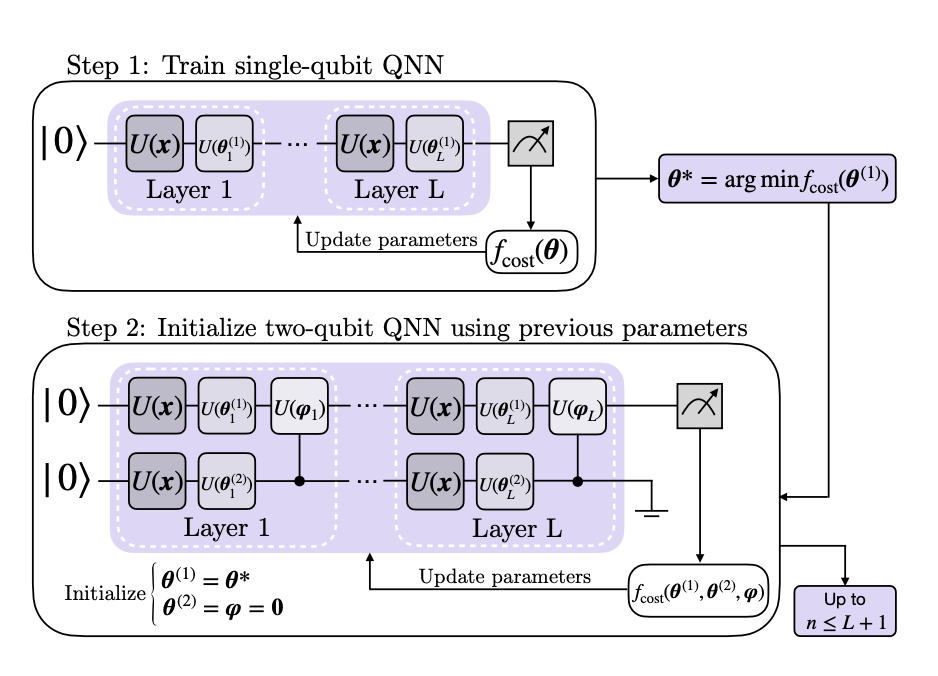
While the arguments above might suggest a preference for kernel or implicit models over explicit ones, practical challenges persist. Firstly, the computational complexity associated with constructing the kernel matrix scales quadratically with the number of training samples. Additionally, selecting the appropriate embedding that defines the kernel function is contingent on the specific problem at hand, demanding careful consideration. The researchers propose a method to straightforwardly scale the training up to an p−qubit QNN. Following training on a given dataset, this QNN is used to generate a q−qubit EQK. This construction is denoted as the p-to-q approach.
Kernel methods play a crucial role in machine learning and the Embedding Quantum Kernels (EQKs), an extension to quantum systems, have shown very promising performance. However, choosing the right embedding for EQKs is challenging.
“Quantum computing is a promising computational paradigm for tackling some complex computational problems which are classically intractable. In particular, its potential in enhancing machine learning tasks has garnered significant attention.”
Pablo Rodriguez-Grasa, Yue Ban, and Mikel Sanz
In this Article, we employ a quantum neural network (QNN) to create an embedding quantum kernel (EQK). This strategy utilizes QNN training to construct the corresponding kernel matrix, significantly reducing the computational cost when compared to constructing the kernel matrix at each training step.
Pablo Rodriguez-Grasa, Yue Ban, and Mikel Sanz
“Our results consider up to 10 qubits, showing that our approach circumvents typical training challenges associated with scaling parametrized quantum circuits.” –
Pablo Rodriguez-Grasa, Yue Ban, and Mikel Sanz
Summary
Researchers have proposed a method using Quantum Neural Networks (QNN) to identify the optimal Embedding Quantum Kernels (EQKs) for a task, which could improve efficiency in quantum computing. The method, which requires constructing the kernel matrix only once, could circumvent typical training challenges associated with scaling parametrized quantum circuits. Published in
- Researchers Pablo Rodriguez-Grasa, Yue Ban, and Mikel Sanz from the University of the Basque Country, TECNALIA, Universidad Carlos III de Madrid, IKERBASQUE, and Basque Center for Applied Mathematics have proposed a method to improve the efficiency of Quantum Neural Networks (QNNs) a published in ArXiv.
- The team’s method involves using a p-qubit QNN based on data re-uploading to identify the optimal q-qubit Embedding Quantum Kernel (EQK) for a task.
- This approach only requires the construction of the kernel matrix once, which significantly reduces computational costs.
- The researchers focused on two cases: n-to-n, where they proposed a scalable approach to train an n-qubit QNN, and 1-to-n, demonstrating that the training of a single-qubit QNN can be leveraged to construct powerful EQKs.
- The team’s findings suggest that their approach circumvents typical training challenges associated with scaling parametrised quantum circuits.




See today’s quantum computing news on Quantum Zeitgeist for the latest breakthroughs in qubits, hardware, algorithms, and industry deals.