Scientists in Russia and China have successfully tested a ‘hack-proof’ quantum communication link, spanning 3,800km between Moscow and Urumqi in China. The communication was encrypted using secure keys transmitted by China’s quantum satellite, Mozi. The test, led by Alexey Fedorov of Russia’s National University of Science and Technology and the Russian Quantum Centre, demonstrates the feasibility of a quantum communication network among BRICS countries. Quantum communication uses cryptography to encode data in single photons, making it impossible for hackers to eavesdrop. The technology could be used to protect strategic and sensitive information, with potential applications in the finance sector.
China and Russia Quantum Communication Link
“Quantum keys, or strings of random bits, “are secret parameters that we use to encode useful information”, making it inaccessible to unauthorised individuals,”
Alexey Fedorov
Quantum Communication Link Tested by China and Russia
Scientists in Russia and China have successfully established a quantum communication link encrypted with secure keys transmitted by China’s quantum satellite, Mozi. This development indicates that a quantum communication network among BRICS nations (Brazil, Russia, India, China, and South Africa) could be technically feasible.
The scientists managed to span a distance of 3,800km between a ground station near Moscow and another near Urumqi in China’s western Xinjiang region. They successfully sent two encoded images secured by quantum keys. This achievement was made possible with the help of China’s quantum satellite, Mozi, which paved the way for the development of national and international quantum communication networks.
Quantum Communication: A Hack-Proof Solution
Quantum communication is a form of quantum physics-based information transfer that uses cryptography to encode data in single photons. This method offers a way to transfer information that hackers cannot eavesdrop on. Encrypted data is transferred in the form of ones and zeros along with a quantum key that is used to decrypt the data. Quantum keys, or strings of random bits, are secret parameters used to encode useful information, making it inaccessible to unauthorized individuals.
The use of quantum key distribution can allow for security that is “guaranteed by the law of physics”. However, ground-based transfer at reasonable speeds using optical fiber cables is limited to around 1,000km due to a loss of photons over long distances.
Overcoming Distance Limitations with Mozi Satellite
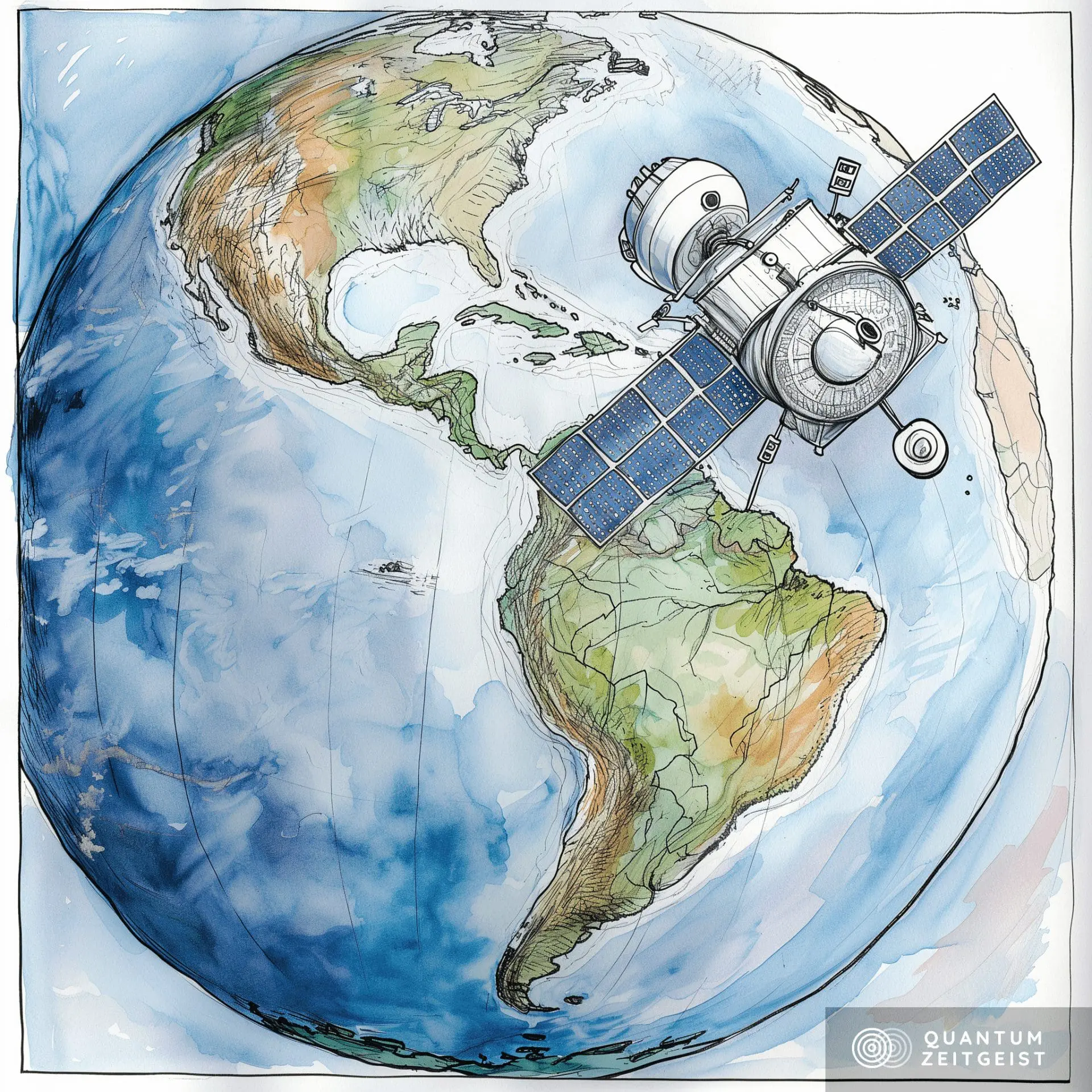
To overcome the distance limitation, China launched Mozi, the world’s first quantum communication satellite in 2016, to begin long-distance quantum transmission. Using the satellite, China has been able to develop a national quantum network of ground stations spanning thousands of kilometers.
In 2020, a Russian team began working with the Mozi team, who helped them set up systems to begin conducting experiments with the satellite. A ground station was set up at the Zvenigorod observatory just outside Moscow, equipped with telescopes and cameras to track the satellite. Various experiments were conducted between the Zvenigorod ground station and China’s Nanshan ground station near Urumqi.
Successful Quantum Communication Experiment
On March 1 last year, a full quantum communication experiment was conducted between the two stations. A secret key was distributed between Zvenigorod and Mozi, which orbited between 600km and 1,100km above the ground station. Once the Chinese side received the shared key from the satellite, a secret key was established between two stations nearly 4,000km apart. Two coded messages were transferred between the teams that were decrypted with the help of two keys.
Quantum Technology: The Future of Secure Communication
Quantum technology is seen as a crucial part of future digital infrastructure. Russian President Vladimir Putin has expressed his intention to develop Russia into an economy where quantum technology plays a significant role. Russia has also proposed a joint effort to advance future technologies with fellow BRICS nations that would include quantum-based efforts.
While quantum communications networks could have many uses, more research is needed before the technology can be commercialized. The finance sector has shown interest in quantum technology, as banks store a massive amount of critical, important information. To commercialize quantum networks, development is heading towards expanding infrastructure through launching mini quantum satellites and building ground stations, along with forging protocols to exchange information.
In June, Russia released its own quantum microsatellite prototype and had begun experimenting with the aim of launching its own quantum satellite. The team hopes to develop its own quantum technology to become a resource to help other nations conduct quantum experiments as China had helped the Russians. Beyond quantum communication, countries across the world are researching various technologies, including quantum computing, which the Russian team would soon use to solve minor tasks.
“We live in an information age, where a lot of what we do “is tied to protected information”, making quantum keys a “useful tool” to protect strategic and sensitive information,”
Alexey Fedorov
Quick Summary
Scientists in Russia and China have successfully established a ‘hack-proof’ quantum communication link, spanning 3,800km, encrypted with secure keys transmitted by China’s quantum satellite, Mozi. This development suggests that a quantum communication network between the BRICS nations (Brazil, Russia, India, China, and South Africa) is technically feasible, offering a way to transfer information that cannot be intercepted by hackers.
“All countries that are interested in technological leadership know that without quantum technology they won’t succeed,”
Alexey Fedorov
- Scientists in Russia and China have successfully tested a quantum communication link, using secure keys transmitted by China’s quantum satellite, Mozi. Reported in South China Morning Post.
- The experiment involved sending two encoded images over a distance of 3,800km between a ground station near Moscow and another near Urumqi in China’s Xinjiang region.
- Quantum communication uses cryptography to encode data in single photons, making it difficult for hackers to eavesdrop. The data is encrypted in the form of ones and zeros, along with a quantum key used to decrypt the data.
- The researchers, including Alexey Fedorov from Russia’s National University of Science and Technology and the Russian Quantum Centre, believe that quantum key distribution can provide security “guaranteed by the law of physics”.
- However, ground-based transfer of quantum keys at reasonable speeds is limited to around 1,000km due to loss of photons over long distances. To overcome this, China launched Mozi, the world’s first quantum communication satellite, in 2016.
- The Russian team began working with the Mozi team in 2020, conducting various experiments between the Zvenigorod ground station near Moscow and China’s Nanshan ground station near Urumqi.
- Fedorov suggests that quantum systems are currently best suited to scientific research, with more research needed before the technology can be commercialised. However, he sees potential for quantum technology in the finance sector due to the large amount of critical information stored by banks.
- Russia has proposed a joint effort to advance future technologies, including quantum-based efforts, with fellow Brics nations Brazil, India, China and South Africa.
“Technically, it’s absolutely possible” to build a quantum communication network between the BRICS nations,”
Alexey Fedorov
See today’s quantum computing news on Quantum Zeitgeist for the latest breakthroughs in qubits, hardware, algorithms, and industry deals.