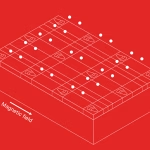
Quantum bits, or qubits, are the most critical components of any quantum computer. And for IonQ, they have used the approach of using Trapped Ion Technology in their system. Founded in 2015, IonQ (now a public company) has successfully launched several commercially scalable quantum computers. IonQ’s qubits are ionized ytterbium atoms, a silvery rare-earth metal.
Ion Trapped Technology is a quantum computing technique that uses ions (charged atoms) trapped in a magnetic or electric field as qubits (quantum bits) to process information. But why are ions, or charged atoms, used as qubits? The fundamental reason is that they can be contained (trapped) in one specific spot utilizing electric fields.
IonQ Ion Trap Technology Timeline
2020
IonQ Harmony (9-qubit)
IonQ developed Harmony in the year 2018-2019 and finally launched it in 2020, is a cloud-based platform, that utilizes trapped ion technology, it is a scalable quantum computer that offers multiple functions such as developing, testing, and deploying software on IonQ’s cloud-based quantum computers, with no additional hardware needed.
Harmony features an advanced optical and laser system with dedicated addressing beams for each qubit, allowing for direct entanglement between any pair of qubits. This capability significantly enhances the performance of various algorithms.
2022
IonQ Aria (20-Qubit)
IonQ’s Aria quantum computer, launched in 2022, is the company’s flagship quantum computer, boasting impressive specifications in the ion technology with an Algorithmic Qubit (#AQ) value of 20, signifying the capability of efficiently performing a quantum circuit across 20 qubits with roughly 400 entangling gate operations. This level of performance renders the Aria exponentially more potent — by several thousandfold — than its predecessor, the IonQ Harmony.
IonQ Aria’s technology demonstrates low error rates for single and two-qubit gates at 0.06% and 0.6%, respectively, and a state preparation and measurement error rate of just 0.5%. Additionally, Aria features a long qubit coherence time of about 1000 milliseconds (T2 time).
Forte (32-qubit)
Forte is IonQ’s latest performing software-configurable quantum computer innovation, with a system that operates at 32-qubit, and an #AQ of 29, Forte currently represents IonQ’s largest single-core quantum processor.
IonQ has incorporated Forte’s laser system with Acousto-optic Deflectors (AODs), opening up dynamic system configuration possibilities. The operating system of Forte is crafted to support new routines that can adjust the system’s settings in real-time to achieve peak performance.
2024+ onwards
Forte Enterprise (35-qubit)
IonQ’s Forte Enterprise is designed to incorporate the company’s miniaturization, modularity, and rack-mounted form factor, is expected to execute an Algorithmic Qubit count of 35 upon its release, and is set to be the company’s most advanced quantum computing system.
Furthermore, Forte’s laser system incorporates Acousto-optic Deflectors (AODs), which open up possibilities for dynamic system configuration. The operating system of Forte is crafted to support new routines that can adjust the system’s settings in real-time to achieve peak performance.
Tempo (64-qubit)
Expected to be launched in 2025, Tempo is expected to outperform earlier models like the Aria and Harmony significantly. This higher AQ count suggests that Tempo can handle more complex quantum algorithms and larger computational tasks, making it suitable for a broader range of applications.
Tempo will execute an Algorithmic Qubit count of 64 and is anticipated to offer a commercial edge for specific uses. Tempo is designed to deliver quicker gate operations, incorporate mid-circuit measurement capabilities, and achieve a high gate fidelity of 99.9%.
Tempo’s performance and system capabilities will provide new, production-ready quantum applications.
Summary
IonQ has developed multiple quantum computers, such as the IonQ Aria and IonQ Harmony, showcasing improvements in qubit count, gate fidelity, and operational speed.
IonQ’s introduction of higher Algorithmic Qubit (AQ) counts incorporated in their systems shows a long-term commitment to addressing increasingly complex computational tasks. Their accomplishments, driven by low error rates, high qubit connectivity, and extended coherence times, are significant steps toward making quantum computing practical, scalable, accessible, and useful for a broader range of applications, from material science to cryptography.
IonQ’s technology continues to progress as they move forward with their development with Tempo, which is expected to be a substantial step forward in the field of quantum computing, offering higher computational power, speed, and accuracy, which could unlock new possibilities in solving complex problems that are currently beyond the reach of classical computers.