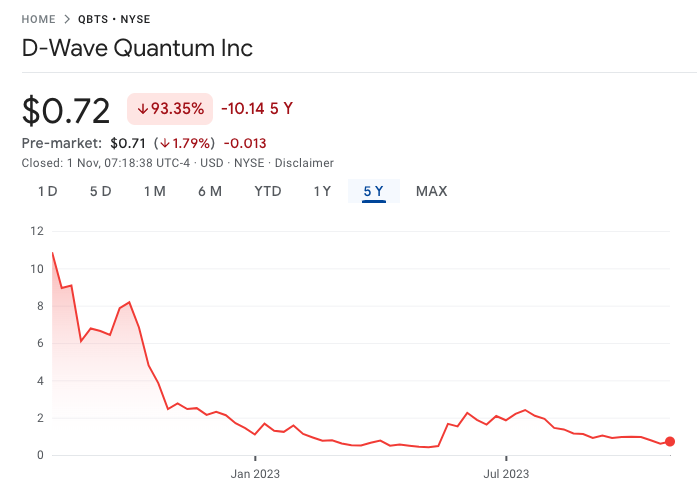
One of the first commercial quantum computer companies and one of the first to debut on the stock market has seen its market cap fall to below $100M USD. The total market cap of the company determined from analysing D-Wave Stock is now just hovering around 1/10th of a billion USD. Recent falls in the stock price have hit the market valuation of the company that commercially pioneered quantum annealing.
D-Wave Systems Inc. is a Canadian quantum computing company founded in 1999. Its founder Alan Baratz, has many years of experience leading technology businesses. It is best known for pioneering the development of quantum annealing machines, which are designed to solve optimization problems. Unlike gate-based quantum computers, D-Wave’s machines use quantum annealing to navigate the landscape of complex problems, seeking optimal or near-optimal solutions.
The company released the D-Wave One in 2011, the world’s first commercially available quantum computer with a 128-qubit processor. It was targeted at businesses and research institutions.
Key clients and partners include Lockheed Martin, Google, NASA, and Los Alamos National Laboratory. The machines have been explored for applications in optimization, machine learning, financial modeling, drug discovery, and more. The company’s strategy has been to target businesses and researchers who can benefit from the heuristic optimization capabilities of quantum annealing, even as debates continue about the actual “quantum advantage” of their machines over classical systems.
D-Wave Stock: QBTS Stock Price Performance
It’s not the first time that the share price has fallen significantly. Previous falls in the stock price have led to notices about delisting from the NYSE (New York Stock Exchange). This time, the stock price falls have led to another notice.
The current price marks a considerable drop from the heady days of the initial float or SPAC, where the share price was under $11 per share. The price is now languishing below $1 at $0.72, so shares have decreased by around 15!
D-Wave is not the only quantum company to have hit the stock market. Rigetti and IonQ are already publicly listed quantum stocks. Zapata is due to be a new quantum stock soon to join the ranks of those that already exist.
Quantum Annealing, so what is it?
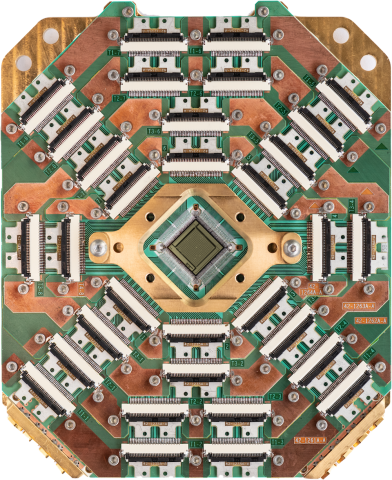
Quantum annealing is a quantum computational technique designed to find the minimum value (or “ground state”) of a complex function, often related to optimization problems. The process is inspired by classical annealing in metallurgy, a technique where a material is heated and then slowly cooled to remove defects, finding a minimum energy state. In quantum annealing, quantum fluctuations escape local minima and find the global minimum of a given function. Devices like the D-Wave quantum computer utilize quantum annealing to tackle optimization problems and have been at the forefront of this approach.
Gate-Based Quantum Computing
Gate-based quantum computing, on the other hand, is the more familiar model of quantum computation. It operates using quantum bits or “qubits”, which, unlike classical bits that are either 0 or 1, can exist in a superposition of both states. Quantum gates manipulate these qubits in a manner analogous to classical logic gates. Algorithms for gate-based quantum computers, like Shor’s algorithm for integer factorization or Grover’s algorithm for search, exploit quantum phenomena like entanglement and superposition to solve specific problems faster than classical computers potentially.
Key Differences between Gate and Annealing
The primary difference between quantum annealing and gate-based quantum computing lies in their approach and application. Quantum annealing is a specialized method for solving optimization problems. It is heuristic, meaning there’s no guarantee of finding the absolute best solution every time, but it often finds reasonable solutions quickly. Gate-based quantum computing, however, is more general-purpose and can be programmed to perform a wide range of tasks, from simulations to cryptographic problems. The universality of gate-based quantum computers makes them more versatile but also more challenging to build and scale due to the need for error correction and precise control of qubits.
Quantum Zeitgeist does not provide personal investment or financial advice, or act as personal financial, legal, or institutional investment advisors, or individually advocate the purchase or sale of any security or investment or the use of any particular financial strategy. All investment strategies include the risk of loss for some or even all of your capital. Before pursuing any financial strategies discussed or relying on information within this website, you should always consult with a licensed financial advisor. Any analysis we provide is for informational purposes only and does not take into consideration your circumstances or other factors that may be important in making decisions. It should not be considered an individualized recommendation or personalized investment advice. Any investment vehicles, stocks, or securities mentioned may not be suitable for all investors.




See today’s quantum computing news on Quantum Zeitgeist for the latest breakthroughs in qubits, hardware, algorithms, and industry deals.