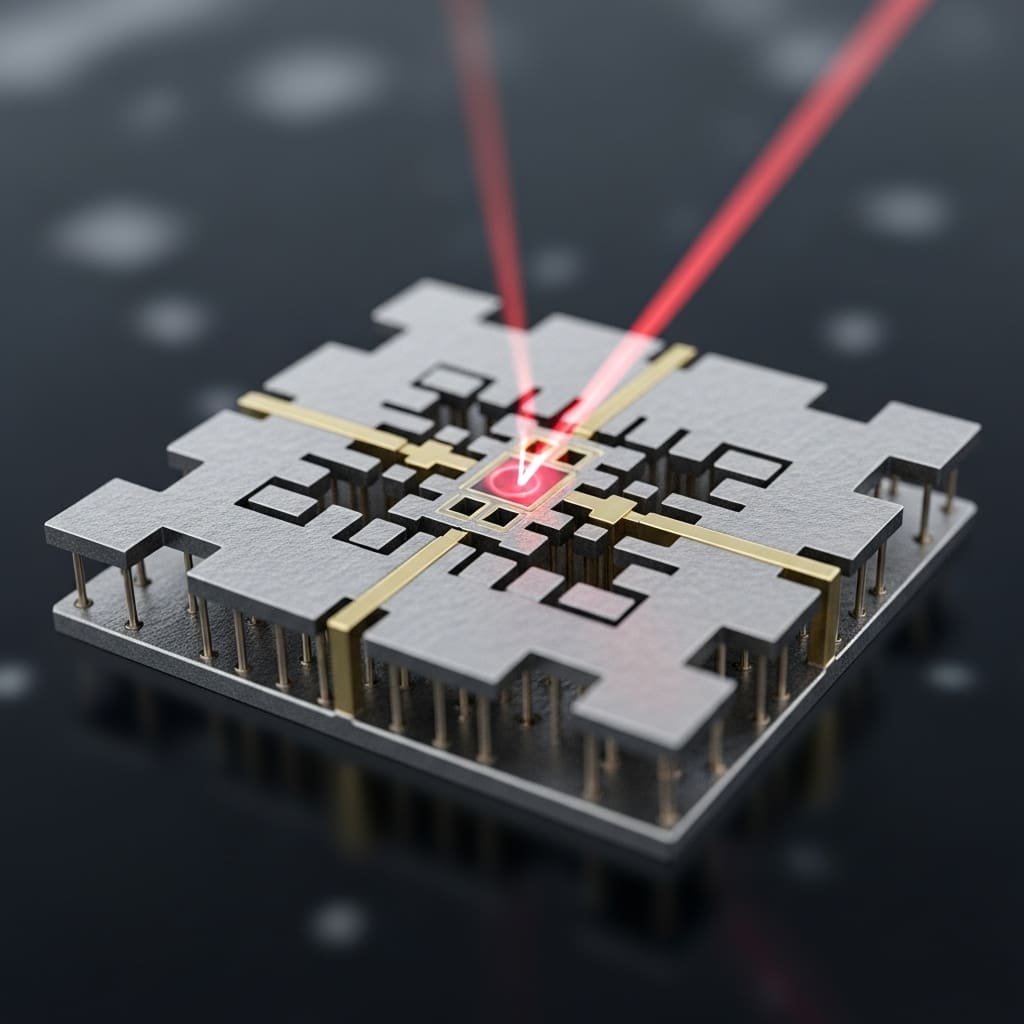
Scientists are tackling a major hurdle in quantum computing: the slow and energy-intensive process of preparing and reading quantum states in silicon. Aidan G. McConnell, Nils Dessmann from the FELIX Laboratory, Wojciech Adamczyk, and Benedict N. Murdin et al. demonstrate a significantly faster and more efficient method utilising 10THz photons to initialise and read the spin of electrons bound to boron atoms in silicon. This research is significant because it bypasses the need for extremely low temperatures , typically below 2 K , and speeds up initialisation by over a thousand-fold, potentially paving the way for more practical and scalable quantum technologies based on solid-state systems and opening new avenues for exploring THz excitations in other quantum materials.
Murdin et al. demonstrate a significantly faster and more efficient method utilising 10THz photons to initialise and read the spin of electrons bound to boron atoms in silicon. This research is significant because it bypasses the need for extremely low temperatures, typically below 2 K, and speeds up initialisation by over a thousand-fold, potentially paving the way for more practical and scalable quantum technologies based on solid-state systems and opening new avenues for exploring THz excitations in other quantum materials.
Rapid Boron-Silicon Qubit initialisation via Optical Pumping enables
Scientists have demonstrated a groundbreaking method for rapidly initialising and reading the spin of electrons trapped by boron atoms in silicon, achieving speeds over a thousand times faster than conventional techniques. The research overcomes a significant hurdle in quantum computing by enabling high-temperature operation and significantly reducing the time required to prepare qubits for computation. This breakthrough utilises optical pumping, a technique borrowed from atomic physics, to selectively populate a specific spin state using circularly polarised ~10THz pulses from a free electron laser. The team achieved this rapid initialisation and readout at temperatures above 3 K, a considerable improvement over the millikelvin temperatures typically required for similar processes.
The study involved directing short, 9ps pulses onto silicon samples containing boron impurities, exploiting the unique energy levels of holes bound to these atoms. By exciting the “1s”-like ground state to higher-lying orbitals and leveraging fast phonon-mediated relaxation, researchers were able to enhance the population of a target spin eigenstate by approximately 12%. This process bypasses the limitations of conventional thermal initialisation, which relies on slow equilibration at extremely low temperatures. Crucially, the transition energy used is far greater than the spin splitting, allowing for efficient initialisation even at elevated temperatures.
The experiment employed a pump-probe geometry with precise control over pulse timing and polarisation, utilising the FELIX free electron laser to generate the necessary THz radiation. Experiments show that this approach not only accelerates state preparation but also enables fast state readout, addressing a critical need for practical quantum computation. Using data obtained from their experiments, the researchers calculate that 99% spin initialisation of boron in strained silicon is achievable within 250ps at 3 K. This represents a substantial leap forward in speed and efficiency compared to existing methods, which typically require microseconds for initialisation in similar silicon-based devices.
Furthermore, the team successfully measured spin-lattice relaxation times in a previously inaccessible regime, without the need for external magnetic fields. The work opens exciting possibilities for the development of scalable quantum technologies, particularly those based on semiconductor platforms. The speedup gained by utilising THz photons instead of microwaves suggests that this technique could be extended to other solid-state quantum systems hosting THz excitations. This innovative approach to spin control promises to accelerate progress towards building practical and efficient quantum computers, potentially revolutionising fields such as materials science, drug discovery, and cryptography.
Terahertz Pumping for Rapid Silicon Spin Initialisation offers
Scientists harnessed terahertz radiation to dramatically accelerate quantum state initialisation in silicon, achieving speeds over a thousand times faster than conventional methods. The research team developed a novel optical pumping technique utilising circularly polarised ~10THz pulses from a free electron laser to preferentially populate a target spin state in boron-doped silicon. This approach bypasses the need for millikelvin temperatures typically required for initialisation via slow microwave processes, enabling operation above 3 K. Experiments employed a pump-probe geometry, where a tunable free electron laser, FELIX, generated coherent pulses of approximately 9ps duration.
The study pioneered a method for manipulating hole spins bound to boron acceptors by exciting the “1s”-like ground state to higher-lying hydrogenic orbitals. Researchers carefully controlled the polarisation of both pump and probe beams using rotating wire-grid polarisers and silicon prism quarter wave plates, allowing for precise manipulation of spin populations. A beam-splitter divided the linearly-polarised FELIX pulse into pump and probe beams, with a translation stage adjusting the pump’s arrival time to control the delay between pulses. The silicon sample, doped with boron, was positioned at a slight angle to filter pump light from the detector channel.
Measurements focused on the 1Γ+ 8 ground state, a fourfold-degenerate manifold with mJ = ±3/2, ±1/2, and the 1Γ− 6 and 1Γ− 7 excited states, both J = 1/2 doublets. The 9.6THz laser frequency was chosen for near-resonance with transitions between these states, exploiting a bandwidth of approximately 40GHz. The team systematically varied pump and probe polarisation combinations , same circular polarisation, opposite circular polarisation, and plane polarised pump with circular probe , to observe the resulting dynamics in probe transmission. Analysis of the transient transmission changes revealed distinct stages of the initialisation cycle, demonstrating a significant increase in the population of the target spin state. Calculations based on the experimental data predict that 99% spin initialisation of boron in strained silicon is achievable within 250ps at 3 K, representing a three-order-of-magnitude improvement over existing dopant-bound qubit initialisation techniques. This THz-driven approach offers a pathway to faster and more efficient quantum technologies, potentially extending to other solid-state quantum systems with THz excitations.
Terahertz pumping creates silicon dark states with potential
Scientists have demonstrated a method for rapidly initialising quantum states in silicon using terahertz (THz) radiation. Conventional initialisation techniques rely on slow microwave processes and require extremely low temperatures, typically below 2 K. This research utilises optical pumping with ~10THz circularly polarised pulses to preferentially populate a specific spin state in boron impurities within silicon, achieving speeds over a thousand times faster than traditional methods. The process operates effectively at temperatures above 3 K, significantly relaxing the cooling demands of semiconductor-based quantum platforms.
The key finding is the ability to selectively prepare a unique dark state, |1Γ+ 8 , mJ = 1/2⟩, within the boron impurity’s ground state manifold, using the combination of specific excited orbital states and polarised THz radiation. This selective preparation is guaranteed by symmetry and independent of experimental parameters. Following optical excitation, rapid orbital decay occurs, and the resulting spin population imbalance is interrogated using a second THz pulse, enabling fast state readout. Calculations suggest that 99% spin initialisation is achievable within 250ps at 3 K for boron in strained silicon.
The authors acknowledge that the exact mechanisms of orbital relaxation via multi-phonon cascades remain unclear, as resonant phonon transitions are not readily available. They also note that the observed orbital decay is assumed to be a random, uniform process for modelling purposes. Future research should explore the application of this THz-based technique to other solid-state quantum systems hosting THz excitations, potentially broadening its impact across various quantum technologies. This advancement offers a pathway towards faster and more energy-efficient quantum information processing in silicon, addressing a critical limitation in current semiconductor quantum platforms.
👉 More information
🗞 Rapid high-temperature initialisation and readout of spins in silicon with 10THz photons
🧠 ArXiv: https://arxiv.org/abs/2601.21880