

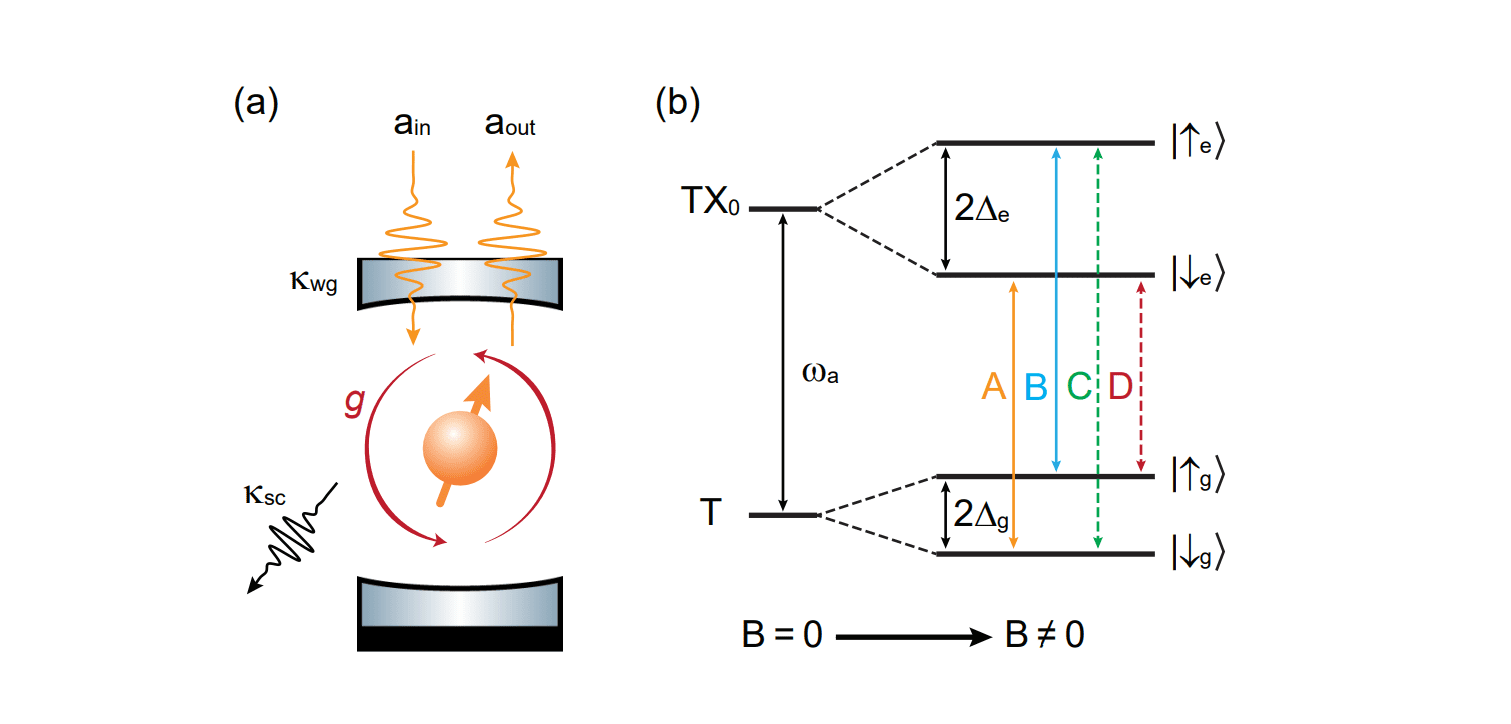
High-fidelity spin readout represents a critical challenge in developing solid-state quantum information processing, and researchers are continually seeking methods to improve both speed and accuracy. Yu-En Wong, Songtao Chen, and colleagues at Rice University now demonstrate two theoretical protocols for achieving fast, single-shot readout of electronic spins within colour centres, known as T centres, by coupling them to optical cavities. Their work proposes leveraging cavity-enhanced fluorescence and spin-dependent reflection contrast to generate strong readout signals, even when the colour centre exhibits limited fluorescence. Calculations reveal that these methods achieve single-shot readout fidelities exceeding 99% within a remarkably short timeframe of 8. 7 seconds, representing a significant advance towards practical quantum technologies
Cavity Enhances Single-Shot T Centre Readout
Researchers have developed a new method for reading the quantum state of individual T centres in diamond with exceptional speed and accuracy. This technique utilizes a carefully designed microwave cavity to strongly couple to the spin of the T centre, dramatically enhancing the optical signal used for detection and enabling a non-destructive measurement of the spin state. By optimising the cavity’s shape and the readout process, the team achieves a readout fidelity of 99. 2%, a significant improvement over existing methods, paving the way for scalable quantum devices. The research also investigates ways to further improve performance, including reducing unwanted decoherence and enhancing the signal-to-noise ratio.
The team proposes and investigates two theoretical methods for quickly determining the quantum state of a single T centre spin coupled to an optical cavity. For fluorescence-based readout, they selectively couple the T centre to a single mode within the cavity, amplifying the emitted light and improving detection efficiency. Alternatively, they leverage changes in light reflected from the cavity to generate a readout signal, achieving high-fidelity readout even when the T centre emits only a modest amount of light.
Solid-State Qubits and Coherence Times
This research focuses on developing quantum technologies based on solid-state qubits, exploring various materials and techniques to improve their performance. The team investigates promising qubit candidates, including silicon-vacancy (SiV) and tin-vacancy (SnV) centres in diamond, rare-earth ions in solid materials, nuclear spins in isotopically engineered silicon carbide, and T centres in silicon. A central goal is to achieve precise control and reliable readout of these qubits, with a particular emphasis on single-shot readout, which allows for determining the qubit state in a single measurement without disturbing the quantum information.
The research employs key technologies, including nanofabrication techniques like focused ion beam milling and electron beam lithography to create nanoscale structures for qubit confinement and control. Cavity quantum electrodynamics confines qubits within optical or microwave cavities, enhancing light-matter interactions and improving qubit coherence. Waveguides guide photons to couple qubits to each other and to external systems. Optical and microwave control techniques manipulate qubit states and perform single-shot readout. Isotopic engineering, using materials with specific isotopic compositions, reduces noise and improves qubit coherence. Diamond nanostructures are utilized due to their excellent properties, such as high purity and strong covalent bonds. The team also focuses on generating photons at wavelengths compatible with optical fibre communication, using rare-earth ions.
Significant achievements include demonstrating coherence times exceeding 10 milliseconds for SiV qubits in diamond, achieving high-fidelity single-shot readout of solid-state qubits, developing nanofabrication techniques for creating arrays of qubits, and creating sources of indistinguishable photons at telecom wavelengths. They have also demonstrated quantum memory based on solid-state qubits, fabricated integrated quantum devices with multiple qubits and control elements, and developed robust multi-qubit quantum network nodes with integrated error detection. Furthermore, they have implemented and tested quantum communication protocols using solid-state qubits and gained improved understanding of spectral diffusion in T centres in silicon.
Ongoing research addresses challenges including mitigating spectral diffusion, which causes qubits to lose coherence, and scaling up to a large number of qubits. Maintaining qubit coherence in complex devices and integrating qubits with other components, such as control electronics and optical fibres, also present hurdles. Developing effective quantum error correction codes is essential for building fault-tolerant quantum computers. The team utilizes tools like Qutip, an open-source Python framework for simulating quantum systems, and performs figure of merit calculations to assess the performance of single-photon generation. This interdisciplinary research combines physics, materials science, nanofabrication, and electrical engineering to build practical quantum technologies.
Fast, High-Fidelity Electron Spin Readout
Researchers have demonstrated two new methods for rapidly and accurately reading the quantum state of single electron spins associated with T centres coupled to optical cavities. Both techniques, based on detecting either fluorescent light emitted by the T centre or changes in light reflected from the cavity, achieve single-shot readout fidelity exceeding 99% within approximately 10 microseconds, positioning them among the highest performing solid-state spin readout techniques currently available. Theoretical investigations confirm that high fidelity is achievable with realistic system parameters, such as specific cavity quality factors and T centre linewidths. The fluorescence-based readout benefits from strong enhancement of the emitted light, making it resilient to noise, while the reflection-based approach can maintain high fidelity even with T centres exhibiting lower fluorescence. Electrical field control can minimize spectral diffusion and improve linewidth, and focused-ion-beam techniques can increase the density of T centres within the cavity, enhancing the overall signal. This work establishes a strong foundation for utilizing T-centre spins in quantum information processing and opens avenues for exploring other cavity-mediated quantum control techniques, such as spin-spin interactions and enhanced Raman emission.
👉 More information
🗞 Cavity-assisted single-shot T center spin readout
🧠 ArXiv: https://arxiv.org/abs/2510.26797

