The escalating demands of artificial intelligence pose a significant challenge to current computing infrastructure, straining energy resources and pushing the limits of conventional electronics. Ziang Yin, Hongjian Zhou, Chetan Choppali Sudarshan, and colleagues at Arizona State University, along with Jiaqi Gu, address this issue by investigating electronic-photonic integrated circuits (EPICs) as a pathway to more sustainable AI systems. Their research demonstrates that EPICs inherently offer advantages in energy efficiency and bandwidth, while also reducing the carbon footprint of chip fabrication. Importantly, the team reveals how advanced design automation and cross-layer co-design techniques can further amplify these benefits, creating reconfigurable and robust hardware that adapts to evolving workloads and extends system lifespan, ultimately paving the way for lifelong-sustainable AI.
Photonic Accelerators for Sustainable AI Computing
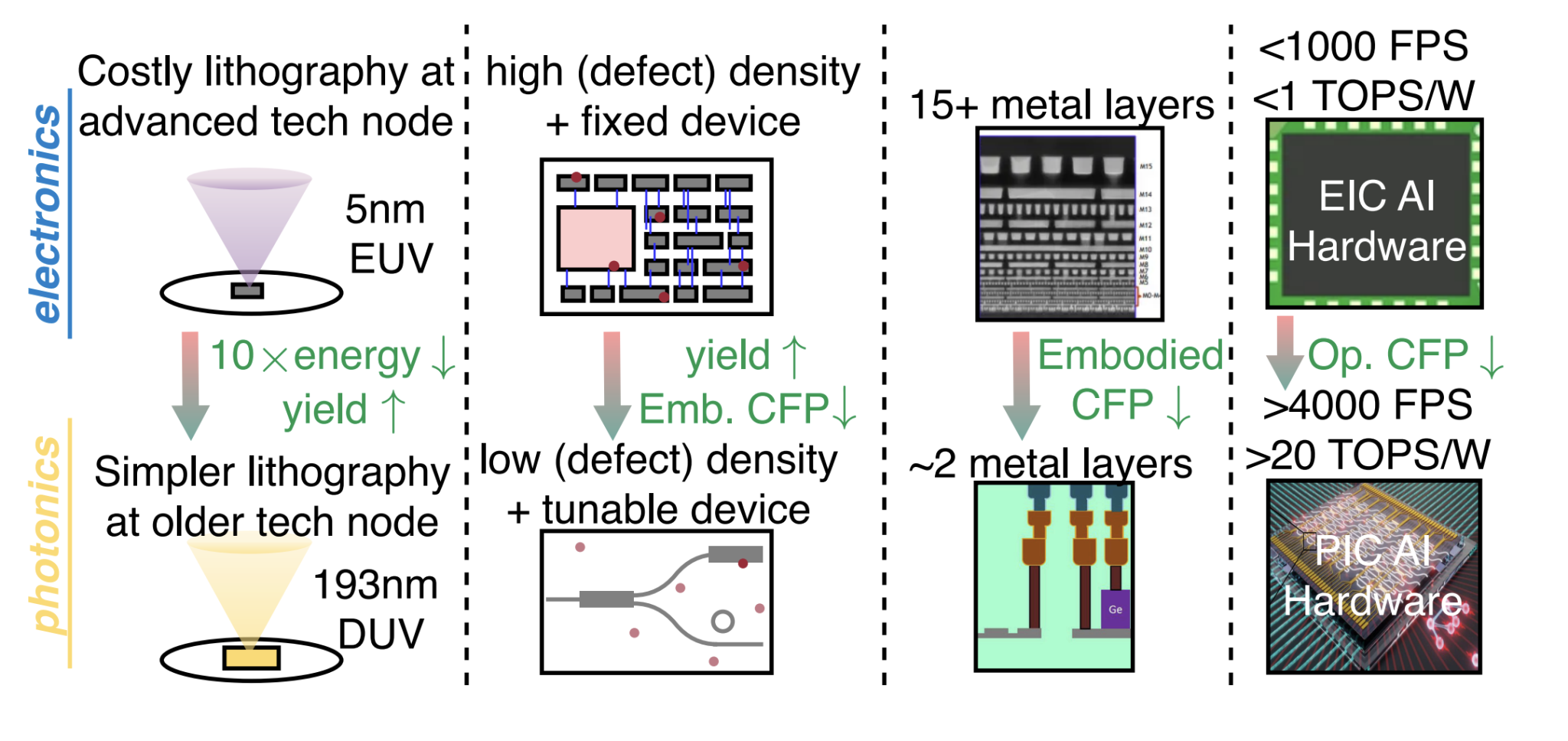
Researchers are pioneering a new approach to artificial intelligence hardware that prioritizes sustainability alongside performance, addressing the growing carbon footprint of increasingly powerful computing systems. The team focuses on photonic integrated circuits (PICs) as a compelling alternative to traditional electronic integrated circuits (EICs), recognizing that the relentless pursuit of miniaturization in electronics is driving up embodied carbon costs, the carbon released during manufacturing, packaging, and material waste. PICs, however, leverage more relaxed manufacturing processes, utilizing deep ultraviolet (DUV) lithography instead of the energy-intensive extreme ultraviolet (EUV) processes required for advanced electronics, and significantly reducing the number of metal layers needed, from over fifteen in advanced EICs to approximately two in PICs. This methodology inherently lowers the embodied carbon footprint, while simultaneously delivering substantial gains in performance and energy efficiency.
Scientists developed a cross-layer co-design approach, integrating device, circuit, and architectural considerations to unlock new sustainability benefits, including ultra-compact circuit designs and reconfigurable hardware topologies that adapt to evolving AI workloads. Furthermore, the team investigates intelligent resilience mechanisms that prolong the lifetime of PICs by tolerating variations and faults, reducing the need for frequent replacements. By extending the traditional performance-power-area paradigm to include carbon considerations, researchers propose metrics like the carbon-delay product and carbon footprint to throughput ratio to comprehensively evaluate the sustainability of AI hardware. The results show that PICs offer a pathway to achieving both high performance, exceeding 20 TOPS/W, and a significantly reduced embodied carbon footprint, potentially lowering it to less than 1000 FPS, compared to over 4000 FPS for advanced electronic circuits. This approach promises a future where AI systems can meet demanding computational needs while minimizing their environmental impact.
Sustainable AI via Photonic Integrated Circuits
Researchers are addressing the escalating energy demands of artificial intelligence by pioneering electronic-photonic integrated circuits (EPICs), offering a pathway to both high performance and drastically reduced environmental impact. These circuits inherently deliver ultra-high bandwidth and low latency, while simultaneously minimizing embodied carbon footprint compared to conventional electronic chips. The team demonstrates how advanced design automation and cross-layer co-design methodologies amplify these benefits, paving the way for truly sustainable AI systems. A key innovation is Apollo, a new design tool that generates compact yet routable layouts for photonic integrated circuits (PICs).
Apollo incorporates “bending-aware” cost functions and predictive net-spacing models, directly addressing the challenges of waveguide routing and minimizing wasted area. Coupled with LiDAR, an automated curvy-aware detailed router, the complete design flow reduces PIC layout time from days to minutes, significantly lowering manufacturing costs and embodied carbon. This automated optimization enables rapid physical implementation with accurate estimation of factors impacting chip carbon footprint, such as area, routing resources, and circuit robustness. Beyond speed and efficiency, the research introduces a novel framework for evaluating hardware sustainability.
By separating total carbon footprint into embodied and operational contributions, and normalizing by delivered performance, the team developed carbon-aware efficiency metrics. They present “carbon per task” and “performance per carbon footprint” as key indicators, allowing for direct comparison of different devices and workloads. Analysis reveals that optimizing for performance alone is insufficient; a holistic approach considering both carbon impact and efficiency is crucial. The team meticulously models carbon footprint, accounting for manufacturing processes, design costs, and operational energy consumption.
They demonstrate how die area, technology node, and sustained performance directly influence the overall carbon impact. For EPICs, they separately report the electronic and photonic footprints and powers, using a 193nm process for photonic designs. This detailed analysis provides a comprehensive understanding of the carbon trade-offs involved in designing and deploying AI systems, ultimately enabling the creation of lifelong-sustainable electronic AI.
EPICs Enable Sustainable Artificial Intelligence Hardware
Electronic-photonic integrated circuits (EPICs) offer a promising pathway to address the increasing energy demands and carbon footprint of artificial intelligence systems. This research demonstrates that EPICs inherently provide advantages in bandwidth, latency, and energy efficiency compared to conventional electronic platforms. Furthermore, the fabrication process for EPICs, utilising relaxed process nodes, naturally reduces embodied carbon compared to advanced digital circuits. The study highlights how advanced electronic design automation (EPDA) tools and cross-layer co-design methodologies can amplify these sustainability benefits, paving the way for truly sustainable AI systems.
Specifically, compact layout generation, reconfigurable hardware topologies, and intelligent resilience mechanisms contribute to reduced chip area, adaptability to evolving workloads, and prolonged system lifetime. The results demonstrate that a design philosophy prioritizing compactness, reconfigurability, and endurance directly translates into lower embodied and operational carbon for AI hardware. The authors acknowledge that while their approach shows significant promise, further work is needed to fully realise the potential of EPICs. Future research should focus on refining design automation tools and exploring new materials and device architectures to further enhance performance and sustainability. This work establishes a principle for building lifelong, carbon-conscious computing systems and sets a precedent for a new design mindset that integrates carbon awareness at every layer of hardware development.
🗞 Toward Lifelong-Sustainable Electronic-Photonic AI Systems via Extreme Efficiency, Reconfigurability, and Robustness
🧠 ArXiv: https://arxiv.org/abs/2509.07396



See today’s quantum computing news on Quantum Zeitgeist for the latest breakthroughs in qubits, hardware, algorithms, and industry deals.