

The pursuit of advanced quantum technologies, including secure communication, powerful computation, and ultra-precise measurement, demands innovative methods for creating and controlling complex states of light. Ozlem Erkilic, Aritra Das, and colleagues from the Australian National University and A*STAR Quantum Innovation Centre demonstrate a significant step forward by developing a unified optical platform that generates these crucial non-Gaussian states. Their approach overcomes previous limitations by relying solely on readily available Gaussian inputs, optical amplification, and photon detection, rather than requiring difficult-to-produce high-photon-number states or strong non-linear effects. This single architecture achieves near-perfect generation of several key states, including photon-added squeezed states, cubic-phase states, and squeezed-cat states, and importantly, allows these states to evolve into the complex GKP grid states necessary for fault-tolerant quantum computation, exceeding a critical threshold for practical applications.
GKP States Generated Via Breeding Technique
This supplementary material details parameters used in a quantum computation scheme for generating Gottesman-Kitaev-Preskill (GKP) states from squeezed-cat states using a breeding technique. GKP states are important for robust quantum information encoding and are a key component in measurement-based quantum computing. The breeding technique creates these states by repeatedly applying operations and making measurements. The material focuses on GKP states, which are continuous-variable quantum states analogous to qubits, and squeezed-cat states, non-classical states of light used as a starting point for the breeding process.
The process involves repeated operations and measurements to grow the desired GKP state from a simpler initial state, utilising squeezing to reduce quantum noise and an optical parametric amplifier (OPA) to generate squeezed states. Success probability, the likelihood of successfully producing a GKP state, is also a crucial metric. The supplementary material presents experimental parameters, including the number of detected photons and breeding rounds, influencing the quality and success of GKP state generation. The OPA gain controls squeezing, while input squeezing defines the initial squeezing applied to the state.
A squeezing correction compensates for experimental imperfections, ensuring correct GKP grid spacing. The success of the GKP breeding process relies on carefully controlling these parameters. The squeezing correction ensures the GKP state has the correct properties, and there is a trade-off between success probability and state quality; more breeding rounds generally improve quality but lower the probability of success. This material provides detailed parameters and calculations used in an experiment to generate GKP states, highlighting the importance of precise control and optimisation for successful quantum computation.
Generating Non-Gaussian States from Gaussian Inputs
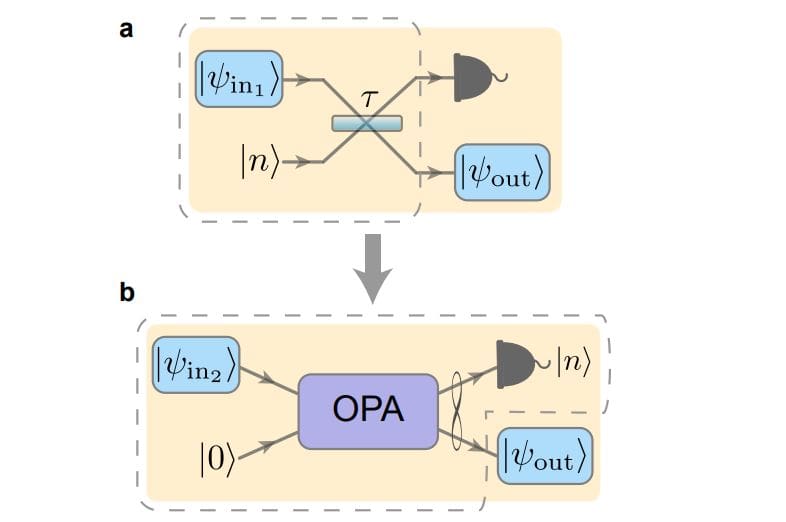
Researchers have pioneered a unified optical framework for generating non-Gaussian states of light, essential resources for advancements in quantum communication, computation, and metrology. This work overcomes limitations by eliminating the need for difficult-to-produce high-photon-number states, instead harnessing Gaussian inputs, optical parametric amplification, and photon-number-resolving detection to create a versatile platform for generating complex quantum states. The core of this breakthrough is a novel non-Gaussian source. A Gaussian seed state is injected into an optical parametric amplifier, generating two correlated output modes.
Photon-number-resolving detection on one mode heralds the creation of a non-Gaussian state in the other, avoiding the need for pre-generated Fock states and enabling the generation of a broader class of non-Gaussian states with improved scalability. Experiments focused on generating photon-added squeezed states, cubic-phase states, and squeezed-cat states. Optimisation of input squeezing parameters achieved near-unit fidelity for photon-added squeezed states, demonstrating the effectiveness of the approach. The generated cubic-phase states exhibit strong non-linearities, making them suitable for high-fidelity quantum gates, while the squeezed-cat states exceed the 9. 75 dB fault-tolerance threshold for quantum computing, requiring only low levels of squeezing and single-photon detection. This unified framework establishes an experimentally accessible platform, providing a common foundation for diverse quantum technologies.
Breeding High-Fidelity GKP States with Light
Scientists have developed a unified optical framework for generating complex states of light, essential for advancements in communication, computation, and precision measurement. This work overcomes limitations of previous methods that relied on high-photon-number states or strong non-linearities, instead utilising Gaussian inputs, optical parametric amplification, and photon detection. The team successfully generated photon-added squeezed states with near-unit fidelity, cubic-phase-like states exceeding 98. 5% fidelity, and squeezed-cat states achieving over 99% fidelity. Crucially, these squeezed-cat states can be iteratively bred into GKP grid states, surpassing the 9.
75 dB threshold required for fault-tolerant quantum computation while operating below 3 dB of input squeezing, establishing a scalable and experimentally accessible platform. Researchers compared their approach to methods using discrete Fock states, demonstrating equivalent performance when generating photon-added squeezed states. Detailed analysis of success probabilities revealed a significant advantage for the OPA-based scheme, particularly as the number of added photons increases. For example, when adding ten photons, the OPA scheme exhibits success probabilities exceeding the SPDC-based Fock-state approach by roughly three orders of magnitude with a beamsplitter transmissivity of 0.
- Even at lower transmissivity values, the OPA scheme maintains a substantial advantage. Fidelity measurements confirm near-unit performance for both schemes at low photon numbers, but the Fock-state scheme experiences a rapid decrease in fidelity as the number of added photons increases. Even accounting for detector imperfections, the OPA scheme maintains a higher fidelity. These results demonstrate the potential of this new framework to generate high-quality non-Gaussian states of light for a range of quantum technologies.
Generating GKP and Diverse Quantum States
This work demonstrates a unified optical framework for generating a range of non-Gaussian states of light, essential resources for advancing quantum technologies. By combining squeezed light, optical amplification, and heralded photon detection, researchers successfully generated squeezed-cat states, photon-added states, cubic-phase-like states, and crucially, GKP grid states exceeding the 9. 75 dB threshold required for fault-tolerant quantum computation. This achievement signifies a significant step towards integrating the state resources needed for diverse applications including computing, communication, and precision measurement within a single, coherent platform. The approach distinguishes itself by operating with low levels of input squeezing, below 3 dB, and relying on Gaussian operations alongside single-photon detection. This simplicity allows for the efficient generation of multiple non-Gaussian states.
👉 More information
🗞 A unified optical platform for non-Gaussian and fault-tolerant Gottesman-Kitaev-Preskill states
🧠 ArXiv: https://arxiv.org/abs/2512.02607


