Terahertz refractive index sensors hold immense promise for applications ranging from environmental monitoring to medical diagnostics, but achieving both high sensitivity and broad operating ranges remains a significant challenge. Osama Haramine Sinan from Chittagong University of Engineering and Technology, and colleagues, now demonstrate a novel sensor design utilising graphene-enhanced metamaterials to overcome these limitations. Their research presents a device capable of detecting subtle changes in refractive index with exceptional sensitivity, achieving a figure of merit that surpasses many existing technologies. Importantly, the sensor operates across an ultra-wide range of refractive indices, encompassing materials relevant to diverse fields including gas sensing, polymer analysis, and crucially, label-free biosensing within the important biomedical window, paving the way for innovative diagnostic tools and advanced material characterisation techniques.
Terahertz Metamaterials for Refractive Index Sensing
This collection of research papers focuses on the development of terahertz (THz) sensors based on metamaterials, specifically designed to detect changes in a material’s refractive index. These sensors hold promise for a variety of applications, including biological sensing, chemical detection, and environmental monitoring. The core principle involves designing metamaterials, artificial structures engineered to interact with electromagnetic waves in unique ways, to respond to alterations in the surrounding environment. Researchers are primarily investigating metamaterials constructed from split-ring resonators and similar structures.
These devices detect changes in refractive index, allowing for the identification of diverse substances and conditions, from cancer cells and trace chemicals to temperature variations and other environmental factors. A key material explored is graphene, leveraged for its unique electrical properties and potential for creating tunable sensors. Current research explores various materials and techniques for constructing these sensors. Vanadium dioxide and lithium niobate are investigated for their ability to change properties in response to external stimuli, enabling active adjustment and multi-parameter sensing.
Microfluidic structures are integrated to precisely control sample environments, while aerogels are utilized as low-refractive index substrates or sensing materials. Different sensing modalities, including absorption, reflection, transmission, and the utilization of bound states in the continuum, are employed to maximize sensitivity. A significant driver for this research is the potential for non-invasive cancer detection and diagnosis. However, challenges remain in fabricating these complex metamaterials efficiently and cost-effectively. Researchers are exploring advanced fabrication techniques like femtosecond laser direct writing and electroless plating to address these hurdles.
Furthermore, extracting meaningful information from THz signals requires sophisticated signal processing algorithms and potentially machine learning techniques to improve accuracy and reliability. Future research directions include developing hybrid metamaterials combining different designs and materials, integrating sensors with artificial intelligence for enhanced data analysis, and creating wearable THz sensors for real-time health monitoring. Expanding the capabilities of these sensors to detect multiple parameters simultaneously and developing low-cost fabrication methods are also crucial areas of investigation. Ultimately, these advancements aim to create versatile and practical THz sensors for a wide range of applications.
Graphene Metasurface Fabrication for Terahertz Sensing
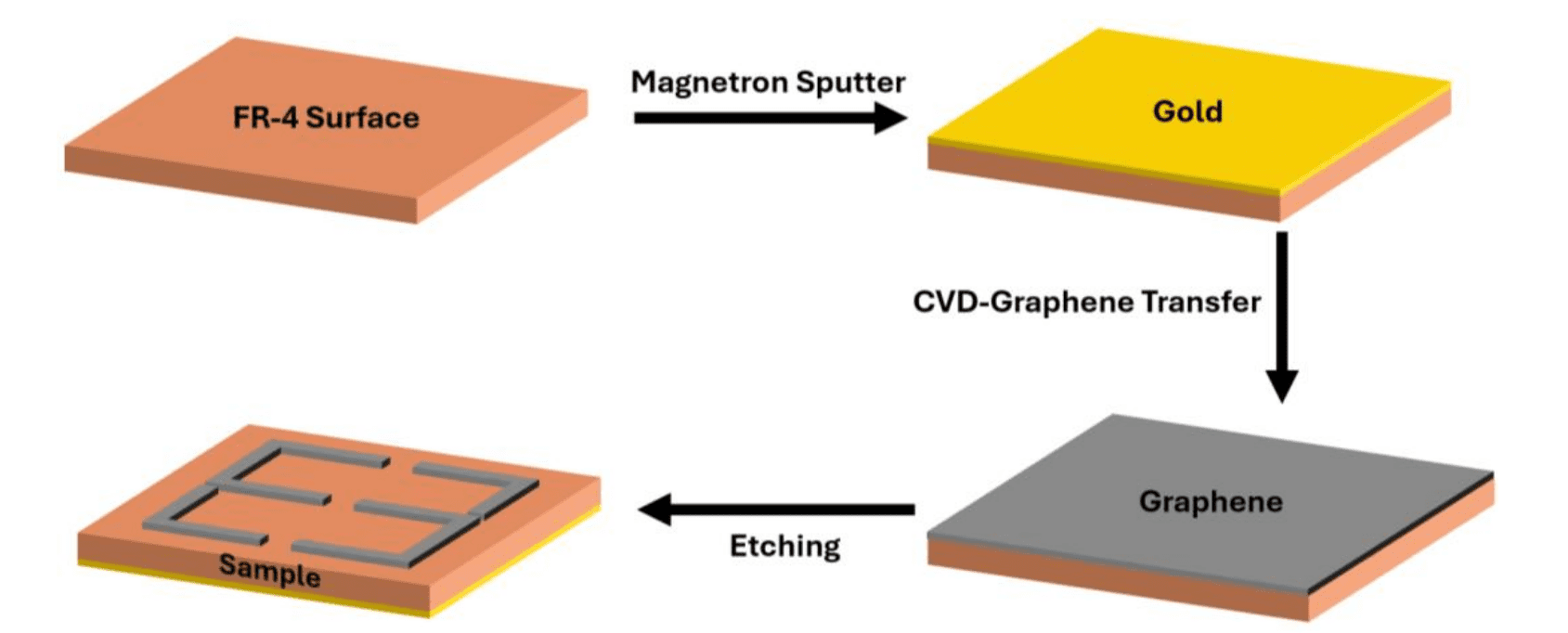
Researchers have developed a terahertz (THz) metamaterial absorber functioning as a refractive index (RI) sensor, achieving high performance through careful fabrication and characterization. The device consists of a patterned graphene metasurface on a dielectric substrate, completed with a gold ground plane, compatible with standard circuit board manufacturing techniques. Fabrication involves depositing a titanium/chromium adhesion layer followed by gold, then transferring a graphene layer onto the substrate using a polymer-assisted process to ensure film continuity. The metasurface pattern is defined using photolithography, followed by selective removal of graphene via oxygen plasma etching to create high-resolution features suitable for THz applications.
Alternative, cost-effective fabrication routes, including electroless gold deposition and femtosecond-laser direct writing, are also explored. Detailed analysis reveals strong absorption at 8. 436THz with 99. 99% absorption and a full width at half maximum of 0. 626THz, yielding a quality factor of 13.
- The device demonstrates a sensitivity of 1698GHz/RIU and a figure of merit of 2. 712, maintaining calibrated operation across a wide refractive index range of 1. 0 to 2. 0. Effective-parameter retrieval elucidates the electromagnetic response, revealing a capacitive effect coupled to a magnetic loop formed between the graphene and gold backplane. These results demonstrate a compact, high-performance THz RI sensor with broad applicability across diverse fields.
Graphene Metamaterial Enables Broadband Refractive Index Sensing
This research presents a graphene-enabled terahertz (THz) metamaterial absorber functioning as a refractive index (RI) sensor with electrically reconfigurable response and broadband index coverage. The sensor maintains calibrated operation across an ultra-wide RI range of 1. 0 to 2. 0, suitable for diverse applications, and encompasses the biomedical window of 1. 30 to 1.
39, enabling label-free biosensing applications. The design unites impedance-matched absorption with deeply confined THz modes, maximizing absorptance by funnelling incident power into a resonant cavity. Electrical reconfigurability, achieved by adjusting graphene’s chemical potential, provides practical control and stabilization of the operating resonance as the surrounding RI varies. This combination of characteristics allows for the detection of a wide range of materials, including gases, polymers, oils, and materials relevant to biomedical applications, all within a single calibrated device. An equivalent circuit model accurately reproduces the simulated spectra, validating the underlying resonance mechanism. The research highlights the synergy between graphene’s tunable conductivity and metamaterial field confinement, delivering a compact, high-figure-of-merit THz RI sensor.
Graphene Sensor Detects Broad Material Range
Researchers have developed a graphene-enabled terahertz metamaterial absorber functioning as a refractive index sensor with electrically reconfigurable properties and a broad operational range. The sensor’s response demonstrates a linear relationship between the analyte’s refractive index and the resonance frequency, achieving a sensitivity of 1698GHz/RIU and a figure of merit of 2. 712 RIU -1 . Electrical tuning, achieved through control of graphene’s chemical potential, provides a means to adjust the sensor’s frequency and absorption depth, while maintaining robust performance under varying incidence and polarization conditions. This combination of characteristics allows for the detection of a wide range of materials, including gases, polymers, oils, and materials relevant to biomedical applications, all within a single calibrated device. Future research will focus on experimental validation, including quantifying detection limits under realistic conditions, integrating the sensor with microfluidic systems, and developing surface functionalization techniques to enhance specificity.
👉 More information
🗞 Graphene enabled metamaterial absorber terahertz refractive-index sensor for biosensing
🧠 ArXiv: https://arxiv.org/abs/2511.01012