

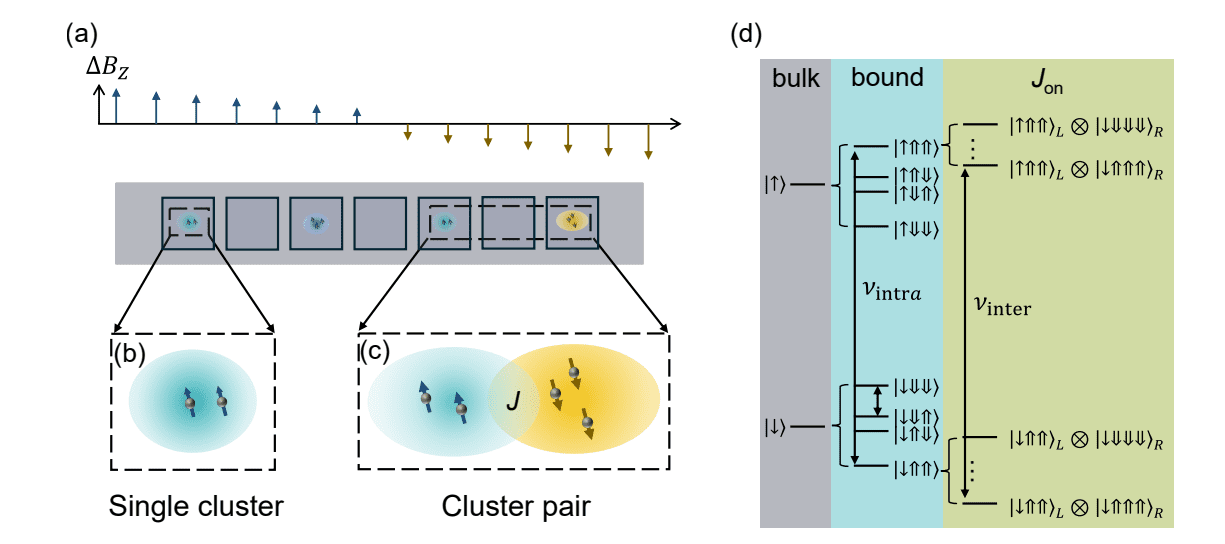
Silicon remains a promising platform for building a quantum computer, and researchers are increasingly focused on harnessing the properties of individual atoms embedded within it. Shihang Zhang, Chunhui Zhang, and Guanyong Wang, along with their colleagues, from the Shenzhen Institute for Quantum Science and Engineering and the International Quantum Academy, now present a new architecture based on deliberately created groupings of these atoms, known as donor clusters. This approach overcomes a key limitation in scaling up quantum processors, as it reduces interference between neighbouring qubits and allows for more complex connections between them. The team demonstrates, through detailed analysis and modelling, that high-fidelity operations are achievable within and between these clusters, paving the way for the creation of larger, more powerful spin-based quantum processors and bringing scalable quantum computing a significant step closer to reality.
Silicon Spin Qubits for Quantum Information
Research into quantum computing increasingly focuses on silicon-based qubits, utilizing the spin of electrons or atomic nuclei to store and process information. Scientists are also investigating higher-dimensional quantum systems, known as qudits, which could increase information density and improve error correction capabilities. A key challenge is controlling and coupling qubits, and researchers are developing methods to physically move qubits, a process called shuttling, to enable long-range interactions and create scalable architectures. Microwave control and coupling qubits to microwave cavities are also being investigated to enhance interactions and control.
Furthermore, scientists are exploring methods that utilize electric fields to control spin qubits and virtual photons to mediate interactions between distant qubits. Protecting quantum information from errors is paramount, and significant effort is dedicated to quantum error correction. The surface code is a leading error correction code being explored for silicon qubits, and researchers are investigating high-threshold codes that can tolerate higher error rates. Techniques for repetitive error detection and the development of quantum memory, capable of reliably storing quantum information, are also crucial areas of research.
These advancements aim to build fault-tolerant quantum computers capable of performing complex calculations. Current research trends emphasize scalability, coherence, and error correction. Scientists are striving to develop architectures that can accommodate a large number of qubits, improve the coherence times of silicon qubits, and implement robust quantum error correction. Hybrid approaches, combining different qubit technologies and control methods, are also being explored to leverage their respective strengths, paving the way for practical and powerful quantum computers.
Scalable Cluster Architecture for Nuclear Spin Qubits
Scientists have developed a scalable architecture for nuclear spin qubits based on phosphorus-doped silicon, addressing challenges related to crosstalk and imprecise atomic placement. This innovative design arranges multiple phosphorus donors into clusters, enabling high-fidelity multi-qubit gates and all-to-all connectivity. Detailed analysis of errors during operations revealed that careful device design and optimized control parameters effectively suppress unwanted interactions. The team pioneered two distinct control protocols: one utilizing electron and nuclear spin rotations assisted by electron spin resonance (ESR), and another employing initial nuclear rotations assisted by nuclear magnetic resonance (NMR) to enhance precision.
Experiments demonstrated that the NMR-assisted scheme achieves higher precision in individual operations, while the ESR-assisted scheme requires fewer operational steps. These findings establish crucial design requirements and parameter targets for future development. Researchers implemented nuclear-nuclear multi-qubit gates via conditional ESR operations, utilizing the Toffoli gate as a representative example. By precisely defining the hyperfine interaction strengths within the cluster, they characterized gate performance under realistic conditions, incorporating both crosstalk and single-qubit decoherence.
The team demonstrated that optimizing qubit coherence and carefully balancing crosstalk error with decoherence-induced error is crucial for achieving high-fidelity operations. This work establishes a viable pathway towards building large-scale quantum processors with enhanced connectivity and fidelity. By carefully controlling the interactions between qubits and mitigating the effects of noise, scientists are bringing the realization of practical quantum computing closer to reality.
Scalable Phosphorus Qubits Demonstrate Cluster Control
Scientists have demonstrated a scalable architecture for nuclear spin qubits based on phosphorus-doped silicon, achieving high-fidelity multi-qubit gates and all-to-all connectivity. This innovative design organizes qubits into small groups, or clusters, enabling precise control and minimizing unwanted interactions. Experiments successfully calibrated individual clusters using electron spin resonance (ESR) and nuclear magnetic resonance (NMR) techniques, accelerating the process with RF-multiplexing and multi-tone driving. By activating exchange interactions, adjacent clusters couple, forming larger single clusters that undergo the same calibration procedure, simplifying the calibration of inter-cluster operations.
Within each cluster, all quantum gates are implemented using NMR driving and conditional ESR driving, achieving addressable and arbitrary single-qubit operations. The ESR spectrum splits into distinct groups, enabling conditional rotations and the realization of multi-qubit CZ gates. Exploiting the mediating role of electrons, the team further demonstrated inter-cluster multi-qubit operations between adjacent clusters. The Hamiltonian for a two-cluster system reveals that the ESR frequencies of electrons depend on the nuclear spin configuration of the neighboring cluster, demonstrating the potential for controlled interactions. This scalable scheme provides a clear path toward building large-scale spin-based processors with enhanced connectivity and fidelity. This work represents a significant step forward in the development of practical quantum computers, demonstrating the feasibility of building large-scale processors with enhanced connectivity and fidelity.
Donor Clusters Mitigate Silicon Qubit Crosstalk
Researchers have detailed a scalable architecture for quantum computing based on donor cluster arrays in silicon, offering a promising route towards large-scale spin-based processors. This innovative design arranges multiple phosphorus donors into small, localized clusters to create qubits, leveraging the electron spins within these clusters for control and computation. Detailed analysis demonstrates that this cluster-based approach mitigates the challenges of crosstalk, a significant obstacle in scaling up silicon spin qubits, by carefully optimizing device design and control parameters. Calculations confirm the feasibility of both within-cluster and between-cluster multi-qubit gates, establishing specific requirements for experimental implementation.
The incorporation of tunable exchange interactions and micromagnets addresses the potential issue of frequency crowding, while strategic use of electron spin resonance and nuclear magnetic resonance techniques further suppresses errors. Furthermore, the team explored potential quantum error correction schemes tailored to the unique characteristics of this cluster-based system, paving the way for more robust quantum computation. The authors acknowledge that realizing a fully scalable two-dimensional architecture requires advanced fabrication techniques and precise control over donor placement. Future research will focus on implementing this scheme using state-of-the-art technologies and exploring alternative dopant species to enhance processor capabilities. This work establishes a solid theoretical foundation for developing silicon-based spin qubits and provides a viable pathway towards realizing large-scale quantum processors. This research represents a significant step forward in the development of practical quantum computers, demonstrating the feasibility of building large-scale processors with enhanced connectivity and fidelity.
👉 More information
🗞 A Quantum Computer Based on Donor-Cluster Arrays in Silicon
🧠 ArXiv: https://arxiv.org/abs/2509.24749