

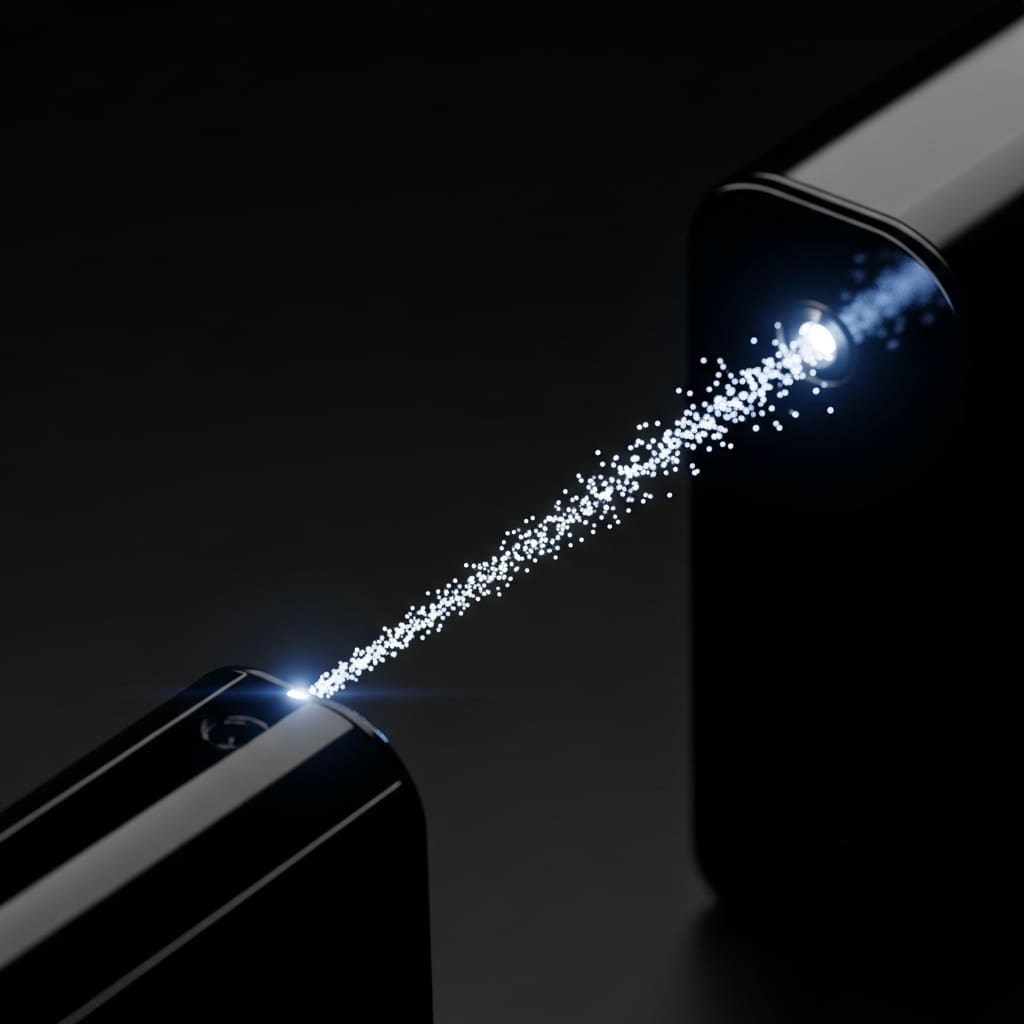
Scientists are tackling the challenge of distributing quantum information across global distances, a crucial step towards realising secure quantum communication and testing the fundamental laws of physics in space! Yi-Han Luo, Yuan Chen, and Ruiyang Chen, from the International Quantum Academy, alongside colleagues including Zeying Zhong et al., have developed a scalable integrated photon-pair source operating in the near-visible spectrum , a significant advancement over existing telecom-band technology! This new device overcomes a critical spectral gap, offering reduced diffraction loss and improved telescope collection efficiency for ground-to-satellite links, and boasts a spectral brightness of 4.87x 10⁶ pairs/s/mW/GHz alongside high-purity single-photon generation and strong energy-time entanglement! Crucially, built upon robust silicon nitride, the device promises long-term stability and manufacturability.
Visible-wavelength photon pairs for satellite quantum links
Scientists have demonstrated a scalable integrated photon-pair source operating in the near-visible spectrum, a crucial advancement for future satellite quantum networks and deep-space missions! The research team overcame a critical spectral gap in integrated photonics by fabricating a device based on an ultralow-loss silicon nitride (Si3N4) microresonator, enabling efficient generation of photon pairs at wavelengths ideal for satellite communication. This breakthrough addresses the limitations of existing telecom-band sources, which suffer from increased diffraction losses and reduced collection efficiency when used for satellite-to-ground links. The study unveils a novel approach to engineering the dispersion of higher-order waveguide modes within the microresonator, effectively overcoming the intrinsic normal dispersion limit that typically hinders phase matching in visible wavelengths.
Experiments show the fabricated device achieves a spectral brightness of 4.87x 10^7 pairs/s/mW^2/GHz, alongside a narrow photon linewidth of 357MHz, key performance indicators for quantum information processing. Researchers report high-purity heralded single-photon generation, reaching a heralding rate of up to 2.3MHz and exhibiting a remarkably low second-order correlation function of 0.0041, confirming the quality of the generated photon pairs. Furthermore, the team observed energy-time entanglement with an impressive 98.4% interference visibility, even at a high flux exceeding 40.6 million pairs/s, demonstrating the device’s capability for complex quantum protocols. The work establishes a flight-ready hardware foundation for daylight quantum communications and on-orbit multiphoton interference, leveraging the proven radiation hardness of Si3N4.
This innovative source is fabricated using CMOS-compatible processes, allowing for high-density integration on 150mm-diameter wafers, yielding hundreds of chips each hosting multiple robust microresonators. These chips are then packaged into compact modules, occupying only a few cubic centimeters and weighing a few hundred grams, an ideal form factor for satellite deployment. The research opens exciting possibilities for realizing global-scale quantum networks and conducting fundamental tests of quantum physics at unprecedented distances.
Near-visible photon pairs from silicon nitride microresonators
Scientists engineered a novel integrated photon-pair source utilising a silicon nitride (Si3N4) microresonator to address the critical spectral gap hindering global quantum networks! The study pioneered a device capable of generating near-visible photons, typically between 700, 850nm, to mitigate diffraction loss and maximise collection efficiency for ground-to-satellite quantum links. Researchers overcame the intrinsic normal dispersion limit of Si3N4, a challenge preventing efficient phase matching for spontaneous four-wave mixing (SFWM), by meticulously engineering the dispersion of higher-order waveguide modes. This innovative approach enables efficient photon pair generation in a spectral regime previously inaccessible with integrated photonics.
Experiments employed a continuous-wave (CW) pump laser at frequency f(μp) directed into the Si3N4 microresonator, initiating SFWM where two pump photons annihilate to create signal and idler photons at frequencies f(μs) and f(μi), adhering to the energy conservation principle 2f(μp) = f(μs) + f(μi). The device, fabricated using CMOS-compatible foundry processes on a 150mm-diameter Si3N4 wafer, exhibits a spectral brightness of 4.87x 10^12 pairs/s/mW/GHz and a narrow photon linewidth of 357MHz, critical performance metrics for quantum information processing. To counteract self- and cross-phase modulation (SPM and XPM) detuning the resonance grid, the team precisely controlled the microresonator dispersion, defined as Dint ≡ω(μ) −ω0 −D1μ = D2μ2/2 + · · ·, ensuring anomalous group velocity dispersion (GVD) where D2 0. The study demonstrated high-purity heralded single-photon generation, achieving a heralding rate up to 2.3MHz and a remarkably low second-order correlation function of 0.0041! Furthermore, scientists observed energy-time entanglement with 98.4% interference visibility, successfully violating the CHSH limit even at a flux exceeding 40.6 million pairs/s. This high level of entanglement, combined with the proven radiation hardness of Si3N4, positions this platform as a promising candidate for future quantum communication networks.
High-brightness SiN source for quantum photons enables efficient
Scientists have achieved a breakthrough in integrated photonics, demonstrating a near-visible photon-pair source based on a silicon nitride (Si N) microresonator! The research addresses a critical spectral gap, enabling the creation of robust, compact, and power-efficient photon sources essential for future quantum networks and deep-space missions. Experiments revealed a spectral brightness of 4.87x 10 pairs/s/mW/GHz, a significant advancement in the field of quantum light generation. This high brightness, coupled with a narrow photon linewidth of 357MHz, positions the device as a promising candidate for long-distance quantum communication.
The team measured high-purity heralded single-photon generation, achieving a heralding rate of up to 2.3MHz and a remarkably low second-order correlation function of 0.0041! These results demonstrate the source’s ability to produce indistinguishable photons, a crucial requirement for quantum interference and information processing. Furthermore, tests prove energy-time entanglement with an impressive interference visibility of 98.4%, even at a high flux exceeding 40.6 million pairs/s. This level of entanglement surpasses the CHSH limit, confirming the quantum nature of the generated photon pairs.
Researchers engineered the dispersion of higher-order waveguide modes to overcome limitations in visible wavelength photonics, achieving efficient phase matching within the Si N microresonator. At a threshold pump power of 0.69mW, the heralding rate reached 2.1MHz, while the maximum achievable photon-pair flux was found to be inversely proportional to the Q-factor. Detailed analysis, incorporating contributions from both radiative and extrinsic losses, is provided in supplementary materials. A folded Franson interferometer, employing a 2m path length difference and a 6.6ns temporal delay, was used to resolve the two-photon interference visibility.
Measurements confirm a raw visibility of 98.7±1.4% from the two-photon interference fringe, obtained at a pump power of 164 μW with a 3.0ns coincidence window. This result is consistent with calculations derived from the interference maxima and minima. The breakthrough delivers a flight-ready hardware foundation for daylight quantum key distribution and protocols requiring on-orbit multiphoton interference, thanks to the proven radiation hardness of Si N. Extended Data Table 1 provides a comprehensive performance benchmark, comparing our results with those reported in previous studies.
Silicon nitride source boosts quantum networking efficiency
Researchers have demonstrated an integrated near-visible photon-pair source fabricated from silicon nitride, addressing a critical spectral gap in integrated photonics! This device leverages a wide-bandgap microresonator and engineered waveguide modes to achieve efficient phase matching, a challenge for visible wavelength photon sources. The resulting source exhibits a spectral brightness of 4.87x 10 15 pairs/s/mW/GHz and a narrow linewidth of 357MHz, enabling high-purity heralded single-photon generation with a second-order correlation function as low as 0.0041! This achievement represents a significant step towards practical quantum communication and sensing networks, particularly those involving ground-to-satellite links, by offering a compact, robust, and power-efficient photon source operating at wavelengths that minimise diffraction losses.
The demonstrated energy-time entanglement, with 98.4% interference visibility and CHSH violation at high flux exceeding 40.6 million pairs/s, confirms the source’s potential for advanced quantum protocols. Furthermore, the silicon nitride material’s inherent radiation hardness suggests suitability for space-based applications. The authors acknowledge that optimising photon extraction efficiency remains a key area for improvement, as it directly impacts the heralding rate and overall flux. They also note the trade-offs between high photon-pair flux and single-photon purity, requiring careful consideration in system design. Future research will likely focus on refining the microresonator geometry to further enhance coupling efficiency and exploring strategies to mitigate multi-photon contributions, ultimately paving the way for deployment in real-world quantum technologies.
👉 More information
🗞 A scalable near-visible integrated photon-pair source for satellite quantum science
🧠 ArXiv: https://arxiv.org/abs/2601.13617