

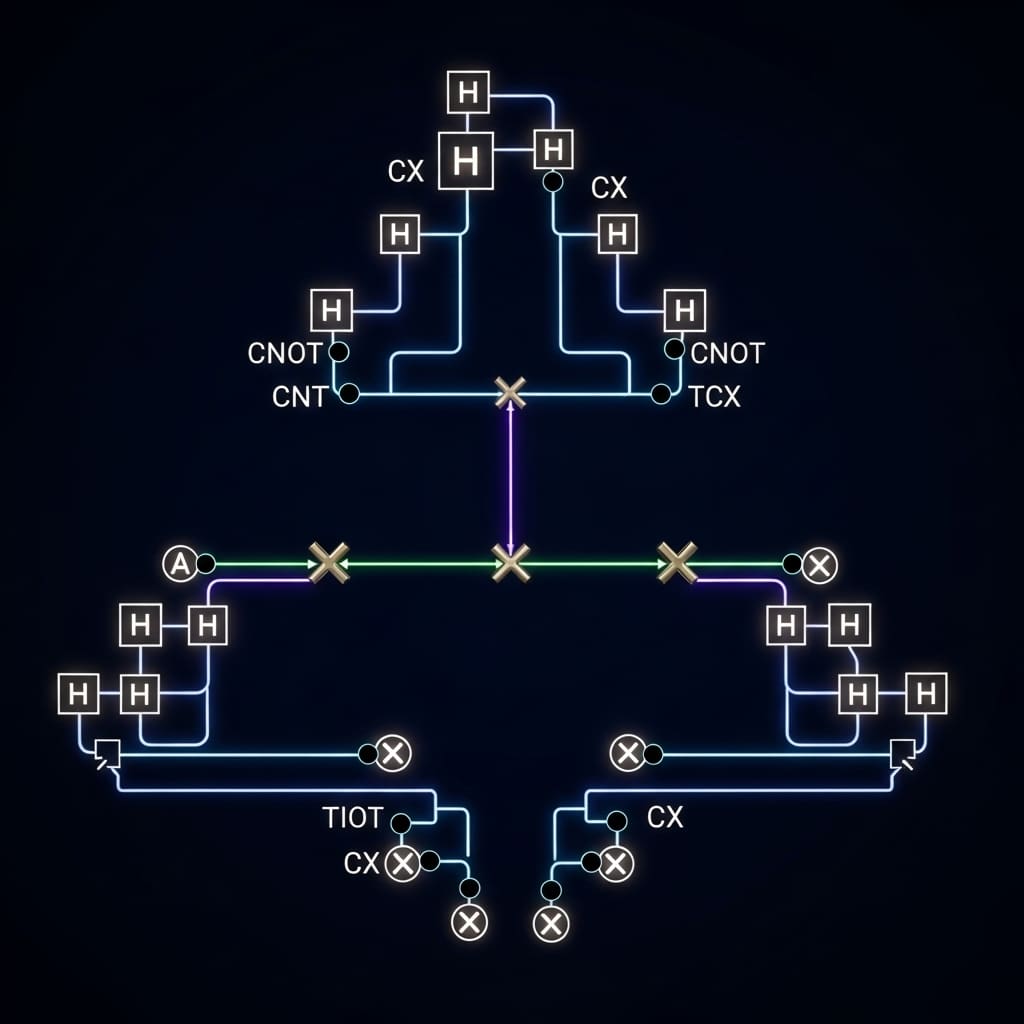
Scientists are tackling a critical challenge in quantum computing: preparing complex quantum states on imperfect hardware. Ramôa, Santos, and Mayhall, alongside Barnes, Economou et al, from Virginia Tech and the International Iberian Nanotechnology Laboratory, present a novel co-designed adaptive protocol , Co-ADAPT , that directly incorporates hardware constraints into the state preparation process. Their research significantly advances the field by optimising circuits for real-world devices plagued by limitations like connectivity and coherence, demonstrating up to a 97% reduction in the number of CNOT gates required for 12-14 qubit systems. Remarkably, Co-ADAPT even outperforms the original ADAPT protocol in ideal, fully-connected scenarios while still operating under restricted linear connectivity , paving the way for more efficient and scalable quantum computations.
Co-ADAPT-VQE tackles quantum hardware limitations by adaptively selecting
Scientists have unveiled a co-designed variant of the ADAPT-VQE algorithm, termed Co-ADAPT-VQE, which explicitly incorporates quantum hardware constraints during the construction of the ansatz, the initial quantum circuit used for calculations. This innovative framework addresses critical limitations of current quantum devices, including restricted qubit connectivity, short coherence times, and variable gate errors, offering a pathway to optimise state preparation circuits for any hardware platform. The team achieved this by modifying the selection criteria within ADAPT-VQE to penalise circuit components less suitable for the target quantum computer, effectively balancing problem-solving ability with hardware feasibility. This customisable penalty can be based on factors like circuit depth, two-qubit gate count after Transpilation, or even device-specific error rates, leading to more compact and resilient quantum circuits.
Experiments demonstrate a significant reduction in the number of CNOT gates, a key measure of circuit complexity, in state preparation circuits designed for devices with linear nearest-neighbor (LNN) connectivity. Specifically, the researchers observed a reduction of up to 97% in CNOT gate count for systems comprising 12-14 qubits, with the benefits increasing for larger and more complex systems. Remarkably, Co-ADAPT-VQE circuits achieved over a 70% reduction in CNOT gate count compared to the original ADAPT-VQE, even when the latter was designed for all-to-all qubit connectivity, a scenario where any qubit can directly interact with any other. This surprising result highlights the algorithm’s ability to create efficient circuits even under the more restrictive LNN connectivity constraints.
The study establishes that standard methods for converting circuits from all-to-all connectivity to LNN connectivity can more than triple the number of two-qubit gates required; however, Co-ADAPT-VQE effectively mitigates this increase. Table I showcases that, for systems ranging from 12 to 14 qubits, Co-ADAPT-VQE significantly outperforms existing methods in minimising CNOT gate counts while maintaining chemical accuracy, a benchmark for the reliability of quantum chemistry calculations. This work opens exciting possibilities for near-term quantum simulations, particularly in areas like materials science and drug discovery, where accurate ground state preparation is crucial. The research team’s approach represents a crucial step towards bridging the gap between theoretical quantum algorithms and the practical limitations of current quantum hardware.
By co-designing the algorithm and the circuit, they have created a system that is simultaneously problem-tailored, system-tailored, and hardware-aware. This allows for the creation of circuits that are not only optimised for specific computational tasks but also readily executable on existing quantum devices, paving the way for more efficient and scalable quantum computations in the future. The algorithm’s adaptability and customisable penalty function promise to be valuable tools for researchers working with a diverse range of quantum hardware platforms.
Co-ADAPT-VQE for constrained quantum circuit optimisation offers promising
Scientists developed Co-ADAPT-VQE, a co-designed variant of the ADAPT-VQE algorithm, explicitly incorporating quantum hardware constraints into the ansatz construction process. This innovative framework optimises state preparation circuits for any device, directly addressing limitations imposed by restricted connectivity, short coherence times, and variable gate errors. The research team demonstrated Co-ADAPT-VQE’s impact by generating state preparation circuits for devices possessing linear nearest-neighbor (LNN) connectivity, a common architectural constraint in many quantum processors. Experiments revealed a substantial reduction in CNOT gate count, up to 97% for 12-14 qubit systems, with the greatest improvements observed in larger, more strongly correlated systems.
The study pioneered a method to penalise circuit components unsuitable for the target quantum computer during the ansatz selection process. This customisable penalty function considers both generic circuit features, such as depth and two-qubit gate count after transpilation, and device-specific characteristics like gate errors. Researchers engineered this penalty to favour circuits more readily executable on noisy intermediate-scale quantum (NISQ) hardware, thereby enhancing resilience and reducing the impact of errors. Specifically, the team implemented a selection criterion that actively discourages the inclusion of circuit elements that would incur significant overhead during transpilation to the LNN connectivity.
To validate Co-ADAPT-VQE, scientists focused on the task of finding molecular ground states using state preparation circuits, restricting the analysis to LNN connectivity and prioritising the minimisation of two-qubit gates. Comparative analysis, detailed in Table I, showed that standard transpilation from all-to-all (ATA) connectivity to LNN connectivity typically increases two-qubit gate counts threefold. However, Co-ADAPT-VQE successfully reduced these LNN counts by up to 97%, achieving a performance exceeding that of the original ATA circuit despite the imposed interaction restrictions. For instance, on a linear H6 system (12 qubits), Co-ADAPT-VQE reduced the CNOT count from 2945 to 348, representing a 12% ratio compared to the previous LNN method. This work builds upon the adaptive derivative-assembled problem-tailored (ADAPT)-VQE algorithm, retaining its resilience against barren plateaus and local minima while integrating hardware awareness. The approach enables the creation of compact, noise-resilient circuits through a protocol simultaneously tailored to the hardware, the problem, and the specific system, representing a significant advancement in variational quantum eigensolver methodologies.
Co-ADAPT-VQE reduces CNOT gate count significantly
Scientists have developed Co-ADAPT-VQE, a co-designed variant of the ADAPT-VQE algorithm, which incorporates quantum hardware considerations directly into the construction of the ansatz. This innovative framework addresses limitations inherent in current quantum devices, such as restricted connectivity, short coherence times, and variable gate errors, offering a pathway to optimized state preparation circuits for any quantum hardware platform. The research team demonstrated the impact of Co-ADAPT-VQE by creating state preparation circuits specifically for devices with linear nearest-neighbor (LNN) connectivity. Experiments revealed a substantial reduction in the CNOT count of the final circuits, achieving up to 97% fewer CNOT gates for 12-14 qubit systems.
This improvement is particularly pronounced for larger and more strongly correlated systems, indicating the scalability of the approach. Surprisingly, the circuits generated by Co-ADAPT-VQE delivered over a 70% CNOT count reduction compared to the original ADAPT-VQE, even when the latter was operating with all-to-all connectivity, a significant achievement given the restriction to LNN qubit interactions. Data shows that the algorithm effectively balances hardware constraints with the need for accurate state preparation. Table I presents a detailed comparison of CNOT counts required to reach chemical accuracy, contrasting all-to-all (ATA) connectivity with LNN connectivity using both state-of-the-art methods and Co-ADAPT-VQE.
For a linear H6 system (12 qubits), the CNOT count was reduced from 854 to 348, representing a 12% ratio of the new method to the previous one. Similarly, for the linear H7 system (14 qubits), the count decreased from 437 to 92, yielding a 6% ratio, and for the triangular H6 system (12 qubits), the reduction moved from 1533 to 184, achieving a 3% ratio. Measurements confirm that transpilation from ATA to LNN connectivity typically increases the two-qubit gate count by a factor of over three; however, Co-ADAPT-VQE successfully mitigates this increase, reducing LNN counts by up to 97% and even surpassing the performance of ATA circuits despite the imposed interaction restrictions. The breakthrough delivers a customizable penalty system based on circuit depth, two-qubit gate count, or device-specific features like gate errors, allowing for the creation of more compact and noise-resilient circuits.
👉 More information
🗞 Co-Designed Adaptive Quantum State Preparation Protocols
🧠 ArXiv: https://arxiv.org/abs/2601.20681


