Precise control of superconducting qubits represents a critical challenge in the development of quantum computing, and researchers are continually seeking ways to improve processor scalability. Tianqi Cai, Chitong Chen, and Kunliang Bu, alongside colleagues at their institutions, now present a new approach to qubit control using a multiplexed double-transmon coupler scheme. This innovative architecture significantly reduces the number of control lines needed to operate multiple qubits, overcoming a major bottleneck in current superconducting processor designs. The team experimentally demonstrates that this method effectively suppresses unwanted interactions between qubits while maintaining the accuracy required for complex gate operations, achieving high-fidelity preparation of multi-qubit entangled states, and paving the way for larger, more powerful quantum processors.
Tunable Couplers Enhance Superconducting Qubit Control
Scientists have detailed research into superconducting qubits, focusing on a new approach to controlling them using tunable double-transmon couplers (DTCs). This work presents a comprehensive analysis of the experimental setup, theoretical simulations, and results achieved with this innovative technology. The research centers on achieving high-fidelity two-qubit gates, essential for building a functional quantum computer, and addresses the challenges of scaling up quantum processors. Superconducting qubits form the fundamental building blocks of quantum processors, exhibiting quantum mechanical properties.
DTCs act as devices connecting qubits and controlling the strength of their interaction, allowing for precise manipulation of quantum states. A key innovation lies in multiplexing, a technique sharing a control line between multiple couplers, reducing wiring complexity and enhancing scalability. This approach significantly simplifies the control systems required for larger quantum processors. The research demonstrates the ability to achieve high-fidelity iSWAP and CZ gates using the multiplexed DTC architecture. This is achieved through careful design and fabrication of the DTCs, alongside detailed numerical simulations of the qubit-coupler system.
The simulations and experiments demonstrate suppression of crosstalk between qubits, a critical factor in maintaining high fidelity. The work utilizes wafer-scale fabrication techniques to ensure uniformity and reproducibility of the qubits and couplers. This research represents a significant step forward in the development of superconducting quantum computers. The multiplexed DTC architecture and advanced fabrication techniques offer a promising path towards building larger, more reliable, and more powerful quantum processors. The high-fidelity gates and crosstalk suppression demonstrated in this research are essential for performing complex quantum computations, paving the way for more advanced quantum algorithms and applications.
Multiplexed Couplers Reduce Qubit Control Complexity
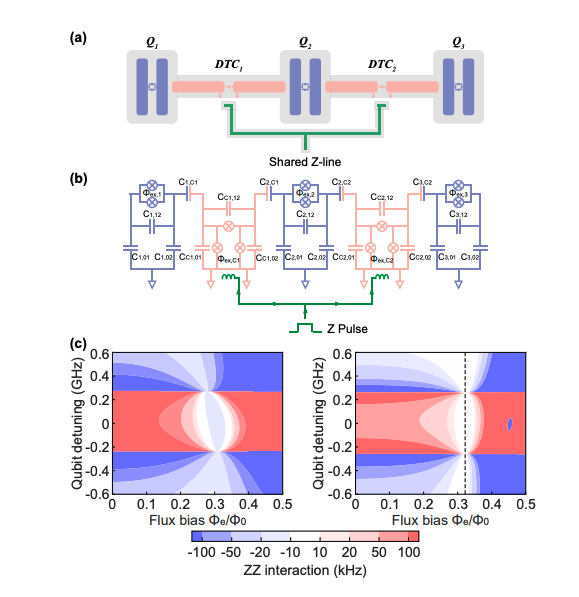
Scientists have developed a novel multiplexed double-transmon coupler (DTC) architecture to address the increasing challenge of control line complexity in superconducting quantum processors. This work pioneers a method for sharing control lines between qubits, significantly reducing wiring overhead and enhancing scalability. The research focuses on a three-qubit unit, where two DTCs mediate interactions, and a single shared control line is strategically split to manage coupling between adjacent qubits. The team meticulously engineered this configuration to minimize unwanted static ZZ coupling, a common source of error in quantum computations, while maintaining precise control over two-qubit gate operations.
Detailed analysis of ZZ coupling characteristics, both through theoretical modeling and experimental verification, confirms the effectiveness of this approach. Researchers demonstrated the feasibility of performing parallel single-qubit gate operations within the multiplexed architecture, confirming that the shared control line does not compromise individual qubit control. Furthermore, the team implemented both a fast coupler Z-control-based CZ gate and a parametric iSWAP gate to demonstrate the versatility of the DTC architecture. To validate the scalability of this approach, scientists prepared Bell states and three-qubit Greenberger-Horne-Zeilinger (GHZ) states using the multiplexed DTC scheme.
The resulting fidelities exceeded 99% for Bell states and reached 96% for three-qubit GHZ states, demonstrating the ability to maintain high-fidelity entanglement in multi-qubit circuits. This achievement establishes the proposed architecture as a promising candidate for building large-scale superconducting quantum processors, offering a pathway to minimize wiring complexity and enhance the scalability of quantum computing systems. The study’s results suggest a significant step towards realizing practical, scalable quantum computation, bringing the development of powerful quantum computers closer to reality.
Multiplexed Qubit Control via Double-Transmon Couplers
Scientists have achieved a significant breakthrough in superconducting qubit control by demonstrating a robust multiplexed control scheme using a double-transmon coupler (DTC) architecture. This work addresses a critical bottleneck in scaling quantum processors, namely the increasing complexity of wiring as qubit numbers grow. The team successfully implemented a system where multiple qubits share control lines via DTCs, substantially reducing wiring complexity without sacrificing control accuracy. Experiments reveal that the DTC architecture effectively suppresses undesirable static coupling between qubits while maintaining precise control over two-qubit gate operations.
Through this method, the team demonstrated the creation of Bell states and three-qubit Greenberger-Horne-Zeilinger (GHZ) states with fidelities exceeding 99% and 96%, respectively, validating the scalability of the approach. Detailed analysis of the static ZZ interaction between qubits shows that the DTC configuration maintains a stable coupling strength across a broader range of qubit detunings compared to single-transmon coupler (STC) systems. The team fabricated a quantum processor featuring five transmon qubits arranged in a one-dimensional chain, utilizing three qubits to demonstrate the multiplexed unit. Measurements confirm that the DTC architecture allows for precise tuning of qubit frequencies while minimizing unwanted interactions.
Randomized benchmarking experiments demonstrate high-fidelity single-qubit gate performance, with sequence fidelities reaching over 99% for isolated qubits and remaining above 98% even when performing simultaneous operations on multiple qubits. These results establish the proposed DTC architecture as a promising candidate for building scalable superconducting quantum processors and significantly advancing the field of quantum computation. This breakthrough paves the way for more complex quantum algorithms and applications, bringing the potential of quantum computing closer to realization.
Multiplexed Control Simplifies Superconducting Qubit Scaling
This research demonstrates a new architecture for superconducting qubits that significantly reduces the complexity of control wiring, a major obstacle to scaling up quantum processors. Scientists developed a double-transmon coupler (DTC) scheme with multiplexed control lines, allowing multiple qubits to share a single control line without compromising performance. Experimental validation confirms the ability to accurately control two-qubit gate operations while suppressing unwanted interactions between qubits. The team successfully implemented both fast coupler-based CZ gates and parametric iSWAP gates using this multiplexed approach, achieving high-fidelity preparation of Bell states and three-qubit GHZ states, exceeding 99% and 96% respectively.
This advancement offers a promising pathway towards building larger and more practical quantum computers by minimizing wiring congestion in two-dimensional qubit arrays. Researchers acknowledge that further work is needed to explore optimal line-sharing strategies, such as alternating multiplexing along rows, to maximize efficiency. The compatibility of this multiplexed DTC scheme with surface codes and other quantum error correction protocols positions it as a strong candidate for scalable architectures in future quantum computing platforms. The team highlights the resilience of the CZ gate to the quantum states of nearby qubits, demonstrating the robustness of the proposed scheme and its potential for building reliable and scalable quantum computers. This research represents a significant step towards realizing the full potential of quantum computation.
🗞 Multiplexed double-transmon coupler scheme in scalable superconducting quantum processor
🧠 ArXiv: https://arxiv.org/abs/2511.02249