Laser cutting, a cornerstone of modern manufacturing, presents challenges to both environmental sustainability and worker safety through the generation of harmful byproducts. Mohamed Abdallah Salem, Hamdy Ahmed Ashur, and Ahmed Elshinnawy, from the Arab academy for science, technology and maritime transport, address these concerns with a novel material classification technique. Their research leverages the principles of speckle sensing and applies deep learning to identify material types during the laser cutting process, offering a pathway towards safer and more efficient operation. By training a convolutional neural network to recognise distinct material characteristics from laser speckle patterns, the team demonstrates a robust and accurate solution that maintains high performance even when laser colour is altered, achieving an impressive F1-score of 0. 9643 across a diverse range of materials. This advancement promises to enable material-aware laser cutting, minimising waste and improving working conditions within manufacturing environments.
Laser Speckle Pattern Material Identification with Deep Learning
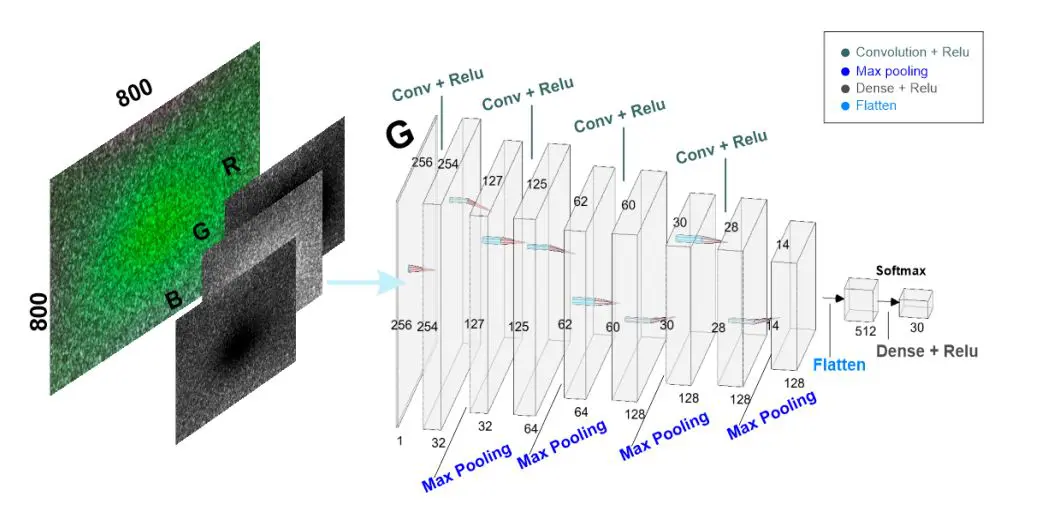
Scientists have developed a new technique for accurately classifying materials used in laser cutting, leveraging the unique interference patterns created when a laser beam reflects off a surface, known as laser speckle. This innovative approach combines speckle pattern analysis with deep learning, specifically convolutional neural networks, to identify materials quickly and reliably, addressing the need for automated material identification in laser cutting workshops. The team demonstrated that accurate classification can be achieved using information from just one color channel of the speckle pattern image, simplifying data processing and reducing computational demands. The system was tested on a diverse range of materials commonly used in laser cutting, consistently achieving high accuracy, precision, recall, and F1-scores.
This research represents a significant step towards more efficient and automated fabrication processes by providing a reliable method for identifying materials before or during laser cutting. Future research will focus on expanding the dataset to include a wider variety of materials and integrating speckle pattern analysis with other sensing techniques, such as thermal imaging and acoustic sensors, to create an even more robust and accurate material identification system. Further optimization of the deep learning model and development of a real-time implementation are also key areas for future work, potentially enabling adaptive laser cutting processes that automatically adjust settings based on the identified material.
Deep Learning Identifies Materials During Laser Cutting
Scientists have developed a novel material classification technique using speckle patterns and deep learning to monitor laser cutting processes, achieving remarkably high accuracy even when laser color is altered. The research demonstrates a system capable of accurately distinguishing between materials with over 98% accuracy on training data and nearly 97% on a validation set, confirming its ability to reliably identify materials. Further evaluation on a new dataset of 3000 images, representing 30 different materials, yielded a strong F1-score, demonstrating robust performance across a diverse range of materials. The team designed a convolutional neural network with a specific architecture optimized for processing speckle pattern images, containing over 13 million trainable parameters.
Comparative analysis against a baseline model reveals significant advantages, achieving higher accuracy while requiring significantly less processing time, highlighting its suitability for real-time applications. These results demonstrate a breakthrough in material-aware laser cutting, offering a robust and accurate solution for process monitoring and control. The system’s ability to accurately identify materials in real-time opens the door to automated laser cutting processes that can adapt to different materials without manual intervention, improving efficiency and reducing waste.
Laser Speckle Identifies Materials During Cutting
This research demonstrates a highly accurate method for identifying materials during laser cutting using deep learning and laser speckle patterns. By training a convolutional neural network on speckle patterns, the team achieved a classification accuracy of over 96% on a diverse set of materials, including wood, plastics, and metals. Importantly, the system maintains its accuracy even when the laser color is altered, addressing a limitation of previous speckle sensing techniques. The developed approach offers a robust and versatile solution for material-aware laser cutting, potentially improving efficiency by reducing material classification time.
The team highlights the effectiveness of utilizing a single channel from the input image to significantly enhance classification performance. While acknowledging the need for expanded datasets and further optimization of the deep learning models, the researchers suggest future work could integrate this speckle sensing data with other sensing techniques to achieve even more comprehensive and accurate material classification. This work establishes a strong foundation for advancements in automated laser cutting processes and material identification, paving the way for more efficient, reliable, and adaptable manufacturing techniques.
🗞 Towards a Safer and Sustainable Manufacturing Process: Material classification in Laser Cutting Using Deep Learning
🧠 ArXiv: https://arxiv.org/abs/2511.16026