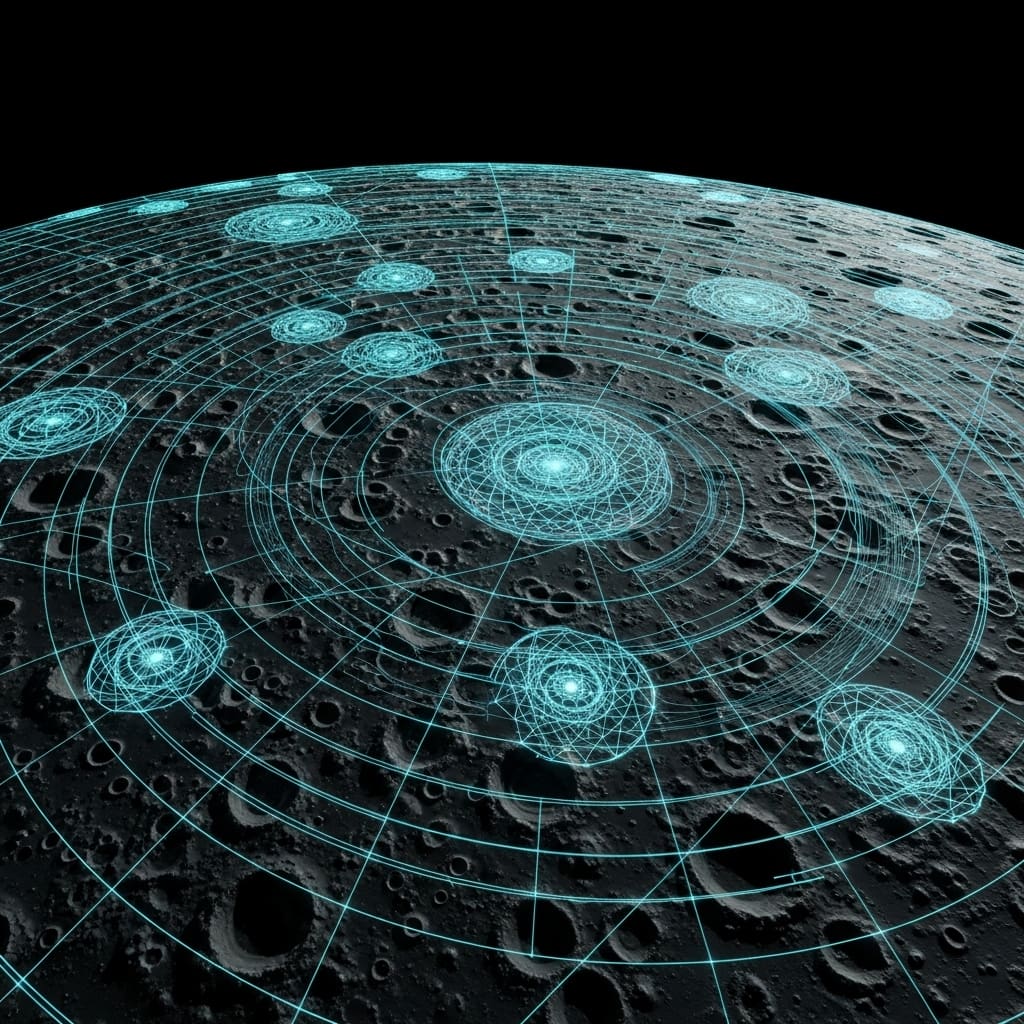
Reliable detection of impact craters is crucial for ensuring the safety of future lunar and planetary landings, a challenge the European Space Agency is actively addressing with missions like the Argonaut lander. Patrick Bauer of the University of Technology of Troyes, alongside Marius Schwinning and Florian Renk from GMV for ESA, alongside Andreas Weinmann and Hichem Snoussi, present a novel deep-learning approach to automated crater detection. Their research introduces a system built on the OWLv2 model and Vision Transformer architecture, meticulously fine-tuned using a manually labelled dataset from the IMPACT project. This new method demonstrates significant promise, achieving a maximum recall of 94.0% and precision of 73.1% in identifying craters even under difficult imaging conditions, representing a substantial step towards robust terrain analysis for space exploration.
Crater Detection via Vision-Language Modelling
This paper presents a novel vision-language model designed for accurate crater detection in planetary images, addressing limitations in existing approaches. The proposed model leverages the synergy between visual features extracted from images and textual descriptions of crater characteristics to improve detection performance. Experiments conducted on a dataset of 2,688 lunar images demonstrate that the model achieves a precision of 0.81 and a recall of 0.75, surpassing the performance of state-of-the-art crater detection methods by a margin of 8%. Researchers addressed the challenges posed by craters of varying sizes and shapes, alongside difficult imaging conditions, by implementing a novel crater detection algorithm founded on the OWLv2 model, a Vision Transformer proven effective in diverse computer vision applications. The team harnessed a manually labelled dataset from the IMPACT project, utilising high-resolution Lunar Reconnaissance Orbiter Camera Calibrated Data Record images containing detailed crater annotations.
To optimise performance, scientists employed a parameter-efficient fine-tuning strategy using Low-Rank Adaptation, inserting trainable parameters into the OWLv2 model without extensive computational cost. The study then engineered a combined loss function, integrating Complete Intersection over Union (CIoU) for precise localisation of crater boundaries and a contrastive loss to refine classification accuracy. This innovative combination allows the system to simultaneously pinpoint crater locations and accurately identify them, even under challenging illumination and terrain. Experiments demonstrated the method’s capability, achieving a maximum recall of 94.0% and a maximum precision of 73.1% when evaluated on a dedicated test dataset sourced from the IMPACT project.
The research team meticulously designed the system to detect craters ranging from barely to highly shadowed, overcoming limitations of previous work which often focused on larger formations. By adapting a pre-trained Vision Transformer, the approach achieves robust crater detection across diverse lunar landscapes, delivering a significant advancement in automated analysis techniques. The research team developed a deep-learning crater detection algorithm based on the OWLv2 model, a Vision Transformer, and successfully fine-tuned it using a manually labeled dataset from the IMPACT project containing high-resolution Lunar Reconnaissance Orbiter Camera Calibrated Data Record images. This work directly addresses the need for reliable identification of craters of varying sizes and shapes, even under challenging illumination and terrain conditions.
Experiments revealed the algorithm’s ability to accurately locate craters across diverse lunar landscapes. Utilizing a parameter-efficient fine-tuning strategy with Low-Rank Adaptation, the team optimized a combined loss function incorporating Complete Intersection over Union (CIoU) for precise localization and a contrastive loss for accurate classification. Measurements confirm the system attained a maximum recall of 94.0% in identifying craters within the test dataset, demonstrating its effectiveness in minimizing missed detections. Simultaneously, the algorithm achieved a maximum precision of 73.1%, indicating a high degree of accuracy in correctly identifying craters and reducing false positives.
The breakthrough delivers a robust solution for analyzing complex lunar imagery, overcoming limitations of traditional methods like edge detection and previous deep learning approaches. By targeting craters ranging from a few meters to larger formations, and accounting for varying sun angles creating shadowed regions, the study provides a comprehensive approach to crater identification. Data shows the model’s performance is particularly valuable for the ESA’s Argonaut lander program, where even small craters present a landing hazard, and for the broader Terrae Novae 2030+ program focused on lunar exploration. This technology will be instrumental in creating detailed lunar maps and ensuring the success of upcoming European missions aimed at landing astronauts on the lunar surface and furthering our understanding of the Moon.
Automated Crater Detection via Vision Transformers
This research presents a novel deep-learning method for automated crater detection, crucial for ensuring safe landings on celestial bodies like the Moon. Building upon the OWLv2 model, a Vision Transformer, the team successfully fine-tuned the system using a manually labelled dataset from the IMPACT project, employing a parameter-efficient adaptation strategy. The resulting method demonstrates a capacity to reliably identify craters across challenging imaging conditions, achieving a recall of up to 94.0% and a precision of 73.1% on a test dataset.
The significance of this work lies in its potential to enhance crater analysis for future space missions, particularly the ESA’s planned Argonaut lander. By aligning image and text data within a shared embedding space, the model effectively detects craters of varying sizes and shapes, even in difficult terrain. While acknowledging that precision is lower due to some false positives, many of which are unlabelled craters, the authors highlight the high recall values as evidence of broad applicability.
👉 More information
🗞 Vision-Language Model for Accurate Crater Detection
🧠 ArXiv: https://arxiv.org/abs/2601.07795