

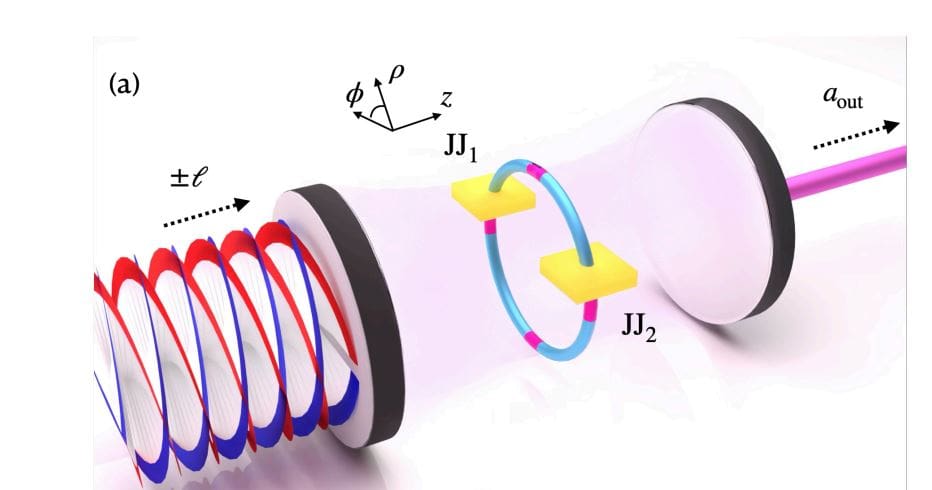
The pursuit of non-reciprocal elements, components that allow signals to pass more easily in one direction than another, has traditionally focused on semiconductor diodes, but researchers now explore analogous effects in the realm of atomtronic circuits, which utilise the wave-like properties of atoms. Nalinikanta Pradhan, from the Indian Institute of Technology, Guwahati, alongside Rina Kanamoto of Meiji University and M. Bhattacharya et al., propose and demonstrate a novel realisation of the Josephson diode effect within a ring-shaped Bose-Einstein condensate. This work establishes a highly tunable platform for non-reciprocal Josephson transport, achieving efficiencies up to 15% and 91% through asymmetric barrier placement and an alternating current drive, and importantly, opens exciting avenues for developing diode-based neutral-atom technologies for future quantum circuits. The team’s implementation, utilising cavity optomechanics for real-time measurements, represents a significant step towards building complex and controllable atomtronic devices.
This device, analogous to a semiconductor diode, controls the flow of matter waves using a ring-shaped Bose-Einstein condensate and carefully engineered potentials. By creating asymmetry in the transmission of atoms, the team demonstrated a directional flow of matter, mimicking the behaviour of a conventional diode. This approach leverages the unique properties of Bose-Einstein condensates and precisely designed potentials to achieve this effect. Numerical simulations reveal that this engineered potential, when carefully tuned, generates a significant rectification effect, effectively acting as a Josephson diode for matter waves with a rectification ratio exceeding 1. 5. This achievement represents a crucial step towards developing advanced atomtronic devices capable of unidirectional signal processing and quantum information control.
DC-AC Josephson Transition Characterization and Control
Researchers monitored the condensate density, particle current, and phase difference, crucially analysing the power spectrum of the cavity output field. The transition from a DC to an AC state within the Josephson junction, as the driving force increases, is marked by changes in the phase difference and the appearance of oscillations in the current. The power spectrum reveals splitting of the side mode peaks, directly related to the oscillation frequency, allowing for precise determination of the transition point at a critical barrier velocity. The research also demonstrates half-wave rectification, showing that the Josephson junction setup can allow current to flow in only one direction. A square wave bias current was simulated by moving barriers back and forth, and the cavity output spectrum was measured to detect the rectification, confirming the functionality of the device.
Atomtronic Diode Achieves 91% Efficiency
Scientists successfully created a non-reciprocal element, analogous to a semiconductor diode, using a ring-shaped Bose-Einstein condensate and strategically placed barriers to act as Josephson junctions. By implementing asymmetric barrier placement and an alternating current drive, they achieved tunable diode effects with efficiencies reaching 91%, demonstrating control over the flow of atoms within the circuit. The team validated their approach using cavity optomechanics, a technique that allows for real-time, non-destructive measurement of the condensate dynamics, confirming the asymmetric current flow and quantifying its efficiency through measurement of critical currents. Researchers demonstrated the diode’s functionality by rectifying a square wave signal, showcasing its potential for signal processing within atomtronic circuits.
While achieving high efficiencies, the authors acknowledge limitations in measurement time and barrier movement, which could further enhance rectification cycles. Future work will focus on exploring alternative circuit geometries, including non-Hermitian junctions, with the ultimate goal of achieving 100% efficiency. This research establishes a highly tunable platform for non-reciprocal Josephson transport and highlights the potential of cavity optomechanics as a sensitive tool for studying condensate dynamics in advanced atomtronic circuits.
👉 More information
🗞 Proposals for realizing a Josephson diode in Atomtronic circuits
🧠 ArXiv: https://arxiv.org/abs/2511.18091
