

Antiferromagnetic materials offer exciting potential for next-generation spintronics, and researchers are actively seeking ways to enhance their ability to convert charge current into spin current. Jiabin Wang from Wuhan University of Science and Technology, Wancheng Zhang from Hubei Polytechnic University, and Yong Liu, along with colleagues at Wuhan University, now demonstrate a particularly efficient mechanism in a newly identified class of antiferromagnets they term ‘X-type’. This research reveals that these materials generate remarkably strong spin currents, exceeding the performance of conventional ferromagnets and other antiferromagnetic systems, due to a unique geometric arrangement of their electronic structure. The team’s findings establish X-type antiferromagnets as a promising foundation for developing low-power spintronic devices that rely on manipulating spin, rather than charge, to process information.
X-type Stacking Boosts Spin Conversion Efficiency
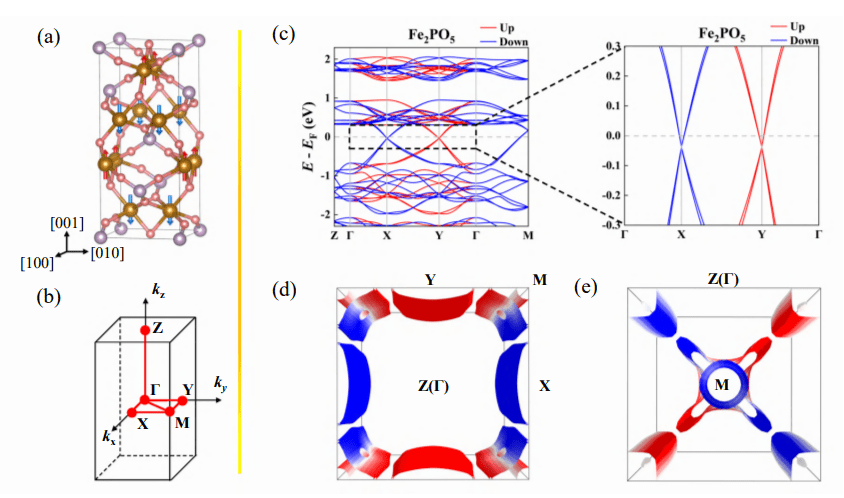
This research presents a significant advance in spintronics, demonstrating exceptionally high charge-to-spin conversion efficiency in the antiferromagnet β-Fe₂PO₅. The material exhibits remarkably large intrinsic charge-to-spin conversion, surpassing many known materials and paving the way for energy-efficient spintronic devices. This high efficiency stems from the unique X-type stacking of the cross-chain antiferromagnetic structure, which creates a non-coplanar spin texture and a large off-diagonal component in the spin Hall conductivity. Crucially, the material exhibits a significant T-odd spin Hall conductivity, meaning the spin current directly relates to the charge current, maximizing conversion efficiency for spin-orbit torque applications.
The research relies on sophisticated theoretical calculations to understand the electronic structure, spin texture, and spin Hall conductivity of β-Fe₂PO₅. By comparing β-Fe₂PO₅ to other materials, the team demonstrates a significant performance advantage, connecting the observed phenomena to the concept of altermagnetism, where unique symmetry properties and non-coplanar spin textures enhance spin-orbit coupling and charge-to-spin conversion. Controlling crystal orientation during material growth is vital to optimize charge-to-spin conversion efficiency. This breakthrough opens possibilities for developing more energy-efficient and faster spin-orbit torque-based memory and logic devices, establishing β-Fe₂PO₅ as a promising new material platform for spintronics. The findings provide valuable insights into designing materials with high charge-to-spin conversion efficiency, guiding future materials discovery efforts.
X-type Antiferromagnets and Spin Hall Conductivity
Scientists investigated a novel class of antiferromagnetic materials, termed X-type antiferromagnets, to enhance spin current generation, a crucial element in next-generation spintronic devices. Advanced theoretical calculations modeled the electronic structure of these materials with high precision, accurately describing the interplay between electron behavior and magnetic order, and incorporating spin-orbit coupling effects essential for understanding spin current generation. These materials achieve a charge-to-spin conversion efficiency reaching 90%, significantly exceeding that of conventional materials. By manipulating the Néel vector orientation, the team controlled the spin current polarization, generating out-of-plane spin-polarized currents with substantially improved efficiencies. Detailed symmetry analysis of the spin Hall conductivity tensor provides a fundamental understanding of the mechanisms governing spin current generation in these materials. The team’s calculations accurately predict the materials’ behavior, confirming the potential of X-type antiferromagnets as highly effective spin sources for low-power spintronics.
X-Type Antiferromagnets Generate High-Efficiency Spin Currents
Scientists have discovered a new class of antiferromagnetic materials, termed X-type antiferromagnets, that generate remarkably efficient spin currents, exceeding the performance of altermagnets. These materials exhibit a unique Fermi surface geometry that facilitates enhanced spin splitting while preserving zero net magnetization. Experiments reveal that the spin current polarization is directly controlled by the orientation of the Néel vector, offering a pathway to manipulate spin flow. This structure enables highly efficient generation of T-odd spin currents, achieving a charge-to-spin conversion efficiency reaching 90%.
Further investigation demonstrates the generation of out-of-plane spin currents with a conversion efficiency of 80%, a substantial improvement over existing materials. Detailed measurements of the spin Hall conductivity and charge-to-spin conversion efficiency confirm the exceptional performance of this material. The computed spin Hall conductivity reveals a high conversion efficiency, while comparative analysis demonstrates that the spin Hall angle of β-Fe₂PO₅ significantly surpasses all established material systems. This breakthrough delivers a valuable design principle for developing low-power spintronic devices, offering a versatile and highly controllable spin source platform.
X-Type Antiferromagnets Generate High-Efficiency Spin Currents
This research demonstrates a new class of antiferromagnetic materials, termed X-type antiferromagnets, which exhibit remarkably efficient generation of spin currents. Scientists discovered that these materials, due to their unique crystallographic structure and resulting Fermi surface geometry, produce stronger spin currents than previously studied altermagnets along specific directions. The efficiency of this spin current generation is directly linked to the orientation of the material’s Néel vector, allowing for control over the direction of the generated spin-polarized currents. These findings establish X-type antiferromagnets as promising candidates for developing low-power spintronic devices, offering a novel and highly effective source of spin currents.
👉 More information
🗞 High-Efficiency Nonrelativistic Charge-Spin Conversion in X-Type Antiferromagnets
🧠 ArXiv: https://arxiv.org/abs/2510.19194