

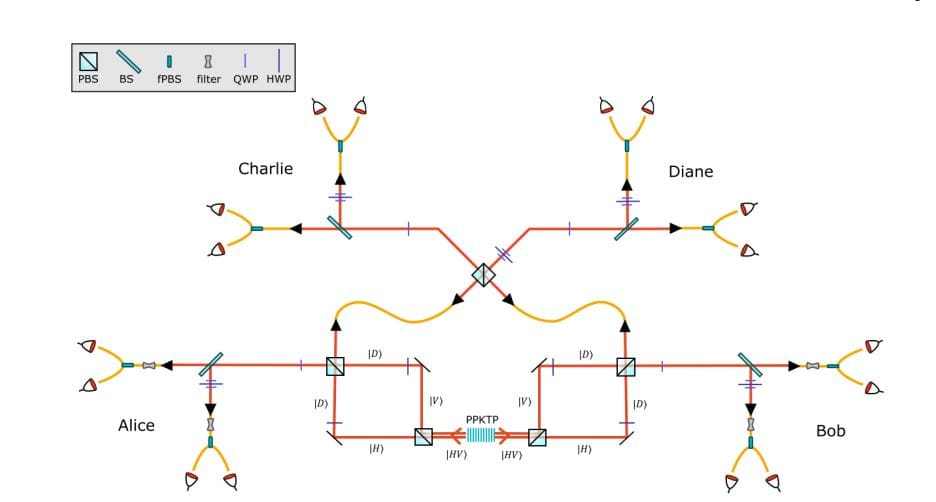
Secure communication remains a critical challenge, and researchers continually explore methods to guarantee privacy and anonymity in increasingly complex systems. Francis Marcellino, Mingsong Wu, and Rob Thew from the University of Geneva now demonstrate a significant step forward by experimentally implementing a quantum election protocol that protects voter privacy. The team successfully conducts a four-party election using photonic GHZ states, achieving high fidelity in both state generation and voter intention recording. This work establishes a crucial proof-of-concept, showing how quantum mechanics can underpin genuinely secure elections where no single entity, not even a central authority, can determine individual voting preferences.
Guarantees are essential to ensure legitimacy. Researchers experimentally implement a recently proposed election protocol, demonstrating that no one, including a potential central authority, can know the preferred candidate of any voter other than themselves. They conduct a four-party election, generating and distributing four-partite GHZ states with approximately 89% fidelity and successfully recording voters’ intentions approximately 87% of the time. Many quantum phenomena, such as no-cloning, true randomness, and destructive measurement, are attractive for cryptographic or communication purposes, where they facilitate protocols that can outperform any classical counterpart, the most salient example being quantum key distribution.
Decentralized Quantum Voting Without Trusted Authorities
This research details a quantum protocol for electronic voting that provides strong security and privacy guarantees without relying on a trusted central authority, like an election commission. It builds upon previous work in quantum secure multi-party computation and addresses the challenges of creating a truly decentralized and verifiable voting system. The protocol eliminates the need for a trusted third party to collect, tally, and verify votes, reducing the risk of manipulation and single points of failure. Votes are protected using quantum principles, ensuring voter anonymity and preventing anyone, even those running the system, from linking a voter to their ballot.
The protocol allows voters to verify that their vote was correctly recorded and included in the final tally, without revealing their vote to anyone else. The system is designed to be resistant to various attacks, including those from malicious voters or colluding parties. The protocol leverages principles of quantum information processing. Votes are encoded and distributed among multiple parties using quantum states, ensuring that no single party has access to complete vote information. Techniques are used to transmit votes in a way that obscures the sender’s identity.
Quantum operations are performed on the distributed vote information to tally the results. Voters can verify the integrity of the tallying process and confirm their vote was included without revealing their choice. This approach is robust even if some participating parties are malicious or attempt to cheat. The authors discuss the challenges of scaling the protocol to a large number of voters and explore potential solutions. The paper addresses practical aspects of implementing the protocol, such as the requirements for quantum hardware and communication channels.
The team demonstrated the feasibility of the approach in a small-scale setting. Future research will focus on improving scalability by developing more efficient quantum communication and computation techniques to handle a larger number of voters. They also aim to develop more reliable and scalable quantum devices for implementing the protocol and explore alternative quantum technologies, such as superconducting qubits or trapped ions. Addressing fault tolerance will be crucial to mitigate the effects of errors in quantum computations. In essence, this research presents a promising step towards building a secure, private, and verifiable electronic voting system based on the principles of quantum information processing. While significant challenges remain, the authors demonstrate the feasibility of the approach and outline a path towards practical implementation.
Secure Election Protocol Using Entangled Photons
This work demonstrates a secure election protocol leveraging quantum mechanics to guarantee voter anonymity and prevent manipulation, even from a central authority. Scientists successfully implemented a four-party election using entangled photons, generating and distributing four-partite GHZ states with a fidelity of 0. 89. Experiments revealed the ability to record voters’ intentions with sufficient timing resolution to establish secure communication. The core of the protocol involves distributing random bits to each voter, ensuring an even parity across all bits.
The team achieved this by creating specific quantum states and allowing voters to randomly choose between different measurement bases. After distributing a large number of states, the team selected events where all four parties successfully received and measured a photon, further refining this to include only events with an even number of measurements. This yielded a subset of states reserved for voting and another for verifying the integrity of the source. Measurements confirm a fourfold coincidence rate of approximately 0. 3 events per second, indicating successful entanglement distribution and detection.
The system utilizes single-photon detectors with efficiencies exceeding 80% and dark count rates below 300 counts per second, ensuring high data quality. Researchers implemented a fourfold anti-coincidence filter and a 1 nanosecond coincidence window to minimize spurious detections and refine the data stream. The team verified the source’s integrity by randomly selecting a party to act as a “Verifier”, who then checked the measurement outcomes against expected parity conditions. If the proportion of failed verifications remained below a defined threshold, the reserved states were used for voting, with measurement outcomes replacing the initial random bits. This approach ensures a malicious source cannot undermine the protocol, even when colluding with other parties. The breakthrough delivers a robust and secure voting system, paving the way for future applications in secure communication and data privacy.
Quantum Voting Protocol Achieves High Privacy
This research team has successfully demonstrated a quantum electronic voting protocol that guarantees voter privacy and anonymity, requiring neither quantum memories nor assumptions about the source of the quantum states. The protocol was experimentally implemented with four voters using multipartite entanglement, specifically four-partite GHZ states, achieving a success probability of approximately 87%. This achievement represents a significant step towards secure and private electronic voting systems, leveraging the principles of quantum mechanics to address vulnerabilities inherent in classical systems. The experiment involved generating and distributing entangled states and recording voters’ intentions, while ensuring that no single entity, including a central authority, could determine an individual voter’s preference.
While acknowledging the experimental complexity and a success rate somewhat lower than theoretically possible due to implementation challenges, the team identified potential improvements. These include an alternative implementation utilizing fast polarization control, which could circumvent the rate reduction associated with the current approach. Further scaling up the system to accommodate a larger number of voters will require practical sources of on-demand single photons, with semiconductor quantum dots identified as a promising candidate due to their potential for high-rate operation.
👉 More information
🗞 Experimental quantum voting using photonic GHZ states
🧠 ArXiv: https://arxiv.org/abs/2512.03659

