Support vector machines, powerful tools for classification and prediction, stand to gain a significant boost from the emerging field of quantum computing. Mario Bifulco and Luca Roversi, both from the Università degli studi di Torino, investigate a complete implementation of a quantum learning pipeline specifically designed for these machines. Their work demonstrates how quantum circuits can construct kernels, the core of support vector machine functionality, and then solve the resulting optimisation problem using quantum techniques. The researchers show that careful alignment of the quantum kernel with the data, combined with appropriate parameter tuning, yields competitive performance, achieving an impressive 90% F1-score and paving the way for practical applications of hybrid quantum-classical algorithms in high-performance computing.
Quantum Kernel Learning with Quantum Annealing
Building the End-to-End Quantum Learning Pipeline
Developing an End-to-End Quantum Learning Pipeline
Scientists developed a fully quantum approach to support vector machine (SVM) learning, integrating gate-based quantum kernel methods with quantum annealing-based optimization to create an end-to-end learning pipeline. The team engineered a system where input vectors are interpreted as quantum states through specifically designed quantum circuits, effectively preparing the data for quantum processing. For each pair of input vectors, researchers constructed quantum circuits that combined transformations, creating a superposition of states crucial for kernel calculation. The core of the method involves estimating the overlap between these resulting quantum states by measuring the probability of the system collapsing to a specific state, which directly defines the kernel matrix used in the SVM.
Data Selection and Benchmarking Methodology Details
To evaluate the pipeline’s performance, the team employed a subset of the Breast Cancer dataset, carefully selecting samples using a unique approach based on prime numbers to ensure the preservation of the original statistical distribution. This dataset was chosen for its established use in benchmarking classification algorithms and its balanced representation of clinically relevant features, allowing for robust evaluation of the pipeline’s generalizability. The researchers harnessed the power of quantum annealing to solve the optimization problem inherent in SVM training, reformulating it as a Quadratic Unconstrained Binary Optimization (QUBO) problem ideally suited for quantum annealers. This innovative method achieves a competitive F1-score of 90% with the best performing model, demonstrating the feasibility of a fully quantum SVM implementation. The study pioneers the use of diverse Quantum Processing Units (QPUs) within a Quantum High-Performance Computing (QHPC) context, enabling collaboration between traditional computing systems and various quantum architectures to tackle computationally intensive problems. By unifying gate-based kernel computation with quantum annealing-based optimization, the team unlocks new possibilities for high-performance machine learning and expands the boundaries of efficient computation.
Quantum Kernels Enable Efficient Data Alignment
Mapping Data into Quantum State Spaces Using Circuits
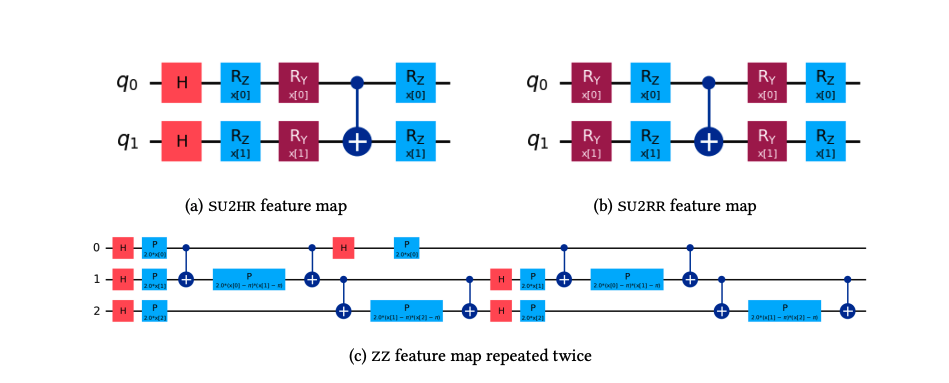
Scientists have successfully constructed a fully quantum learning pipeline for support vector machines, integrating gate-based kernel methods with quantum annealing-based optimization. The team developed a method to map input data into quantum states using specifically designed quantum circuits, enabling the computation of quantum kernels that exploit qubit entanglement and superposition to potentially compress data representation. This approach allows for the construction of kernel matrices that define the similarity between data points based on their quantum representations, paving the way for more efficient data analysis. Experiments reveal that a high degree of alignment between the quantum kernel and the target data, combined with appropriate regularization, leads to competitive performance in machine learning tasks.
Validation Results: Achieving Competitive Performance Levels
Utilizing a subset of the Breast Cancer dataset, the researchers rigorously evaluated their pipeline, employing prime number seeds to ensure the preservation of the original statistical distribution of the data. The results demonstrate the feasibility of this end-to-end quantum learning approach, achieving a peak F1-score of 90%, a key metric for evaluating classification accuracy. This breakthrough delivers a pathway towards hybrid quantum architectures for high-performance computing (QHPC), where traditional computing systems collaborate with various quantum processing units (QPUs). The team’s work highlights the potential of combining the strengths of gate-based quantum computing for kernel computation with the optimization capabilities of quantum annealing, offering a versatile framework for tackling complex machine learning problems.
Quantum SVM Achieves Classical Performance Levels
Achieving Competitive Performance with Quantum Kernels
This study successfully demonstrates a fully quantum pipeline for support vector machine learning, integrating quantum kernel methods with quantum annealing-based optimization. Researchers constructed quantum kernels using various qubit configurations and feature maps, achieving competitive classification performance on a benchmark dataset. The best performing model attained a 90% F1-score, a result comparable to classical support vector machines employing radial basis function kernels. These findings highlight the feasibility of end-to-end quantum machine learning and the potential of hybrid quantum-classical high-performance computing workflows.
Understanding Limitations and Future Scaling Potential
The research indicates that both the number of qubits used and the chosen feature map significantly influence the model’s performance, with fewer qubits leading to reduced accuracy. While the approximation inherent in representing continuous variables with discrete binary variables in the quantum annealing process did not substantially degrade performance, the authors note the presence of systematic false negatives suggests potential for further refinement. They acknowledge that improvements could be achieved through enhanced data preprocessing strategies or the use of larger, more representative datasets, and believe these areas offer the most promising avenues for future research. This work represents an initial step towards scalable quantum machine learning pipelines and exploring the role of quantum computing in broader computational workflows.
🗞 Exploring an implementation of quantum learning pipeline for support vector machines
🧠 ArXiv: https://arxiv.org/abs/2509.04983