Detecting faint, continuous gravitational waves remains a significant challenge for astronomers, requiring extensive computational resources to search vast datasets. Damon H. T. Cheung from the University of Michigan and colleagues demonstrate a novel approach using an attention U-Net, a type of convolutional neural network, to efficiently identify these elusive signals. The team trained this model on simulated gravitational wave data, achieving comparable sensitivity to existing deep learning methods, but with substantially reduced training time and data requirements. This achievement represents a crucial step towards scalable, all-sky gravitational wave searches, offering a promising pathway to unlock new insights into astrophysical phenomena and test the predictions of Einstein’s theory of general relativity.
The team trained the network on approximately 10. 67 days of simulated data containing Gaussian noise, demonstrating a new approach to navigating the extensive parameter space required for these searches. The model trained specifically at 20Hz achieved the highest sensitivity, reaching a detection depth of 29. 97 ±0.
24Hz−1/2 at 90% detection efficiency with a 1% false alarm rate per 50mHz. Extending the observation time for this model to approximately 21 days resulted in an improved sensitivity depth of 35. 86 ±0. 38Hz−1/2, with measurements confirming that sensitivity scales with total observation time as T0. 28±0.
- Experiments revealed the robustness of the neural network when analyzing datasets with time gaps, demonstrating its potential for use with real-world data, and sensitivity was found to depend on the duty factor, scaling as η0. 53±0. 02. This work demonstrates an effective and scalable approach to all-sky continuous gravitational wave searches, offering a promising new tool for detecting these elusive signals and furthering our understanding of dense matter physics and neutron stars.
Deep Learning Enhances Gravitational Wave Detection
This research demonstrates the successful application of an attention U-Net, a type of convolutional neural network, to the challenging task of detecting continuous gravitational waves across the entire sky. By training the model on simulated data, scientists achieved sensitivity comparable to state-of-the-art deep learning methods, but with significantly reduced training time and data requirements. The attention U-Net effectively identifies weak signals embedded in noise, demonstrating its potential for wide-parameter searches that are computationally expensive with traditional methods. The team found that the model’s sensitivity improves with longer observation times, following a predictable scaling relationship, and remains robust even when data contains gaps, with sensitivity linked to the proportion of available data.
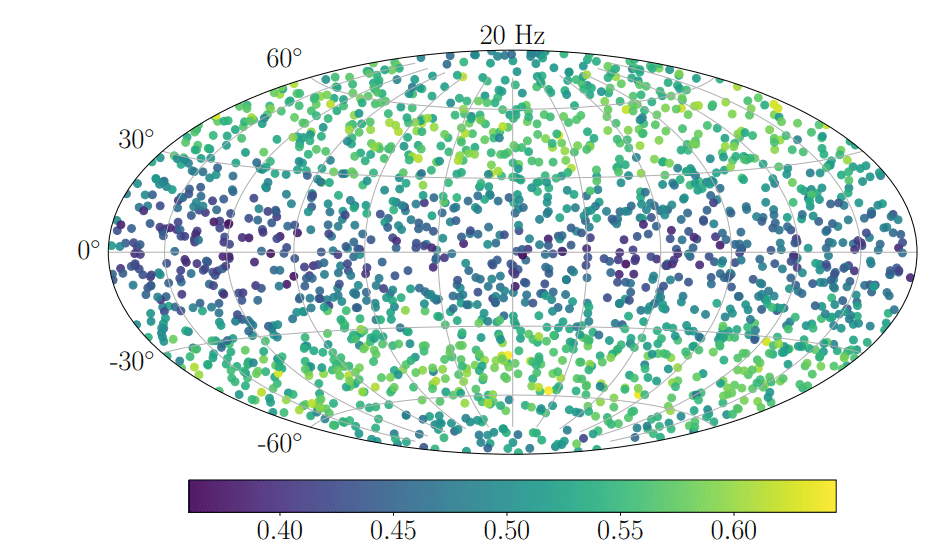
Analysis of the model’s performance across different sky locations revealed frequency-dependent variations, highlighting the complexities introduced by Doppler shifts of the gravitational wave signals. Increasing the scale of training data and initial feature channels showed promising gains, suggesting avenues for future optimization. Continuous gravitational waves, emitted by rapidly rotating neutron stars, are incredibly faint and difficult to detect. Traditional methods struggle with the vast amount of data required to search the entire sky. This research offers a new approach, leveraging the power of deep learning to efficiently and effectively identify these elusive signals.
The attention U-Net’s ability to learn complex patterns in the data allows it to filter out noise and pinpoint potential gravitational wave sources with greater accuracy and speed. The findings suggest that deep learning has the potential to revolutionize the search for continuous gravitational waves, opening up new possibilities for understanding the properties of neutron stars and the fundamental laws of physics. Future research will focus on addressing the challenges of Doppler modulation and scaling up the model with more extensive training data to unlock its full potential for gravitational wave detection.
👉 More information
🗞 Attention U-Net for all-sky continuous gravitational wave searches
🧠 ArXiv: https://arxiv.org/abs/2509.19838