Fluorescent defects in materials like diamond and boron nitride hold immense promise for nanoscale sensing, but realising their full potential requires methods to amplify their signals and integrate them into practical devices. Daniel J. Tibben, Roy Styles, and David A. Broadway, along with colleagues at RMIT University, now present a scalable technique for achieving this, using optical cavities to dramatically enhance the performance of fluorescent nanodiamonds and boron nitride nanoparticles. The team demonstrates that embedding these materials within thin-film cavities boosts their brightness and accelerates their response times, with some nanoparticles exhibiting a thirteen-fold increase in signal enhancement. Crucially, this approach also improves magnetic field sensitivity nearly five-fold, paving the way for more sensitive and cost-effective quantum sensors with applications ranging from medical imaging to materials science.
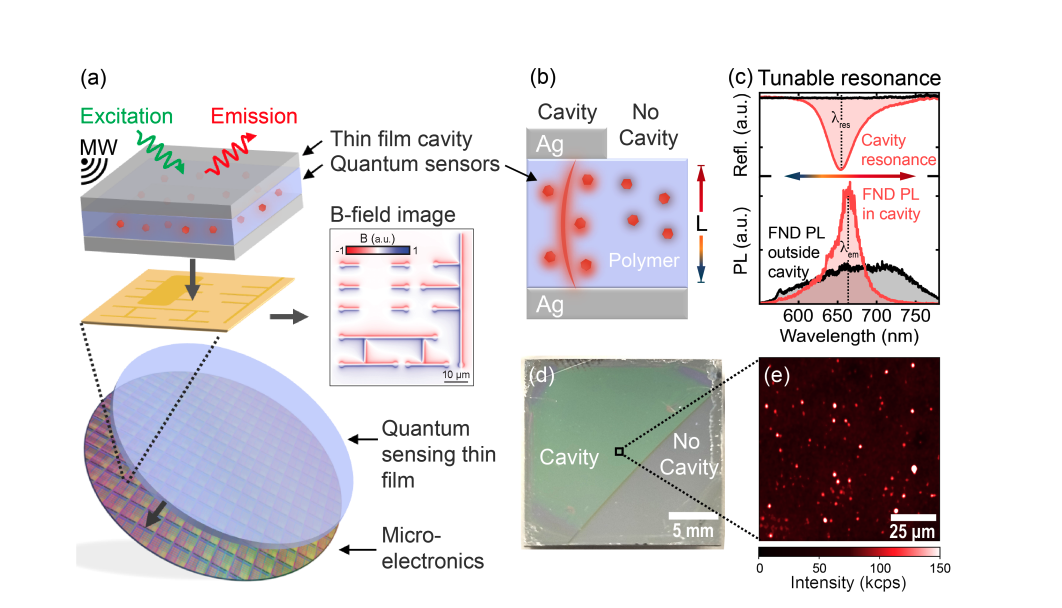
These materials are central to numerous quantum technologies, and methods for integrating them into macroscopic structures that improve sensitivity and enable large-scale deployment are highly sought after. This work demonstrates cavity-enhanced photoluminescence from fluorescent nanodiamonds and hexagonal boron nitride nanoparticles embedded in polymer-based thin-film optical cavities fabricated on centimeter scales. The cavity resonances efficiently modulate the spectral position of light emitted from nitrogen-vacancy centers in nanodiamonds across the entire emission spectrum, leading to up to a 2. 9-fold increase in the rate at which they emit light. Furthermore, the brightness of hexagonal boron nitride nanoparticles increases by up to a factor of three, and their emission decay rate is also enhanced.
HBN Emitters and Cavity Enhancement Studies
This research explores single-photon emitters in hexagonal boron nitride and, to a lesser extent, nanodiamonds with nitrogen-vacancy centers. Studies cover identifying and characterizing single-photon emitters in hBN, understanding their origin, whether from point defects, carbon impurities, or organic molecules, and coupling them to optical cavities to enhance emission efficiency and control their properties. Researchers also investigate and control nitrogen-vacancy centers in nanodiamonds for applications in magnetometry, sensing, and quantum information processing, complementing these experimental investigations with theoretical studies and materials characterization techniques. A central question is the origin of the single photons emitted by hBN.
Research suggests emission arises from point defects within the hBN lattice itself, carbon-related impurities, or organic molecules adsorbed on the surface. Characterizing the wavelengths and emission spectra of these single photons is crucial, as is enhancing emission by coupling emitters to photonic crystal cavities and microresonators. Statistical analysis helps researchers understand the distribution and properties of emitters across hBN flakes, while theoretical modeling provides insights into defect structures and predicts their optical properties. Studies on nanodiamonds focus on characterizing nitrogen-vacancy centers and utilizing them for magnetometry, sensing, and quantum information processing, also investigating the size, surface chemistry, and colloidal properties of the nanodiamonds.
Photonic crystal cavities and optical spectroscopy are key techniques used to characterize the emission properties of these materials. Theoretical modeling and statistical analysis play vital roles in understanding material properties and identifying trends. This curated collection of research papers provides a snapshot of the exciting work being done on single-photon emitters in two-dimensional materials and nanodiamonds, offering a valuable resource for literature reviews, research direction, grant proposal writing, and educational purposes.
Enhanced Nanoparticle Emission via Polymer Microcavities
Scientists have developed a novel method for enhancing the performance of nanoscale light emitters, specifically nitrogen-vacancy centers in nanodiamonds and hexagonal boron nitride nanoparticles, by embedding them within polymer-based optical cavities. These microcavities, fabricated on centimeter-scale thin films, dramatically modulate the optical properties of the embedded nanoparticles, leading to significant improvements in both brightness and sensitivity. The team successfully created these cavities using a low-cost and scalable fabrication process, paving the way for advanced sensing technologies. Experiments reveal that the cavity design efficiently alters the spectral position of light emitted from nitrogen-vacancy centers in nanodiamonds across their entire emission spectrum.
This modulation results in up to a 2. 9-fold increase in the rate at which the centers emit light, a phenomenon known as Purcell enhancement. Furthermore, the brightness of hexagonal boron nitride nanoparticles increases by up to a factor of three, and their light emission decay rate is enhanced by as much as 13-fold when placed inside the cavities. The most significant breakthrough lies in the improved magnetic field sensitivity achieved with these cavity-enhanced sensors, with researchers measuring up to a 4. 8 times improvement for 20-nanometer nanodiamonds due to the combined effect of enhanced optical contrast and increased brightness.
This enhancement promises substantial advancements in applications requiring precise magnetic field detection, such as magnetic imaging and current sensing in microcircuits. The team demonstrated the fabrication of devices spanning a broad spectral range, covering the emission wavelengths of both nanodiamonds and hBN emitters, highlighting the versatility of this approach. These findings demonstrate a pathway toward creating highly sensitive, commercially viable quantum sensors for a wide range of applications.
Enhanced Nanoparticle Fluorescence in Optical Cavities
This research demonstrates a successful method for enhancing the fluorescence of both fluorescent nanodiamonds and hexagonal boron nitride nanoparticles by embedding them within thin-film optical cavities. The team achieved up to a 2. 9-fold increase in the rate of light emission from the nanodiamonds and a 13-fold enhancement for the boron nitride nanoparticles, demonstrating the effectiveness of this cavity-based approach. Importantly, this enhancement translated to a 4. 8-fold improvement in the sensitivity of nanodiamonds when detecting magnetic fields, highlighting the potential for advanced sensing technologies.
The study establishes a scalable and cost-effective fabrication process for these thin-film cavities, paving the way for wafer-scale production of enhanced quantum sensors. While the current devices show significant improvements, the authors acknowledge that thicker cavities may be needed to achieve even greater enhancement, but this must be balanced against potential optical losses. Future work will likely focus on optimising cavity thickness and exploring low-loss materials to maximise performance. This research represents a significant step towards integrating nanoscale quantum sensors into practical, large-scale applications.
🗞 A scalable method for cavity-enhanced solid-state quantum sensors
🧠 ArXiv: https://arxiv.org/abs/2509.04760