

Current artificial intelligence systems often benefit from being structured as agents with memory and tools, but adapting these agents to become true domain experts remains a significant challenge. Jiahao Qiu, Xuan Qi, and Hongru Wang, along with colleagues, address this by presenting ALITA-G, a novel framework that evolves general-purpose agents into highly capable specialists. The team achieves this through a systematic process of generating, refining, and curating tools, allowing the agent to learn from successful experiences and build a reusable knowledge base. Across challenging benchmarks including GAIA, PathVQA, and Humanity’s Last Exam, ALITA-G not only achieves state-of-the-art performance, reaching 83. 03% pass@1 on the GAIA validation set, but also substantially reduces computational costs, representing a major step towards more efficient and adaptable artificial intelligence.
The system learns and improves by systematically generating, organizing, and reusing specialized tools, termed Context Protocol (MCP) components. This approach transforms a general-purpose agent into a domain expert, enhancing both accuracy and efficiency. The framework benefits from advanced embedding models and technologies like Octotools and Smo-Lagents, providing comprehensive tool-augmented agent capabilities. The research demonstrates substantial performance improvements through evolutionary algorithms, multi-turn reinforcement learning, and self-evolution with language feedback. By leveraging these techniques, ALITA-G consistently outperforms baseline agents and achieves state-of-the-art results, consolidating knowledge into reusable components and benefiting from large-scale datasets for improved reasoning.
Self-Evolving Agents Learn from Iterative Experience
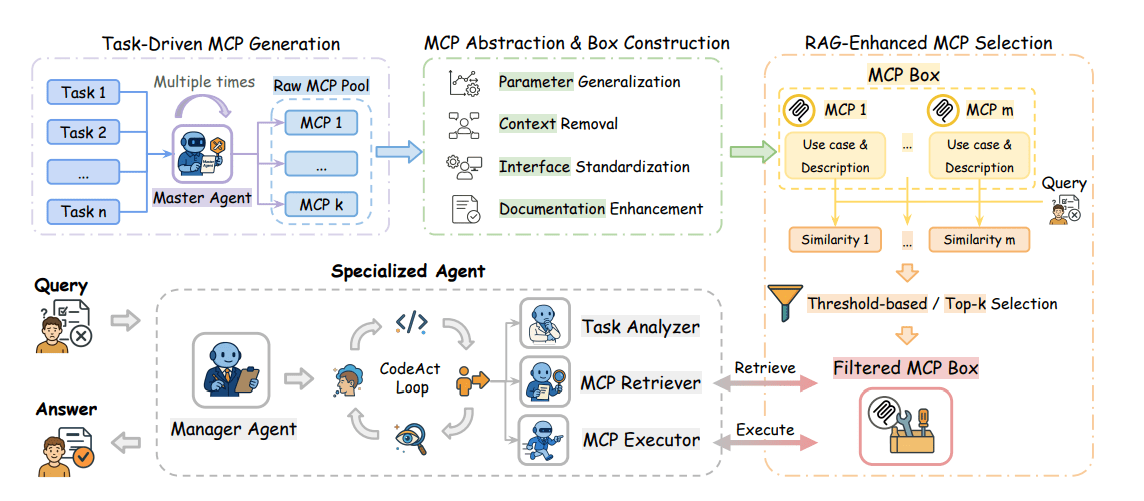
Scientists have created ALITA-G, a novel self-evolution framework that transforms general-purpose AI agents into domain specialists. The system achieves this by systematically generating, abstracting, and curating specialized tools, known as Context Protocol (MCP) components, from successful task executions. Through repeated engagement with tasks, ALITA-G synthesizes diverse MCP components and captures adaptable behaviors, abstracting successful strategies into parameterized primitives and consolidating them into an MCP Box. At inference time, ALITA-G utilizes retrieval-augmented MCP selection, leveraging descriptions and use cases to identify the most relevant tools for new tasks.
ALITA-G Evolves Domain-Specialist Reasoning Agents
Researchers have developed ALITA-G, a novel self-evolution framework that transforms general-purpose AI agents into domain specialists, achieving substantial performance improvements within specific areas of expertise. The work demonstrates a pathway from general capability to reusable, domain-specific competence, improving both accuracy and efficiency on complex reasoning tasks. ALITA-G operates by systematically generating, abstracting, and curating Context Protocol (MCP) tools from successful task executions, creating a reusable MCP Box. The team achieved this by systematically generating, abstracting, and curating task-derived tools into what they term Context Protocol (MCP) Boxes. These boxes organize tools and enable retrieval-augmented selection during problem-solving, significantly enhancing agent capabilities on specific tasks while also reducing computational costs. The results demonstrate that organizing tools into reusable MCP Boxes not only improves performance but also converts transient problem-solving into a form of reusable competence.
👉 More information
🗞 Alita-G: Self-Evolving Generative Agent for Agent Generation
🧠 ArXiv: https://arxiv.org/abs/2510.23601