

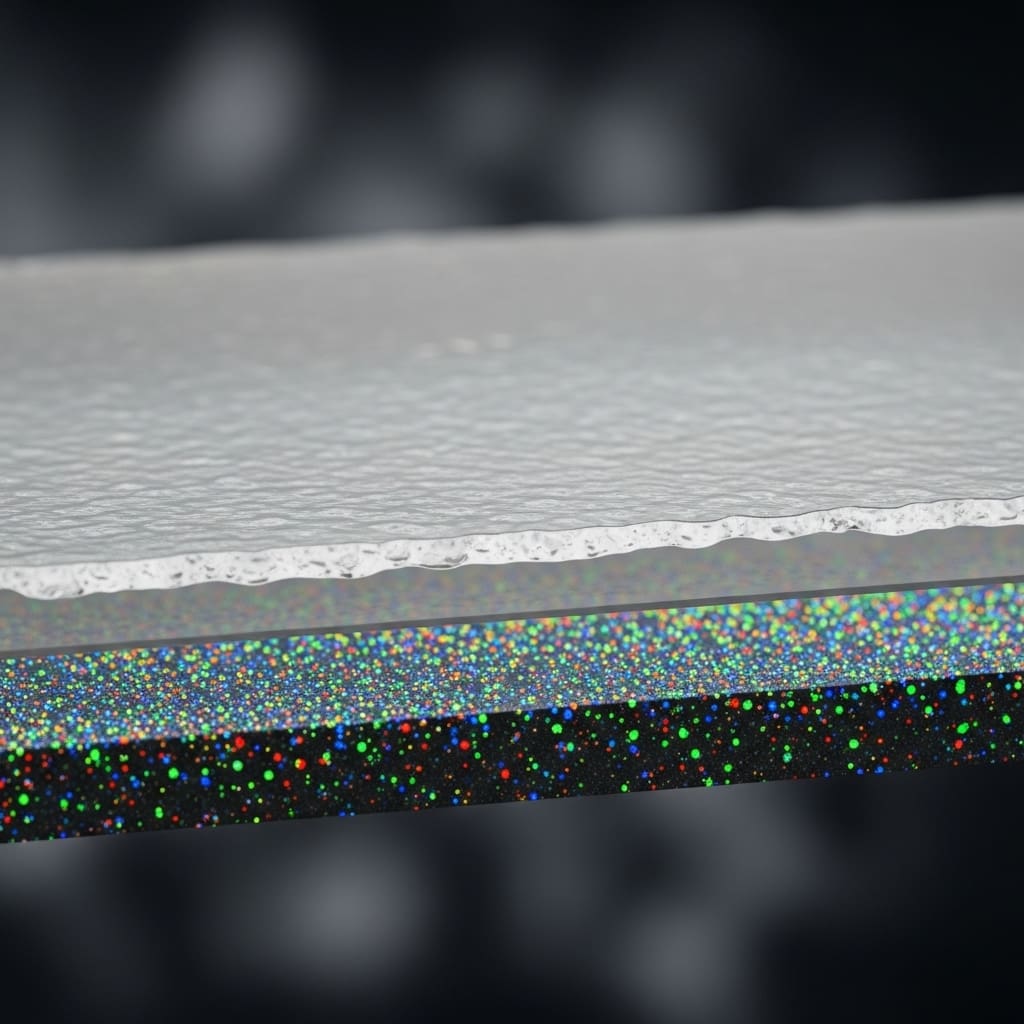
Scientists are tackling a major hurdle in scaling up quantum dot technology , the wasteful and inefficient processes currently used to create thin films. Shlok Joseph Paul, Letian Li, and Zheng Li, alongside colleagues from New York University Tandon School of Engineering and the Molecular Design Institute, demonstrate a novel dip-coating technique that dramatically reduces material consumption. Their research, detailed in a new paper, introduces a ‘biphasic’ approach, utilising an underlayer to minimise the volume of quantum dot ink needed , achieving up to a 20-fold reduction and paving the way for more sustainable and cost-effective manufacturing of optoelectronic devices, particularly those containing regulated materials like lead. This breakthrough decouples material use from film thickness, offering a viable path towards resource-efficient production and potentially unlocking widespread adoption of this promising technology.
Biphasic Dip-Coating Reduces Nanocrystal Waste significantly
Scientists have developed a novel biphasic dip-coating strategy that dramatically improves the efficiency of nanocrystal film fabrication, addressing a critical bottleneck in the scalable manufacturing of next-generation optoelectronic devices. The research team tackled the inherent wastefulness of traditional spin-coating methods, which are both costly and environmentally problematic, particularly when utilising colloidal quantum dots (cQDs) containing regulated elements like lead, cadmium, or mercury. By implementing an immiscible underlayer, they achieved a deposition geometry that decouples material consumption from the total precursor volume, significantly reducing waste and lowering production costs. This innovative approach promises a more sustainable and economically viable pathway for the widespread adoption of cQD-based technologies.
The study reveals a biphasic dip-coating technique where approximately 88% of the active reservoir volume is displaced by an immiscible underlayer, minimising the amount of expensive and potentially hazardous materials needed for film deposition. Infrared PbS photodetectors fabricated using this method demonstrated performance comparable to those created with conventional spin-coating, but with an astonishing reduction in ink consumption, up to 20-fold. This substantial decrease in material usage not only lowers costs but also mitigates the environmental impact associated with the disposal of hazardous substances. The team’s work establishes a framework for low-waste solution processing, paving the way for resource-efficient manufacturing of advanced optoelectronic devices.
Furthermore, a detailed technoeconomic analysis demonstrated that the biphasic architecture achieves cost parity at film thicknesses an order of magnitude lower than conventional monophasic dip-coating. This means that devices can be produced with significantly less material, further enhancing sustainability and reducing expenses. To facilitate broader adoption, the researchers also developed an open-source, multistage dip-coater costing approximately $300, offering a programmable workflow for cQD deposition using up to three solvents. This accessible and customisable hardware platform empowers researchers and manufacturers to explore and optimise the biphasic dip-coating process without the need for expensive commercial equipment.
Experiments show that the dip-coated PbS cQD infrared photodetectors exhibit performance on par with spin-coated devices, validating the effectiveness of the new technique. The research establishes a clear pathway towards scalable and sustainable manufacturing of cQD films, addressing a long-standing challenge in the field of optoelectronics. By minimising material waste and reducing costs, this breakthrough unlocks the potential for wider application of cQD-based technologies in areas such as sensors, photodetectors, and photovoltaics, ultimately contributing to a more environmentally responsible and economically feasible future for optoelectronic manufacturing.
Biphasic Dip-coating for Reduced Nanocrystal Waste
Scientists engineered a biphasic dip-coating strategy to dramatically improve the efficiency of nanocrystal film fabrication for optoelectronic devices. This work addresses the limitations of conventional spin-coating, which generates substantial waste and is restricted to planar geometries, particularly problematic for materials containing regulated elements like lead, cadmium, or mercury. The team developed a method decoupling consumption from total precursor volume by utilizing an immiscible underlayer to displace approximately 88% of the active reservoir volume during the dip-coating process. Infrared PbS photodetectors fabricated using this technique maintained performance comparable to spin-coated benchmarks, while simultaneously reducing ink consumption by up to 20-fold.
To facilitate this research, the scientists constructed an open-source, multistage dip-coater costing around $300, providing fully programmable workflows for colloidal quantum dot (cQD) deposition with up to three solvents. Experiments employed precisely controlled parameters, including a dip speed of 1000mm/min with 1-second and 10-second hold times at each of the three sequential beakers, containing PbS cQD solutions, tetrabutylammonium iodide in methanol, and neat methanol, respectively. Interdigitated Indium Tin Oxide (ITO) substrates underwent a rigorous cleaning process involving sonication in Hellmanex, DI water, and acetone, followed by a 20-minute UV-Ozone treatment to ensure optimal surface preparation. The PbS cQDs were synthesized via a modified Thompson method, beginning with a lead-oleate precursor prepared by degassing lead(II) acetate trihydrate, 1-octadecene, and oleic acid under vacuum at 100°C.
A sulfur solution, created by dissolving bis(trimethylsilyl)sulfide in 1-octadecene, was swiftly injected into the lead-oleate mixture at 150°C, initiating a 60-second reaction before air-cooling and transfer to a nitrogen glovebox. Subsequent purification involved three cycles of precipitation with methanol/acetone and redispersion in toluene, yielding a stable cQD dispersion. This innovative approach enables a low-waste framework for solution-processed materials, offering a viable pathway for resource-efficient manufacturing. Furthermore, the researchers quantified the advantages of biphasic dip-coating through a technoeconomic analysis tracking material mass and volume as a function of substrate area, film thickness, and bath geometry. This analysis revealed cost parity at film thicknesses an order of magnitude lower than conventional monophasic dip-coating, demonstrating the potential for significant cost savings and reduced environmental impact. Coupled with the automated dip coater, this biphasic method provides a practical route for scalable and responsible processing of cQD films.
Biphasic Dip-Coating Reduces Nanocrystal Waste Significantly
Scientists have developed a biphasic dip-coating strategy that dramatically improves the efficiency of nanocrystal film fabrication, addressing a key limitation in the production of next-generation optoelectronics. The team demonstrated that by utilising an immiscible underlayer, they could displace approximately 88% of the active reservoir volume, effectively decoupling material consumption from the total precursor volume used in the process. This innovative approach allows for the creation of high-performance films with significantly reduced waste, a critical step towards sustainable industrial manufacturing. Experiments revealed that infrared PbS photodetectors fabricated using this biphasic dip-coating method maintained performance levels comparable to those achieved with traditional spin-coated benchmarks.
Crucially, the team measured a reduction in ink consumption of up to 20-fold, representing a substantial decrease in material usage and associated costs. Data shows that the biphasic architecture achieves cost parity at film thicknesses an order of magnitude lower than conventional monophasic dip-coating, highlighting the economic benefits of this new technique. These findings establish a low-waste framework for solution-processed materials, paving the way for resource-efficient manufacturing of optoelectronic devices. Researchers also constructed an open-source, multistage dip coater at a nominal cost of approximately $300, providing a low-cost alternative to expensive commercial instruments.
This automated system enables fully programmable workflows for colloidal quantum dot (cQD) deposition, utilising up to three solvents. The team fabricated dip-coated PbS cQD infrared photodetectors that exhibited performance comparable to spin-coated devices, validating the effectiveness of the combined hardware and process. Measurements confirm the potential for scalable and responsible processing of cQD films, particularly important given the use of regulated elements like lead, cadmium, and mercury in some high-performance cQDs. Furthermore, a technoeconomic analysis was performed, revealing that the biphasic architecture achieves cost parity at film thicknesses significantly lower than conventional methods.
The study quantified the advantages of this approach through a cost model tracking both mass and volume of material as a function of substrate area, film thickness, and bath geometry. Results demonstrate a clear pathway towards reducing the environmental burden associated with hazardous materials and promoting the long-term sustainability of optoelectronic technologies. This work establishes a viable.
👉 More information
🗞 Biphasic Meniscus Coating for Scalable and Material Efficient Quantum Dot Films
🧠 ArXiv: https://arxiv.org/abs/2601.15149